Reducing Low-Value Testing in Family Medicine: High-Yield Diagnostic Stewardship for Common Outpatient Complaints

Abstract
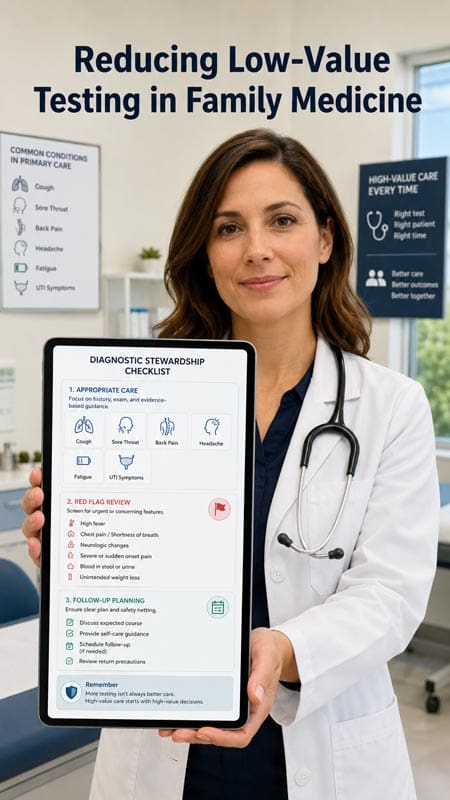
Low-value diagnostic testing is common in family medicine. These tests can expose patients to false-positive results, incidental findings, and unnecessary treatments. They may also involve radiation, lead to higher costs, and increase anxiety for patients. Diagnostic stewardship does not mean ordering fewer tests for every patient. It means ordering the right test for the right patient at the right time, with a clear plan for how the result will change care.
This review highlights practical stewardship strategies for common outpatient issues in older adults. These include acute respiratory symptoms, sore throat, low back pain, headache, fatigue, and suspected urinary tract infection. High-value care relies on structured history, focused examination, validated decision tools when appropriate, careful attention to red flags, shared decision-making, and reliable follow-up. The safest approach is not reflexive testing or reflexive test avoidance. This plan outlines when testing is needed and when it is not. It details which clinical changes should prompt reassessment and how the patient will be monitored.
Introduction
Family medicine clinicians practice in a setting where serious disease is uncommon but never absent. Most patients with cough, sore throat, headache, back pain, urinary symptoms, or fatigue have conditions that are usually mild and not urgent. A small number of people have conditions like pneumonia, meningitis, or cancer. Some may have cauda equina syndrome, systemic inflammatory disease, or sepsis. Others might need quick evaluations for various issues. Diagnostic stewardship helps clinicians find balance. It prevents habits, patient demands, and fear of missing rare diagnoses from taking over their reasoning.
Low-value testing is diagnostic testing that probably won’t improve outcomes or change patient care in a specific clinical situation. A test can be low value even when it is inexpensive. An abnormal result outside the clinical context can cause several issues. It may lead to repeat tests, imaging, referrals, antibiotic exposure, procedures, and increased patient anxiety. Avoiding a test can be risky. This is especially true if the patient shows red flags, has worsening symptoms, has a high chance of a positive result, or cannot be followed up reliably.
A practical outpatient stewardship framework begins with three questions. What diagnosis is the clinician trying to confirm or exclude? Will the result change management now or during the planned follow-up? What is the potential harm of testing, not testing, or delaying testing?
These questions keep testing decisions tied to patient-specific probability and clinical action.
Acute Cough, Bronchitis, and Upper Respiratory Symptoms
Acute cough and upper respiratory symptoms are among the most frequent reasons for outpatient visits. Most uncomplicated presentations are viral and self-limited. In healthy adults with symptoms of acute bronchitis, routine chest X-rays and antibiotics are usually unnecessary. This is only if pneumonia or another serious condition is suspected.
The main job is to tell uncomplicated bronchitis apart from pneumonia, asthma, COPD flare-ups, heart failure, pulmonary embolism, pertussis, and other conditions. Each needs a different approach. Fever, tachypnea, and tachycardia are important signs. Low oxygen levels and focal crackles in the lungs are also key. Asymmetric breath sounds, rigours, and frailty should raise concerns. Immunocompromise, hemoptysis, pleuritic chest pain, or clinical deterioration should prompt quicker imaging or further evaluation.
Testing should also be tied to a decision. Viral testing may be useful. It helps make decisions about antiviral treatment, isolation guidance, and outbreak management. It also informs choices regarding occupational exposure and high-risk household contacts. It is a lower value when the result will not change management.
The visit should end with a clear plan. Patients should understand how long a cough may last. They need to know which symptoms require urgent reassessment. Also, they should be aware of when routine follow-up is necessary. This communication is often more valuable than a low-yield test ordered for reassurance.
Sore Throat and Group A Streptococcal Testing
Sore throat illustrates the difference between targeted testing and indiscriminate testing. Patients with cough, runny nose, hoarseness, mouth sores, or pink eye are more likely to have viral pharyngitis. They usually don’t need testing for group A strep. Patients without viral features require a more structured assessment because clinical judgment alone cannot reliably distinguish viral from streptococcal pharyngitis.
Clinical scoring systems like Centor or McIsaac help find patients who are unlikely to have a group A streptococcal infection. Their main role is not to prove infection. They help find patients who don’t need testing. They also guide testing for those with a sufficiently high pretest probability.
Testing is most appropriate when the result will determine antibiotic use. A positive rapid antigen test or throat culture supports treatment. In children and adolescents, a negative rapid antigen test is commonly confirmed by throat culture, according to public health guidance. Adults typically don’t need a backup culture after a negative rapid antigen test. But this can change if local outbreaks, patient risks, or epidemiology suggest otherwise.
Antibiotic stewardship and diagnostic stewardship overlap here. Testing low-probability patients raises false positives and irrelevant results. This can lead to unnecessary antibiotic use. Antibiotic exposure can lead to several issues. These include allergies, gastrointestinal problems, and drug interactions. It may also cause Clostridioides difficile infections and promote the emergence of resistant organisms.
Low Back Pain
Acute low back pain is typically mechanical in nature. It generally improves over time and benefits from movement, conservative therapy, and reassurance. Imaging during the first several weeks of uncomplicated low back pain rarely improves outcomes. It may reveal degenerative findings that are common in asymptomatic adults. Those findings can increase anxiety and may lead to referrals or procedures that do not improve function.
The clinical priority is to identify red flags and neurologic compromise.
Get immediate imaging or urgent referral if you suspect:
- Cauda equina syndrome
- Severe or worsening neurologic deficit
- New urinary retention or overflow incontinence
- Saddle anesthesia
- Fever
- Recent bacteremia
- Injection drug use
- Immunosuppression
- History of cancer
- Unexplained weight loss
- Significant trauma
- Osteoporosis
- Chronic glucocorticoid use
- Possible vertebral compression fracture
For patients with no red flags, clinicians should note the neurologic exam, functional status, pain pattern, and follow-up plan. Imaging is needed when symptoms last despite effective conservative treatment. It’s also important if radiculopathy worsens or becomes disabling, or if the results will affect surgical planning.
Patients often feel dismissed when imaging is deferred. A better message is: “Your exam does not show signs that imaging would help today. Most early imaging finds age-related changes that do not explain pain. The safer plan is treatment now, follow-up, and imaging if the pattern changes or recovery stalls.”
Headache
Most outpatient headaches are primary headache disorders, especially migraine and tension-type headache. Neuroimaging is not usually needed for stable headaches that look like migraines or tension-type headaches. This is true when the neurologic exam is normal, and there are no unusual signs.
The clinician’s task is to identify secondary headache features.
Consider imaging or urgent evaluation for these signs:
- Thunderclap headache
- Focal neurologic deficit
- Papilledema
- Altered mental status
- Meningismus
- New headache during or after pregnancy
- Headache with cancer or immunosuppression
- New headache after age 50
- Exertional headache
- Valsalva-triggered headache
- Positional headache
- Trauma
- Progressive pattern change
- Suspected giant cell arteritis
For stable migraine, the higher-value interventions often include diagnostic clarity, acute-treatment optimization, preventive-treatment assessment, medication-overuse screening, trigger review, and follow-up. Imaging done just for reassurance may help a bit, but it can also lead to new worries with incidental findings.
Fatigue
Fatigue is common, nonspecific, and often multifactorial. Low-value testing occurs when clinicians order broad panels without a diagnostic hypothesis. Undertesting can occur when persistent fatigue is dismissed without follow-up.
A balanced evaluation begins with duration, sleep, mood, medication and substance review, cardiopulmonary symptoms, menstrual and pregnancy history when relevant, infection risk, weight change, fever, night sweats, pain, neurologic symptoms, diet, occupational stress, and functional impairment. The examination should look for anemia, thyroid disease, cardiopulmonary disease, inflammatory disease, malignancy, sleep-disordered breathing, medication adverse effects, and depression or anxiety when clinically relevant.
Initial testing should be selective but not superficial.
For ongoing or unclear fatigue, basic tests usually include:
- Complete blood count
- Metabolic panel
- Thyroid-stimulating hormone
Other tests may be added based on age, sex, symptoms, medications, and the exam.
Ferritin or iron studies might be needed if you have anemia, heavy menstrual bleeding, restless legs, dietary restrictions, or other risk factors. Vitamin B12 testing is higher-yield in the presence of macrocytosis, neuropathy, malabsorption risk, metformin use, acid-suppression therapy, bariatric surgery, strict vegan diet, or older age.
Inflammatory markers, antinuclear antibody tests, Lyme tests, testosterone tests, Epstein-Barr tests, tumour markers, and broad micronutrient panels should not be routine in the evaluation of fatigue. There needs to be signs or symptoms to be required. The follow-up plan is essential. Persistent fatigue with weight loss, fever, night sweats, lymphadenopathy, exertional dyspnea, chest pain, syncope, focal neurologic findings, inflammatory joint symptoms, or progressive functional decline should prompt a more specific evaluation.
Suspected Urinary Tract Infection in Older Adults
Urine testing is often overused in older adults. This is especially true if they show signs such as confusion, falls, weakness, cloudy or foul-smelling urine, even without clear urinary symptoms. A positive urinalysis or urine culture in this context may reflect asymptomatic bacteriuria rather than infection. Treating colonization exposes patients to the adverse effects of antibiotics and antimicrobial resistance without improving outcomes.
Testing is of higher value when the patient has dysuria, urinary frequency, urgency, suprapubic pain, flank pain, fever without another source, hemodynamic instability, or sepsis physiology. In catheterized patients, fever, rigours, new suprapubic pain, costovertebral angle tenderness, or systemic instability may warrant testing after ruling out other causes.
A urine culture should not be sent unless the results will be interpreted in a clinical context. This is important for guiding treatment decisions. Sending a culture “just to check” often creates pressure to treat colonization.

Table 1. Common Outpatient Testing Decisions
| Presentation | Often low value | Higher value when |
|---|---|---|
| Acute cough or bronchitis | Chest radiograph or antibiotics in low-risk uncomplicated illness | Abnormal vitals, hypoxemia, focal lung findings, frailty, immunocompromise, clinical worsening |
| Sore throat | Strep testing when clear viral features are present | No viral features and clinical score suggests sufficient risk |
| Acute low back pain | Early lumbar x-ray, CT, or MRI without red flags | Cauda equina symptoms, progressive neurologic deficit, cancer, infection, trauma, fracture risk |
| Stable headache | CT or MRI for typical migraine or tension-type headache with normal exam | Thunderclap onset, neurologic deficit, papilledema, cancer, immunosuppression, pregnancy/postpartum, new headache after age 50 |
| Fatigue | Broad autoimmune, vitamin, hormone, tumor-marker, or infectious panels without clues | Persistent unexplained symptoms, abnormal exam, systemic features, anemia risk, thyroid symptoms, medication risks |
| Older adult with nonspecific symptoms | Urinalysis or urine culture without urinary symptoms | Dysuria, frequency, urgency, suprapubic pain, flank pain, fever without source, sepsis physiology |
Table 2. Red Flags That Should Override Test Deferral
| Complaint | Red flags |
|---|---|
| Low back pain | Saddle anesthesia, urinary retention, fecal incontinence, progressive motor deficit, fever, cancer history, unexplained weight loss, immunosuppression, injection drug use, significant trauma, osteoporosis, chronic steroid use |
| Headache | Thunderclap onset, neurologic deficit, papilledema, altered mental status, meningismus, pregnancy/postpartum, cancer, immunosuppression, new headache after age 50, exertional or positional headache |
| Respiratory symptoms | Hypoxemia, tachypnea, persistent fever, focal lung findings, rigors, hemoptysis, pleuritic chest pain, frailty, immunocompromise, clinical deterioration |
| Fatigue | Weight loss, fever, night sweats, lymphadenopathy, syncope, exertional chest pain or dyspnea, focal neurologic findings, inflammatory arthritis, severe depression or suicidality |
| Possible UTI | Dysuria, new frequency or urgency, suprapubic pain, flank pain, fever without another source, rigors, hemodynamic instability, sepsis physiology |
Implementation Strategies
Diagnostic stewardship succeeds when it is built into routine workflow. Education alone is rarely durable. Stronger programs mix clinician education, easy algorithms, order-set design, and feedback. They also use peer comparison when needed and tools for patient communication.
Electronic health record interventions should be selective. A useful prompt asks for the clinical indication, displays relevant red flags, and offers an easy way to document why testing is deferred. A poor prompt interrupts workflow, fires too often, or creates alert fatigue.
Audit and feedback help clinicians compare their testing patterns to those of peers or guidelines. Feedback should be timely, clinically credible, and paired with practical alternatives. For example, a practice might track lumbar imaging for uncomplicated low back pain, neuroimaging for stable headache with normal neurologic examination, strep testing in patients with viral features, urine cultures in older adults without urinary symptoms, or repeat laboratory panels without a monitoring indication.
Table 3. Practical Stewardship Metrics for Family Medicine
| Metric | Why it matters |
|---|---|
| Lumbar imaging for uncomplicated acute low back pain | Identifies early imaging that may not improve outcomes |
| Neuroimaging for stable primary headache with normal exam | Tracks imaging unlikely to change management |
| Strep testing when viral features are documented | Identifies testing that may drive unnecessary antibiotics |
| Urine cultures without urinary symptoms | Reduces treatment of asymptomatic bacteriuria |
| Repeat laboratory panels without monitoring indication | Reduces duplicate or nonactionable testing |
| Return visits or escalation after test deferral | Balances stewardship with diagnostic safety |
| Abnormal-result follow-up completion | Prevents harm from tests that are ordered but not closed |
Communicating With Patients
Patients often request tests for reassurance, explanations, or proof that their concerns matter. A stewardship conversation should not sound like rationing. It should make the diagnostic plan explicit.
One useful script is: “Based on your history and examination today, this test is unlikely to change what we do and could lead to false alarms. The safer plan is to treat your symptoms, watch for specific warning signs, and reassess if the pattern changes.”
This approach acknowledges uncertainty while preserving trust. It also involves the patient in the safety plan. Clinicians should note the relevant negatives. They must also document the decision rule or the rationale for the guideline when needed. Include the counselling given and the follow-up instructions.
Measuring Stewardship Without Encouraging Underuse
Measurement should include both reductions in low-value testing and safeguards against missed diagnoses. A practice should not reward clinicians simply for ordering fewer tests. The goal is appropriate testing.
Here are some useful process measures:
- Imaging rates for uncomplicated low back pain
- Neuroimaging for stable primary headaches
- Strep testing in patients with viral symptoms
- Urine cultures without urinary symptoms
- Repeat lab tests without a monitoring reason
Balancing measures should include return visits, delayed diagnoses, escalation of care, patient complaints, antibiotic prescribing, abnormal-result follow-up, and clinician-override patterns.
When a patient returns after testing was deferred, the case should be reviewed constructively. The goal is not blame. The goal is to refine red-flag criteria, improve follow-up systems, and strengthen communication.
Future Directions
Artificial intelligence, natural language processing, and predictive analytics may eventually support diagnostic stewardship by identifying duplicate testing, surfacing relevant prior results, and helping clinicians estimate risk. These tools are for clinical decision support. They should not replace clinical judgment.
Before routine use, these systems need validation in various outpatient groups. They need clear details about their limits, ongoing bias checks, and evidence that they actually improve patient outcomes, not just reduce usage.
To cut low-value tests in family medicine, we need strong clinical reasoning. It’s not enough to simply avoid tests. The highest-yield approach is to define the diagnostic question, estimate pretest probability, identify red flags, determine whether the result will change management, and create a reliable follow-up plan.
Diagnostic stewardship is most effective when clinicians are supported by practical algorithms, thoughtful EHR design, audit and feedback, and patient-centred communication. The clinical message is straightforward: test when the result can help the patient, defer when it cannot, and always document the reassessment plan.
References
Agency for Healthcare Research and Quality. (2024). Diagnostic stewardship as a model to improve the quality and safety of diagnosis (AHRQ Publication No. 24-0010-6-EF). U.S. Department of Health and Human Services. https://psnet.ahrq.gov/issue/diagnostic-stewardship-model-improve-quality-and-safety-diagnosis
Centers for Disease Control and Prevention. (2025, November 18). Clinical guidance for group A streptococcal pharyngitis. U.S. Department of Health and Human Services. https://www.cdc.gov/group-a-strep/hcp/clinical-guidance/strep-throat.html
Centers for Disease Control and Prevention. (2026, April 17). Evaluation of ME/CFS. U.S. Department of Health and Human Services. https://www.cdc.gov/me-cfs/hcp/diagnosis-testing/evaluation-of-me-cfs.html
Chou, R., Qaseem, A., Owens, D. K., & Shekelle, P., for the Clinical Guidelines Committee of the American College of Physicians. (2011). Diagnostic imaging for low back pain: Advice for high-value health care from the American College of Physicians. Annals of Internal Medicine, 154(3), 181–189. https://doi.org/10.7326/0003-4819-154-3-201102010-00008
Cliff, B. Q., Avanceña, A. L. V., Hirth, R. A., & Lee, S. D. (2021). The impact of Choosing Wisely interventions on low-value medical services: A systematic review. The Milbank Quarterly, 99(4), 1024–1058. https://doi.org/10.1111/1468-0009.12531
Evans, R. W., Burch, R. C., Frishberg, B. M., Marmura, M. J., Mechtler, L. L., Silberstein, S. D., & Turner, D. P. (2020). Neuroimaging for migraine: The American Headache Society systematic review and evidence-based guideline. Headache, 60(2), 318–336. https://doi.org/10.1111/head.13720
Fine, A. M., Nizet, V., & Mandl, K. D. (2012). Large-scale validation of the Centor and McIsaac scores to predict group A streptococcal pharyngitis. Archives of Internal Medicine, 172(11), 847–852. https://doi.org/10.1001/archinternmed.2012.950
Harris, A. M., Hicks, L. A., & Qaseem, A., for the High Value Care Task Force of the American College of Physicians and for the Centers for Disease Control and Prevention. (2016). Appropriate antibiotic use for acute respiratory tract infection in adults: Advice for high-value care from the American College of Physicians and the Centers for Disease Control and Prevention. Annals of Internal Medicine, 164(6), 425–434. https://doi.org/10.7326/M15-1840
Hutchins, T. A., Peckham, M., Shah, L. M., Parsons, M. S., Agarwal, V., Boulter, D. J., Burns, J., Cassidy, R. C., Davis, M. A., Holly, L. T., Hunt, C. H., Khan, M. A., Moritani, T., Ortiz, A. O., O’Toole, J. E., Powers, W. J., Promes, S. B., Reitman, C., Shah, V. N., … Corey, A. S. (2021). ACR Appropriateness Criteria® low back pain: 2021 update. Journal of the American College of Radiology, 18(11S), S361–S379. https://doi.org/10.1016/j.jacr.2021.08.002
Ivers, N., Yogasingam, S., Lacroix, M., Brown, K. A., Antony, J., Soobiah, C., Simeoni, M., Willis, T. A., Crawshaw, J., Antonopoulou, V., Meyer, C., Solbak, N. M., Murray, B. J., Butler, E. A., Lepage, S., Giltenane, M., Carter, M. D., Fontaine, G., Sykes, M., … Grimshaw, J. M. (2025). Audit and feedback: Effects on professional practice. Cochrane Database of Systematic Reviews, 2025(3), CD000259. https://doi.org/10.1002/14651858.CD000259.pub4
Linder, J. A., Watson, M. E., Wessels, M. R., Carter, D. M., Cohen, A. L., Dien Bard, J., Erdem, G., Gregory, C. J., Kourtis, A. P., Martin, J. M., Mochon, A. B., Shapiro, D. J., Stevens, R. W., Kaur, D., & Barshak, M. B. (2025). 2025 clinical practice guideline update by the Infectious Diseases Society of America on group A streptococcal pharyngitis: Risk assessment using clinical scoring systems in children and adults. Clinical Infectious Diseases. Advance online publication. https://doi.org/10.1093/cid/ciaf668
Nicolle, L. E., Gupta, K., Bradley, S. F., Colgan, R., DeMuri, G. P., Drekonja, D., Eckert, L. O., Geerlings, S. E., Köves, B., Hooton, T. M., Juthani-Mehta, M., Knight, S. L., Saint, S., Schaeffer, A. J., Trautner, B., Wullt, B., & Siemieniuk, R. (2019). Clinical practice guideline for the management of asymptomatic bacteriuria: 2019 update by the Infectious Diseases Society of America. Clinical Infectious Diseases, 68(10), e83–e110. https://doi.org/10.1093/cid/ciy1121
Stadje, R., Dornieden, K., Baum, E., Becker, A., Biroga, T., Bösner, S., Haasenritter, J., Keunecke, C., Viniol, A., & Donner-Banzhoff, N. (2016). The differential diagnosis of tiredness: A systematic review. BMC Family Practice, 17, 147. https://doi.org/10.1186/s12875-016-0545-5
U.S. Preventive Services Task Force. (2019). Screening for asymptomatic bacteriuria in adults: US Preventive Services Task Force recommendation statement. JAMA, 322(12), 1188–1194. https://doi.org/10.1001/jama.2019.13069
Utukuri, P. S., Shih, R. Y., Ajam, A. A., Callahan, K. E., Chen, D., Dunkle, J. W., Hunt, C. H., Ivanidze, J., Ledbetter, L. N., Lee, R. K., Malu, O., Pannell, J. S., Pollock, J. M., Potrebic, S. X., Setzen, M., Shih, R. D., Soares, B. P., Staudt, M. D., Wang, L. L., & Burns, J. (2023). ACR Appropriateness Criteria® headache: 2022 update. Journal of the American College of Radiology, 20(5S), S70–S93. https://doi.org/10.1016/j.jacr.2023.02.018
Zhi, M., Ding, E. L., Theisen-Toupal, J., Whelan, J., & Arnaout, R. (2013). The landscape of inappropriate laboratory testing: A 15-year meta-analysis. PLOS ONE, 8(11), e78962. https://doi.org/10.1371/journal.pone.0078962
Recent Articles


Integrative Perspectives on Cognition, Emotion, and Digital Behavior

Sleep-related:
Longevity/Nutrition & Diet:
Philosophical / Happiness / Social:
Other:
Modern Mind Unveiled
Developed under the direction of David McAuley, Pharm.D., this collection explores what it means to think, feel, and connect in the modern world. Drawing upon decades of clinical experience and digital innovation, Dr. McAuley and the GlobalRPh initiative translate complex scientific ideas into clear, usable insights for clinicians, educators, and students.
The series investigates essential themes–cognitive bias, emotional regulation, digital attention, and meaning-making—revealing how the modern mind adapts to information overload, uncertainty, and constant stimulation.
At its core, the project reflects GlobalRPh’s commitment to advancing evidence-based medical education and clinical decision support. Yet it also moves beyond pharmacotherapy, examining the psychological and behavioral dimensions that shape how healthcare professionals think, learn, and lead.
Through a synthesis of empirical research and philosophical reflection, Modern Mind Unveiled deepens our understanding of both the strengths and vulnerabilities of the human mind. It invites readers to see medicine not merely as a science of intervention, but as a discipline of perception, empathy, and awareness–an approach essential for thoughtful practice in the 21st century.
The Six Core Themes
I. Human Behavior and Cognitive Patterns
Examining the often-unconscious mechanisms that guide human choice-how we navigate uncertainty, balance logic with intuition, and adapt through seemingly irrational behavior.
II. Emotion, Relationships, and Social Dynamics
Investigating the structure of empathy, the psychology of belonging, and the influence of abundance and selectivity on modern social connection.
III. Technology, Media, and the Digital Mind
Analyzing how digital environments reshape cognition, attention, and identity- exploring ideas such as gamification, information overload, and cognitive “nutrition” in online spaces.
IV. Cognitive Bias, Memory, and Decision Architecture
Exploring how memory, prediction, and self-awareness interact in decision-making, and how external systems increasingly serve as extensions of thought.
V. Habits, Health, and Psychological Resilience
Understanding how habits sustain or erode well-being-considering anhedonia, creative rest, and the restoration of mental balance in demanding professional and personal contexts.
VI. Philosophy, Meaning, and the Self
Reflecting on continuity of identity, the pursuit of coherence, and the construction of meaning amid existential and informational noise.
Keywords
Cognitive Science • Behavioral Psychology • Digital Media • Emotional Regulation • Attention • Decision-Making • Empathy • Memory • Bias • Mental Health • Technology and Identity • Human Behavior • Meaning-Making • Social Connection • Modern Mind
Video Section