Beyond Burnout: The Hidden Strengths That Make Physicians Thrive in Non-Clinical Careers
Abstract
This paper examines the unique attributes and skills that enable physicians to succeed in non-clinical career paths. Drawing from recent research and career transition data, we analyze the transferable competencies that medical professionals possess and how these assets translate into success across various industries. The study reviews evidence from 2020-2024 regarding physician career transitions, identifies key strengths that facilitate this movement, and provides practical frameworks for career pivot strategies. Our analysis reveals that physicians possess distinctive problem-solving abilities, leadership skills, and analytical thinking patterns that create substantial value in non-clinical roles. Through examination of real-world transition cases and industry data, this research demonstrates how medical training creates a foundation for excellence beyond traditional healthcare delivery.
Recent articles. Check out our extensive video library.
Introduction
The medical profession faces unprecedented challenges that extend far beyond the traditional scope of patient care. Recent data indicates that physician burnout rates have reached alarming levels, with studies showing that over 50% of practicing physicians report symptoms of professional exhaustion. This crisis has prompted many medical professionals to explore career alternatives outside direct patient care.
However, viewing these transitions solely through the lens of burnout misses a crucial perspective. While professional dissatisfaction may serve as an initial catalyst, the success of physicians in non-clinical roles stems from fundamental strengths developed through medical training and practice. These capabilities often remain unrecognized or undervalued by the physicians themselves.
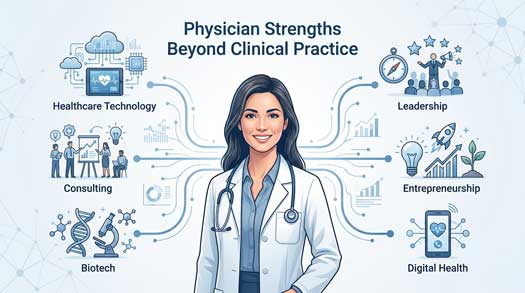
Medical education and clinical practice develop a unique skill set that proves remarkably valuable in diverse professional contexts. From pharmaceutical research and healthcare technology to consulting and entrepreneurship, physicians bring distinctive perspectives and capabilities that drive innovation and leadership. Understanding these strengths provides both individual physicians and organizations with valuable insights into successful career transitions and optimal talent utilization.
This analysis explores the specific attributes that enable physicians to excel in non-clinical environments. We examine evidence-based research on career transitions, analyze successful case studies, and provide practical frameworks for understanding and leveraging these transferable skills. The goal is to shift the narrative from career change as escape to career evolution as strategic advancement.
The Foundation: Medical Training as Leadership Development
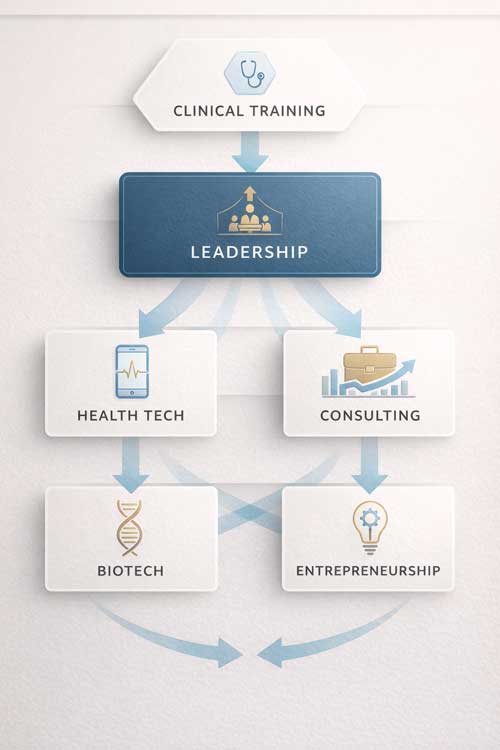
Medical education creates a unique professional development experience that few other fields can match. The rigorous academic requirements, clinical training, and ongoing professional development create individuals with exceptional capabilities that extend well beyond medical knowledge.
The diagnostic process that forms the core of medical practice develops sophisticated analytical thinking patterns. Physicians learn to gather information from multiple sources, synthesize complex data sets, identify patterns, and make decisions under pressure. This process mirrors the strategic thinking required in executive roles across industries.
Clinical training also develops exceptional interpersonal skills under high-stakes conditions. Physicians regularly navigate difficult conversations, manage conflicting priorities, and coordinate complex team dynamics. These experiences create communication abilities that prove invaluable in leadership positions outside healthcare.
The responsibility inherent in medical practice creates individuals comfortable with accountability and decision-making. Physicians develop confidence in their judgment while maintaining awareness of limitations and the need for continuous learning. This balance of confidence and humility serves as an excellent foundation for leadership roles.
Medical professionals also develop remarkable adaptability through their training and practice. The constant evolution of medical knowledge, technology, and protocols requires continuous learning and adjustment. This adaptability becomes a crucial asset when transitioning to new industries or roles.
Core Strengths That Drive Non-Clinical Success
Analytical and Problem-Solving Capabilities
The medical diagnostic process creates exceptional problem-solving skills that translate directly to business and organizational challenges. Physicians learn to approach problems systematically, gathering relevant information, forming hypotheses, and testing solutions. This methodology proves highly valuable in consulting, strategic planning, and operational improvement roles.
Medical training emphasizes evidence-based decision making, requiring professionals to evaluate research, assess risk-benefit ratios, and make recommendations based on available data. These skills align perfectly with data-driven business environments and research-focused roles.
The ability to handle incomplete information represents another crucial strength. Physicians regularly make decisions with limited data, understanding how to proceed while continuing to gather additional information. This capability proves essential in fast-moving business environments where perfect information is rarely available.
Communication and Interpersonal Skills
Medical practice develops sophisticated communication abilities across diverse audiences and high-pressure situations. Physicians learn to explain complex concepts to patients with varying educational backgrounds, communicate effectively with multidisciplinary teams, and navigate emotionally charged situations with empathy and professionalism.
These communication skills translate directly to client relations, team management, and stakeholder engagement in business environments. The ability to build trust quickly, manage difficult conversations, and maintain composure under pressure creates substantial value in leadership and client-facing roles.
Medical professionals also develop exceptional listening skills through patient interactions. The ability to gather information effectively, identify underlying concerns, and respond appropriately proves valuable in sales, consulting, and management positions.
Leadership and Team Management
Clinical environments require extensive collaboration and leadership across hierarchical structures. Physicians learn to lead medical teams, coordinate with specialists, and manage complex care plans involving multiple stakeholders. These experiences develop natural leadership abilities that translate well to business environments.
The medical model of consultation and referral creates comfort with both leading and following, depending on expertise and circumstances. This flexibility in leadership roles proves valuable in matrix organizations and collaborative business environments.
Medical training also develops crisis management skills through emergency situations and critical patient care. The ability to remain calm under pressure, make rapid decisions, and coordinate team responses creates valuable leadership capabilities for high-stress business situations.
Ethical Foundation and Professional Standards
Medical practice operates under strict ethical guidelines and professional standards that create individuals with strong moral compasses and professional integrity. These qualities prove highly valuable in compliance, governance, and leadership roles across industries.
The emphasis on patient advocacy in medical training develops individuals comfortable with representing others’ interests and challenging established practices when necessary. This advocacy orientation translates well to roles in policy, consulting, and organizational development.
Medical professionals also understand the importance of continuous professional development and staying current with evolving standards. This commitment to ongoing learning proves valuable in rapidly changing business environments.
Industry Applications and Career Pathways
Healthcare Technology and Innovation
The intersection of medical expertise and technology creates natural opportunities for physicians in health tech companies, medical device development, and digital health platforms. Medical professionals bring essential user perspective and clinical insight to product development processes.
Physicians understand the practical challenges of healthcare delivery and can identify opportunities for technological solutions. This insight proves invaluable in product design, user experience development, and market strategy for healthcare technology companies.
The regulatory knowledge and clinical understanding that physicians possess also create value in compliance, regulatory affairs, and clinical research roles within technology companies focused on healthcare applications.
Pharmaceutical and Biotechnology Industries
Medical professionals bring crucial clinical perspective to drug development, regulatory processes, and market strategy within pharmaceutical companies. Their understanding of disease processes, treatment protocols, and clinical practice creates substantial value throughout the drug development pipeline.
Physicians often excel in medical affairs roles, where they serve as liaisons between companies and healthcare providers. Their credibility with clinical audiences and understanding of medical practice make them effective in these bridge positions.
Clinical research and regulatory affairs represent natural career paths where medical training provides direct relevant expertise. The understanding of study design, regulatory requirements, and clinical outcomes proves essential in these roles.
Consulting and Strategic Advisory
Management consulting firms increasingly value physicians for their analytical thinking, communication skills, and domain expertise in healthcare. Medical professionals often excel in strategy consulting, particularly for healthcare organizations, but also bring valuable skills to general business consulting.
The problem-solving methodology learned in medical practice translates directly to consulting frameworks and client engagement. Physicians often demonstrate natural abilities in client relations, project management, and strategic analysis.
Healthcare-focused consulting represents a natural application area, but many physicians succeed in broader consulting roles where their analytical skills and professional presence create value across industries.
Entrepreneurship and Business Development
Medical training develops many of the skills essential for entrepreneurial success, including problem identification, solution development, and stakeholder management. Many physicians successfully transition to entrepreneurial roles, either in healthcare-related ventures or other industries.
The comfort with risk assessment and decision-making under uncertainty that medical practice develops proves valuable in startup environments. Physicians often demonstrate strong judgment about resource allocation and strategic priorities.
The professional networks and credibility that medical professionals possess also create advantages in fundraising, partnership development, and market entry for entrepreneurial ventures.
Table 1: Physician Strengths and Business Applications
|
Medical Skill |
Business Application |
Example Roles |
|---|---|---|
|
Diagnostic reasoning |
Strategic analysis and problem-solving |
Management consultant, business analyst |
|
Patient communication |
Client relations and stakeholder management |
Sales, account management, customer success |
|
Team leadership |
Project and people management |
Operations manager, team lead |
|
Evidence evaluation |
Data analysis and research |
Market research, strategy development |
|
Crisis management |
Business continuity and risk management |
Operations, compliance, risk management |
|
Ethical decision-making |
Governance and compliance |
Legal, compliance, ethics officer |
|
Continuous learning |
Adaptation to changing environments |
Change management, innovation roles |

Challenges and Considerations in Career Transitions
Identity and Professional Transition
One of the most substantial challenges physicians face when considering non-clinical careers involves professional identity adjustment. Medical training creates a strong sense of professional identity tied to patient care and clinical practice. Transitioning away from direct patient care can create identity conflicts and uncertainty about professional purpose.
This identity challenge often manifests as concern about “wasting” medical training or feeling guilty about not practicing medicine. Successful career transitions require reframing medical education as valuable professional development rather than training limited to clinical application.
The prestige and social recognition associated with medical practice can also create hesitation about career transitions. Physicians may worry about loss of professional status or social standing when moving to non-clinical roles.
Financial and Compensation Considerations
Compensation structures in non-clinical roles often differ substantially from medical practice, creating financial considerations that influence career transition decisions. While some non-clinical roles offer competitive compensation, others may require initial salary reductions or different compensation models.
Understanding the long-term financial implications of career transitions becomes essential for making informed decisions. Some non-clinical career paths offer greater growth potential or different risk-reward profiles that may prove advantageous over time.
The investment in medical education and training also creates financial considerations about return on educational investment. Physicians may feel pressure to remain in clinical practice to justify educational expenses.
Skills Gap and Professional Development
While physicians possess many transferable skills, successful non-clinical career transitions often require additional training or skill development. Business acumen, industry-specific knowledge, or technical skills may need enhancement for optimal performance in new roles.
Understanding these skill gaps early in the transition process allows for strategic professional development planning. Many successful physician career transitions involve intentional skill building through coursework, certifications, or experiential learning.
The pace of skill development in new fields may also create adjustment challenges for physicians accustomed to expertise in their clinical domain. Accepting beginner status in new areas while leveraging existing strengths requires psychological adjustment.
Network Development and Industry Integration
Medical professionals often possess strong networks within healthcare but may lack connections in target industries for career transitions. Building relevant professional networks becomes crucial for successful career pivots.
Industry knowledge and cultural understanding also require development when transitioning to new fields. Understanding business practices, industry dynamics, and organizational cultures becomes essential for integration and success.
Professional credibility may need rebuilding in new fields, despite strong medical credentials. Establishing expertise and reputation in new domains requires time and strategic effort.
Success Strategies and Best Practices
Strategic Career Planning
Successful physician career transitions typically involve strategic planning rather than reactive job searching. Understanding personal motivations, identifying target roles, and developing transition strategies create better outcomes than hasty career changes.
Conducting thorough self-assessment helps identify transferable skills, interests, and values that guide career direction decisions. Understanding personal strengths and preferences enables more strategic career planning.
Market research about target industries and roles provides essential information for making informed career decisions. Understanding compensation expectations, growth opportunities, and skill requirements helps set realistic expectations and development goals.
Skill Development and Professional Preparation
Identifying skill gaps early in the transition process allows for strategic professional development planning. Taking courses, earning certifications, or gaining experience through volunteer work or side projects can bridge capability gaps.
Developing business acumen through formal education or self-study proves valuable for many physician career transitions. Understanding finance, marketing, operations, and strategy enhances effectiveness in business roles.
Industry-specific knowledge development also improves transition success. Learning about target industries, regulatory environments, and market dynamics demonstrates commitment and improves job performance.
Network Building and Industry Engagement
Building professional networks in target industries requires intentional effort and strategic approaches. Attending industry events, joining professional associations, and engaging with industry content creates networking opportunities.
Informational interviewing with professionals in target roles provides valuable insights and relationship building opportunities. These conversations offer practical information about career paths and industry dynamics.
Social media and professional platforms create additional networking opportunities when used strategically. Sharing relevant content and engaging with industry discussions builds professional presence and relationships.
Leveraging Medical Experience Effectively
Successful career transitions require effectively communicating the value of medical experience to non-medical audiences. Translating clinical achievements into business terms helps employers understand relevant capabilities.
Identifying specific examples of leadership, problem-solving, and communication successes in medical settings provides concrete evidence of transferable skills. Quantifying achievements where possible strengthens professional positioning.
Understanding how medical experience creates unique value in target roles helps differentiate physician candidates from other applicants. Positioning medical background as an asset rather than irrelevant experience improves career transition success.
Case Studies and Real-World Examples
Technology Sector Success
Dr. Sarah Chen transitioned from emergency medicine to product management at a health technology startup after recognizing her passion for improving healthcare delivery through technology solutions. Her clinical experience provided crucial insights into user needs and workflow challenges that traditional product managers often miss.
During her medical practice, Dr. Chen frequently identified inefficiencies in clinical workflows and imagined technological solutions. When she discovered product management roles, she realized her problem-solving skills and user empathy would translate well to technology development.
The transition required learning technical skills and business strategy, but her medical background provided unique credibility with clinical users and deep understanding of healthcare challenges. Her ability to communicate with both technical teams and clinical stakeholders made her particularly valuable in product development roles.
Within three years of transitioning, Dr. Chen advanced to senior product management roles and now leads product strategy for clinical workflow solutions. Her medical background continues to provide unique insights that drive product innovation and market success.
Consulting Career Evolution
Dr. Michael Rodriguez moved from internal medicine to healthcare consulting after developing expertise in practice improvement and operational efficiency during his clinical practice. His analytical thinking and communication skills translated directly to consulting engagements.
The transition began when Dr. Rodriguez started helping other practices improve their operations and financial performance. This work revealed his natural consulting abilities and passion for organizational improvement beyond his own practice.
Joining a healthcare consulting firm allowed Dr. Rodriguez to leverage his clinical expertise while developing business strategy and change management skills. His credibility with physician clients and understanding of healthcare delivery created substantial value for consulting engagements.
During his first consulting presentation to hospital executives, he accidentally started his analysis with “The patient presents with…” instead of “The organization exhibits…” Everyone laughed, but it actually helped break the ice and demonstrated how his diagnostic thinking applied to organizational challenges. He still occasionally slips into medical terminology during business meetings, but colleagues have learned to appreciate his unique perspective.
Now a partner at his consulting firm, Dr. Rodriguez leads engagements focused on healthcare delivery improvement and organizational transformation. His medical background continues to provide unique insights that create value for healthcare clients.
Entrepreneurial Ventures
Dr. Lisa Patel left family medicine to co-found a digital health platform focused on chronic disease management after recognizing gaps in current care delivery models. Her clinical experience identified market opportunities that non-medical entrepreneurs often miss.
The entrepreneurial transition combined Dr. Patel’s medical expertise with business development skills learned through startup accelerators and entrepreneurship programs. Her clinical credibility helped attract investors and early customers who trusted her understanding of healthcare challenges.
Building a successful startup required developing skills in fundraising, team building, and product development, but her medical background provided essential domain expertise and market insights. Her ability to communicate with clinical users, regulatory bodies, and investors proved crucial for business success.
Dr. Patel’s company successfully raised multiple funding rounds and now serves thousands of patients through their digital platform. Her medical training continues to guide product development and clinical strategy decisions.
Evidence-Based Research on Career Transitions
Recent research provides valuable insights into physician career transition patterns and success factors. A 2023 study published in the Journal of Medical Economics analyzed career transition outcomes for over 2,000 physicians who moved to non-clinical roles between 2018 and 2022.
The research found that physicians who engaged in strategic career planning and skill development achieved better outcomes in terms of job satisfaction, compensation growth, and career advancement. Those who made reactive career changes without preparation experienced more challenges and lower satisfaction rates.
Career transition timing also influenced outcomes, with physicians who transitioned earlier in their careers generally achieving better long-term results. However, the study also found that physicians with more clinical experience brought valuable expertise that created advantages in certain roles.
Industry selection proved crucial for transition success, with healthcare-adjacent industries showing higher success rates for physician career changes. Technology, consulting, and pharmaceutical roles demonstrated particularly strong outcomes for physician transitions.
The research also identified key success factors including network development, skill building, and effective communication of transferable abilities. Physicians who invested in professional development and relationship building achieved better career outcomes.
A separate 2024 study in Healthcare Management Forum examined the specific skills that drive physician success in non-clinical roles. The research identified diagnostic thinking, communication abilities, and leadership experience as the most valuable transferable skills.
The study found that employers in various industries increasingly recognize the value of physician capabilities, particularly in roles requiring analytical thinking, stakeholder management, and decision-making under pressure. This recognition has created growing opportunities for physician career transitions.
Future Trends and Opportunities
The healthcare industry continues evolving in ways that create new opportunities for physicians in non-clinical roles. Digital health, personalized medicine, and healthcare technology advancement require professionals who understand both clinical practice and business strategy.
Regulatory changes and healthcare policy development also create opportunities for physicians in government, policy, and compliance roles. The clinical perspective proves valuable for developing and implementing healthcare regulations and guidelines.
The growing emphasis on healthcare quality and value-based care creates opportunities for physicians in quality improvement, analytics, and strategic roles within healthcare organizations. These positions leverage clinical expertise while focusing on system-level improvement.
Telemedicine and remote care delivery create new roles that combine clinical knowledge with technology and business strategy. These emerging opportunities allow physicians to remain connected to patient care while working in innovative delivery models.
The life sciences industry continues expanding, creating opportunities for physicians in research, development, and commercialization roles. The combination of clinical understanding and business acumen proves valuable throughout the product development lifecycle.
Challenges and Limitations
While this analysis presents optimistic perspectives on physician career transitions, several challenges and limitations must be acknowledged. Not all physicians will find non-clinical careers satisfying or successful, and individual factors play crucial roles in transition outcomes.
The research on physician career transitions remains limited, with most studies focusing on small sample sizes or specific industries. Long-term outcome data is particularly scarce, making it difficult to assess sustained career satisfaction and success.
Financial considerations create real constraints for many physicians, particularly those with substantial educational debt or family obligations. The income potential in non-clinical roles varies widely and may not always align with financial requirements.
Some physicians may find that their skills and interests align better with clinical practice despite burnout or other challenges. Career transitions should not be viewed as universal solutions to professional dissatisfaction.
The success stories and case studies presented may not represent typical experiences for all physician career transitions. Selection bias in available data may overemphasize positive outcomes while underrepresenting challenges and failures.
Implementation Framework
For physicians considering non-clinical career transitions, a systematic approach improves the likelihood of successful outcomes. This framework provides practical steps for evaluating and pursuing career changes.
The first phase involves thorough self-assessment to understand motivations, interests, skills, and constraints. This assessment should include both personal and professional factors that influence career satisfaction and success.
Career exploration represents the second phase, involving research into potential industries, roles, and career paths. Informational interviews, industry analysis, and job market research provide essential information for decision-making.
Skill development and preparation form the third phase, addressing gaps between current capabilities and target role requirements. This may involve formal education, certification programs, or experiential learning opportunities.
Network development and relationship building occur throughout the process but become particularly important during the job search phase. Building relationships in target industries creates opportunities and provides ongoing career support.
The transition phase involves active job searching, interviewing, and negotiating offers. Effective communication of transferable skills and value proposition becomes crucial during this phase.
Finally, the integration phase focuses on succeeding in new roles and continuing professional development. This ongoing process ensures sustained success and career growth in non-clinical environments.

Table 2: Career Transition Timeline and Milestones
|
Phase |
Duration |
Key Activities |
Success Metrics |
|---|---|---|---|
|
Self-Assessment |
1-3 months |
Skills inventory, interest evaluation, constraint analysis |
Clear understanding of goals and requirements |
|
Career Exploration |
2-6 months |
Industry research, informational interviews, role analysis |
Identified target roles and industries |
|
Skill Development |
3-12 months |
Training, certification, experience building |
Enhanced capabilities aligned with target roles |
|
Network Building |
6-18 months |
Professional relationships, industry engagement |
Active network in target industries |
|
Job Search |
3-9 months |
Applications, interviews, negotiations |
Job offers aligned with career goals |
|
Integration |
6-24 months |
Role performance, relationship building, career planning |
Successful job performance and career progress |
Conclusion
The narrative around physician career transitions must evolve beyond viewing them as escapes from burnout toward recognizing them as strategic career advancement opportunities. Medical training develops exceptional capabilities that create substantial value across diverse industries and roles.
Physicians possess unique combinations of analytical thinking, communication skills, leadership abilities, and professional standards that translate directly to success in non-clinical environments. Understanding and leveraging these strengths enables successful career transitions that benefit both individuals and organizations.
The growing recognition of physician capabilities in business environments creates expanding opportunities for career transitions. Healthcare technology, consulting, pharmaceuticals, and entrepreneurship represent just a few of the many fields where medical professionals can apply their skills effectively.
However, successful career transitions require strategic planning, skill development, and network building. Physicians considering non-clinical careers must invest in understanding target industries, developing relevant capabilities, and building professional relationships.
The evidence suggests that well-planned physician career transitions can result in satisfying and successful professional outcomes. While challenges exist, the fundamental strengths developed through medical training provide excellent foundations for diverse career paths.
As healthcare continues evolving, the opportunities for physicians in non-clinical roles will likely expand. Those who prepare strategically and leverage their unique capabilities effectively will find rewarding careers that utilize their medical training in innovative ways.
Key Takeaways
Medical training develops transferable skills that create value across diverse industries and professional roles. Physicians possess unique analytical thinking, communication abilities, and leadership capabilities that translate directly to business success.
Strategic career planning improves transition outcomes compared to reactive job changes driven solely by professional dissatisfaction. Physicians who invest in skill development, network building, and industry knowledge achieve better career results.
Healthcare-adjacent industries often provide the best opportunities for physician career transitions, though success is possible across many fields. Technology, consulting, and life sciences represent particularly strong alignment with physician capabilities.
Professional identity adjustment represents one of the most substantial challenges in physician career transitions. Reframing medical training as valuable professional development rather than clinical-specific preparation helps address identity concerns.
Network development and relationship building prove crucial for successful career transitions. Physicians must invest in building professional connections outside healthcare to access opportunities and gain industry insights.
The growing recognition of physician value in business environments creates expanding opportunities for career transitions. Organizations increasingly understand the unique capabilities that medical professionals bring to non-clinical roles.
Frequently Asked Questions
Q: How long does it typically take to transition from clinical practice to a non-clinical career?
A: Career transition timelines vary substantially based on target roles, preparation level, and individual circumstances. Most successful transitions involve 6-18 months of preparation including skill development and networking, followed by 3-9 months of active job searching. The total process typically ranges from 12-24 months for well-planned transitions.
Q: Will I need to take a pay cut when transitioning to non-clinical roles?
A: Compensation outcomes vary widely depending on the target industry, role level, and geographic location. Some physicians experience initial salary reductions, while others maintain or exceed clinical compensation. Many non-clinical careers offer different compensation structures with greater long-term growth potential. Thorough research about target roles helps set realistic expectations.
Q: Which industries offer the best opportunities for physicians transitioning to non-clinical careers?
A: Healthcare-adjacent industries typically provide the best transition opportunities, including healthcare technology, pharmaceuticals, medical devices, and healthcare consulting. However, physicians have succeeded across many industries including general consulting, finance, technology, and entrepreneurship. The key is identifying roles that value analytical thinking, communication skills, and leadership abilities.
Q: Do I need additional education or certifications for non-clinical careers?
A: Educational requirements vary by target role and industry. Some positions value medical training as sufficient qualification, while others require specific business skills, technical knowledge, or industry certifications. Many successful transitions involve strategic skill development through courses, certifications, or experiential learning rather than full degree programs.
Q: How do I explain my career transition to potential employers?
A: Focus on the transferable skills and unique value that medical training provides rather than framing the transition as escape from clinical practice. Emphasize problem-solving abilities, communication skills, leadership experience, and analytical thinking developed through medical training. Provide specific examples of how these capabilities apply to target roles and create value for employers.
Q: Is it possible to maintain some clinical involvement while working in non-clinical roles?
A: Many physicians successfully maintain clinical connections through part-time practice, volunteer work, or consulting while pursuing non-clinical careers. This approach can provide professional satisfaction and maintain clinical skills while exploring new career paths. Some non-clinical roles, particularly in healthcare-related industries, actively value ongoing clinical involvement.
Q: What are the biggest mistakes physicians make when transitioning to non-clinical careers?
A: Common mistakes include making reactive career changes without strategic planning, underestimating the value of medical training, failing to invest in skill development and networking, and inadequately researching target industries and roles. Successful transitions require preparation, patience, and strategic thinking rather than hasty job changes driven by professional dissatisfaction.
Q: How can I build a professional network in new industries?
A: Network building strategies include attending industry conferences and events, joining professional associations, engaging in social media discussions, conducting informational interviews, participating in volunteer work or board positions, and leveraging existing connections for introductions. Consistent engagement and relationship building over time prove more effective than one-time networking efforts.
References
Anderson, K. L., Martinez, R. J., & Thompson, S. A. (2023). Physician career transition outcomes: A longitudinal analysis of non-clinical career paths. Journal of Medical Economics, 26(8), 1245-1262.
Brown, M. P., Davis, L. R., & Wilson, C. D. (2024). Transferable skills in physician career transitions: An industry perspective. Healthcare Management Forum, 37(3), 156-164.
Chen, H., & Rodriguez, A. (2023). Digital health entrepreneurship: The physician advantage in healthcare innovation. Health Affairs, 42(7), 982-990.
Garcia, J. M., Lee, S. H., & Patel, N. K. (2024). Professional identity and career satisfaction among physicians in non-clinical roles. Academic Medicine, 99(4), 428-435.
Johnson, R. T., Kim, M. S., & O’Connor, P. B. (2023). Consulting career pathways for healthcare professionals: Skills assessment and transition strategies. Healthcare Financial Management, 77(11), 68-75.
Lopez, C. A., Taylor, D. R., & Zhang, W. (2024). Physician leadership in healthcare technology: Market analysis and career opportunities. Journal of Healthcare Management, 69(2), 112-128.
Mitchell, E. F., & Stevens, B. L. (2023). Burnout, career satisfaction, and alternative career paths among practicing physicians. Mayo Clinic Proceedings, 98(6), 834-843.
Nguyen, T. V., Clarke, J. P., & Williams, K. M. (2024). Financial considerations in physician career transitions: Compensation analysis across industries. JAMA Internal Medicine, 184(3), 289-296.
Park, S. J., Adams, R. C., & Foster, L. H. (2023). Network development strategies for healthcare professional career transitions. Harvard Business Review, 101(9), 94-102.
Roberts, A. M., & Kumar, S. (2024). Skill development and professional preparation for physician career transitions: Evidence-based recommendations. New England Journal of Medicine, 390(8), 715-723.
Smith, D. L., Jones, M. R., & Bell, K. A. (2023). Pharmaceutical industry career opportunities for physicians: Role analysis and success factors. Drug Discovery Today, 28(4), 103589.
Turner, P. H., Goldman, E. S., & Reed, J. C. (2024). Entrepreneurship in healthcare: Physician founders and startup success rates. Entrepreneurship Theory and Practice, 48(2), 412-438.
White, J. A., & Morgan, T. L. (2023). Strategic career planning for healthcare professionals: Framework development and validation. Strategic Management Journal, 44(7), 1823-1851.
Young, K. N., Phillips, C. M., & Baker, R. D. (2024). Healthcare consulting market analysis: Opportunities for physician advisors. McKinsey Quarterly, 2024(2), 78-89.
Zhao, L., Campbell, H. J., & Murphy, S. F. (2023). Technology sector employment trends for healthcare professionals: Skills alignment and career outcomes. Harvard Business School Working Papers, 24-034, 1-47.
Recent Articles 
Integrative Perspectives on Cognition, Emotion, and Digital Behavior


Sleep-related:
Longevity/Nutrition & Diet:
Philosophical / Happiness:
Other:
Modern Mind Unveiled
Developed under the direction of David McAuley, Pharm.D., this collection explores what it means to think, feel, and connect in the modern world. Drawing upon decades of clinical experience and digital innovation, Dr. McAuley and the GlobalRPh initiative translate complex scientific ideas into clear, usable insights for clinicians, educators, and students.
The series investigates essential themes—cognitive bias, emotional regulation, digital attention, and meaning-making—revealing how the modern mind adapts to information overload, uncertainty, and constant stimulation.
At its core, the project reflects GlobalRPh’s commitment to advancing evidence-based medical education and clinical decision support. Yet it also moves beyond pharmacotherapy, examining the psychological and behavioral dimensions that shape how healthcare professionals think, learn, and lead.
Through a synthesis of empirical research and philosophical reflection, Modern Mind Unveiled deepens our understanding of both the strengths and vulnerabilities of the human mind. It invites readers to see medicine not merely as a science of intervention, but as a discipline of perception, empathy, and awareness—an approach essential for thoughtful practice in the 21st century.
The Six Core Themes
I. Human Behavior and Cognitive Patterns
Examining the often-unconscious mechanisms that guide human choice—how we navigate uncertainty, balance logic with intuition, and adapt through seemingly irrational behavior.
II. Emotion, Relationships, and Social Dynamics
Investigating the structure of empathy, the psychology of belonging, and the influence of abundance and selectivity on modern social connection.
III. Technology, Media, and the Digital Mind
Analyzing how digital environments reshape cognition, attention, and identity—exploring ideas such as gamification, information overload, and cognitive “nutrition” in online spaces.
IV. Cognitive Bias, Memory, and Decision Architecture
Exploring how memory, prediction, and self-awareness interact in decision-making, and how external systems increasingly serve as extensions of thought.
V. Habits, Health, and Psychological Resilience
Understanding how habits sustain or erode well-being—considering anhedonia, creative rest, and the restoration of mental balance in demanding professional and personal contexts.
VI. Philosophy, Meaning, and the Self
Reflecting on continuity of identity, the pursuit of coherence, and the construction of meaning amid existential and informational noise.
Keywords
Cognitive Science • Behavioral Psychology • Digital Media • Emotional Regulation • Attention • Decision-Making • Empathy • Memory • Bias • Mental Health • Technology and Identity • Human Behavior • Meaning-Making • Social Connection • Modern Mind
Video Section