Evidence-based clinical review
C. difficile in 2026: Are We Finally Preventing Recurrence More Effectively?
Fidaxomicin, microbiota restoration, and risk-stratified care have changed the recurrence conversation, but access and evidence gaps still matter.

Abstract
Background: Clostridioides difficile infection (CDI) causes almost half a million infections annually in the United States, and recurrence remains a central treatment failure. CDC patient guidance estimates that about 1 in 9 people experience another episode within 2-8 weeks, although recurrence rates vary with case definition, population, episode history, and treatment.[1,2]
Objective: To assess whether recurrence prevention has materially improved by 2026 and to translate current evidence into an episode-based clinical approach.
Key findings: Prevention has improved through three linked changes: using a recurrence-sparing initial antibiotic when feasible, performing an explicit risk assessment after every episode, and restoring the microbiota after recurrent disease. Fidaxomicin is favored for nonfulminant CDI, while vancomycin remains acceptable. FDA-approved microbiota products have demonstrated better 8-week outcomes than placebo in selected adults after recurrent CDI was controlled with antibiotics. Conventional fecal microbiota transplantation remains investigational and subject to FDA enforcement discretion and safety requirements. Evidence for prophylactic oral vancomycin during subsequent non-CDI antibiotic courses remains insufficient for routine use.[3,4,6,8,11,12,14,15,16]
Conclusion: The answer is yes, but with an important qualifier: clinicians can prevent recurrence more effectively than before, yet the benefit is uneven. Diagnostic precision, access, patient selection, product logistics, later antibiotic exposure, and limited comparative evidence still determine whether an individual patient escapes the recurrence cycle.[3,4,6,8,14,15,16]
Key takeaways
- Recurrence prevention now begins with the first episode. For nonfulminant disease, fidaxomicin is favored when feasible because it produces fewer recurrences than a standard course of vancomycin, while vancomycin remains an acceptable and often more accessible alternative.[3,4]
- Two FDA-approved microbiota products, oral fecal microbiota spores, live-brpk (VOWST) and rectal fecal microbiota, live-jslm (REBYOTA), provide standardized options after antibacterial control of recurrent infection. Neither product treats active C. difficile infection.[6,8]
- The 2026 American Gastroenterological Association (AGA) expert update recommends offering fecal microbiota-based therapy after treatment of a second recurrence, with earlier consideration for selected patients at high risk or after an unusually morbid episode.[3]
- Current guidance does not support routine use of oral vancomycin during subsequent antibiotic treatment. Two small randomized trials suggest possible benefit, but the effect remains uncertain, and one trial found more vancomycin-resistant Enterococcus carriage.[3,14,15,16]
The answer in one sentence
Yes, recurrent CDI is more preventable in 2026, but prevention is not a single intervention, and it is not reliably achieved for every patient. The most effective strategy starts at episode one, using antibiotic stewardship and recurrence-aware treatment, and moving promptly to microbiota restoration when the recurrence history and patient risk justify it.[3,4,6,8]
Why recurrence remains difficult
Antibacterial treatment can control toxin-mediated disease without immediately restoring the ecological defenses that normally suppress C. difficile. The same antibiotic exposure that precipitated the infection may also leave the patient vulnerable after symptoms improve. CDC notes that antibiotic-associated risk is greatest during treatment and the month after treatment, and that microbiome effects can persist for months.[1]
Recurrence is also not one uniform event. A patient may relapse from residual organisms or spores, acquire a new strain, or have post-infectious bowel symptoms that are mistaken for active CDI. That distinction matters because a positive molecular test can persist after clinical recovery. Testing should be limited to patients with compatible new or worsening diarrhea, and routine tests of cure should not be performed.[3,17]
Risk rises with prior CDI, older age, immunocompromising conditions, severe illness, healthcare exposure, and renewed antibiotic use. The practical implication is that a treatment plan should not end when the antibiotic prescription is written. It should include an explicit recurrence-risk assessment, instructions for symptom reassessment, and a plan for unavoidable future antibiotics.[1,3]
What has changed by 2026
1. Prevention begins with the first antibiotic choice
The 2026 AGA expert review favors fidaxomicin 200 mg orally twice daily for 10 days as first-line therapy for nonfulminant CDI because of lower recurrence rates. Oral vancomycin 125 mg four times daily for 10 days remains acceptable when access, cost, formulary restrictions, or other practical considerations limit fidaxomicin. The 2021 IDSA/SHEA focused update similarly suggests fidaxomicin over a standard vancomycin course, while emphasizing that vancomycin is an acceptable alternative.[3,4]
This is not simply a question of initial symptom resolution. The outcome that matters is sustained response after treatment stops. A regimen that cures the acute episode but produces more recurrences transfers risk into the next several weeks.
2. Empiric extension of vancomycin has not proved a durable answer
The 2026 TAPER-V randomized trial asked whether extending vancomycin after a first episode or first recurrence would reduce recurrence. All 265 analyzed participants received 14 days of standard-dose vancomycin; the intervention group then received 7 days twice daily and 7 days once daily, while controls received placebo. Recurrence at day 56 was 14.8% versus 17.7% (adjusted relative risk 0.84; 95% credible interval 0.48-1.45), and the prespecified superiority threshold was not met. An early day-38 difference favored tapering, but the later curves narrowed, raising the possibility that the regimen delayed some recurrences rather than preventing them durably.[5]
TAPER-V therefore does not support routine extension after every initial episode. It does reinforce a more useful principle: longer exposure is not automatically better prevention, and the timing of an endpoint relative to the last active dose can change the apparent result.

3. Microbiota restoration has moved from improvised procedure to regulated product
The most consequential change is the availability of FDA-approved live microbiota products. These products are administered only after antibacterial treatment has controlled recurrent CDI. They are preventive therapies, not treatments for active diarrhea, fulminant colitis, ileus, toxic megacolon, or shock.[6,8]
| Product | Administration | Pivotal efficacy result | Key cautions |
| VOWST
fecal microbiota spores, live-brpk |
Complete antibacterial treatment 2-4 days before treatment. After the labeled bowel-preparation and fasting steps, take 4 capsules orally once daily for 3 days. Antibacterials should not be given concurrently.[6] | In adults with at least 3 CDI episodes within 12 months, 8-week recurrence was 12.4% with VOWST and 39.8% with placebo; relative risk 0.32 (95% CI 0.18-0.58).[6,7] | Not for active CDI. Potential transmission of infectious agents and possible food allergens. Common reactions included abdominal distension, fatigue, constipation, chills, and diarrhea.[6] |
| REBYOTA
fecal microbiota, live-jslm |
Administer one 150 mL dose rectally 24-72 hours after the last CDI antibiotic dose.[8] | Bayesian model-estimated 8-week treatment success, defined as absence of recurrent CDI diarrhea, was 70.6% with REBYOTA and 57.5% with placebo; difference 13.1 percentage points (95% credible interval 2.3-24.0).[8,9] | Not for active CDI. Potential transmission of infectious agents, allergic reactions, and possible food allergens. Common reactions included abdominal pain, diarrhea, abdominal distension, flatulence, and nausea.[8] |
Do not compare the percentages across rows as though the products were tested head-to-head. Trial populations, designs, endpoint definitions, analyses, and placebo outcomes differed. Product choice should be based on labeling, patient preference, route, logistics, contraindications, access, and clinician experience, not an indirect ranking of percentages.
When should microbiota restoration enter the plan?
Sequencing matters more than simply knowing the products exist. The 2026 AGA expert update advises treating a first recurrence with fidaxomicin or a tapering vancomycin regimen, assessing recurrence risk, and considering microbiota restoration. It advises offering a fecal microbiota-based therapy after treatment of a second recurrence, which is the third CDI episode. Earlier use may be considered after an initial episode or first recurrence in a patient at high risk for another episode or after an unusually morbid or difficult-to-treat infection.[3]
The 2024 AGA guideline is more conservative because it used formal evidence grading and found much of the evidence to be low certainty. It suggests select use of fecal microbiota-based therapies in immunocompetent adults with recurrent CDI after standard antibiotics. For mildly or moderately immunocompromised adults, it suggests select use of conventional fecal microbiota transplantation. For severely immunocompromised adults, it suggests against fecal microbiota-based therapies because safety and efficacy are too uncertain.[10]
These recommendations are not contradictory. They reflect different methods and purposes. The 2024 document is a formally graded guideline across microbiota-based therapies. The 2026 document is an expert review intended to give timely, practical advice and does not assign formal evidence-certainty or recommendation-strength ratings.[3,10]
A practical threshold
For a patient who has recovered from a second recurrence, the decision should no longer be framed as “antibiotics again or nothing.” Clinicians should actively offer a microbiota-restoration option and determine its feasibility before the next relapse occurs. Earlier referral is reasonable when the patient is older, immunocompromised but not severely so, repeatedly exposed to healthcare, likely to need further systemic antibiotics, or has already experienced a severe or highly disruptive episode.[3,10]
Where conventional fecal microbiota transplantation still fits
Conventional fecal microbiota transplantation (FMT) is not the same regulatory category as VOWST or REBYOTA. FDA-approved products have defined manufacturing, labeling, dosing, and pharmacovigilance requirements. Conventional FMT remains investigational. FDA currently exercises enforcement discretion from investigational new drug requirements only in limited circumstances for CDI not responding to standard therapies, with informed consent and donor and stool screening conditions. The policy does not apply to FMT obtained from a stool bank.[11]
Safety is not theoretical. FDA has issued alerts after suspected transmission of pathogenic organisms through investigational FMT, including enteropathogenic and Shiga toxin-producing Escherichia coli. Programs that use conventional FMT must maintain current donor qualification, pathogen testing, traceability, informed consent, and adverse-event procedures.[12]
Conventional FMT may remain valuable where expertise exists, particularly for selected recurrent cases and certain severe or fulminant rescue pathways.[3] However, it should never be presented as an unregulated wellness intervention or as interchangeable with a licensed product.
What happened to bezlotoxumab?
Older CDI guidelines include bezlotoxumab, a monoclonal antibody against toxin B, as an adjunct for selected patients at high recurrence risk. That recommendation is now difficult to operationalize in the United States. Merck discontinued Zinplava in January 2025 and was the sole supplier, according to the American Society of Health-System Pharmacists drug-shortage record.[4,13]
By 2026, recurrence-prevention algorithms should not imply that bezlotoxumab is routinely available. Its historical trial evidence remains relevant to the evolution of prevention, but current care planning must focus on treatments and services that can actually be obtained.[13]

The hardest unresolved problem: later systemic antibiotics
A patient may do everything correctly, recover, and then require antibiotics for pneumonia, pyelonephritis, surgery, or another serious indication. This exposure can destabilize the recovering microbiome and trigger another episode. The first intervention is stewardship: confirm that the antibiotic is necessary, choose the narrowest effective agent, and use the shortest effective duration. A history of CDI should be visible in the medical record and communicated to prescribers, including dental clinicians.[2,18]
Oral vancomycin prophylaxis during systemic antibiotic exposure is common in some practices, but evidence remains too weak for routine use. In a 2025 randomized trial of 81 adults with CDI in the previous 180 days, recurrence occurred in 43.6% with vancomycin 125 mg daily during systemic antibiotics and for 5 days afterward, compared with 57.1% with placebo. The difference was not statistically significant because the trial was underpowered. At 8 weeks after treatment, vancomycin-resistant Enterococcus carriage was detected in 50.0% versus 24.0% of evaluable patients.[14]
The 2026 PREVAN trial randomized only 21 very high-risk patients and found recurrence in 14.3% with prophylaxis and 42.9% with placebo, but the difference was not statistically significant. A 2026 Bayesian meta-analysis of these two randomized trials, totaling 102 patients, estimated a pooled odds ratio of 0.61 (95% credible interval 0.27-1.40). The analysis found an 88% probability of some benefit, but its wide credible and predictive intervals left the size and reliability of benefit uncertain.[15,16]
The 2026 AGA update therefore advises against vancomycin during systemic antibiotic administration as a routine prevention strategy. Selective use may still be discussed with infectious diseases or gastroenterology specialists for an exceptionally high-risk patient, but this is an individualized, off-label decision rather than a standard preventive prescription.[3]
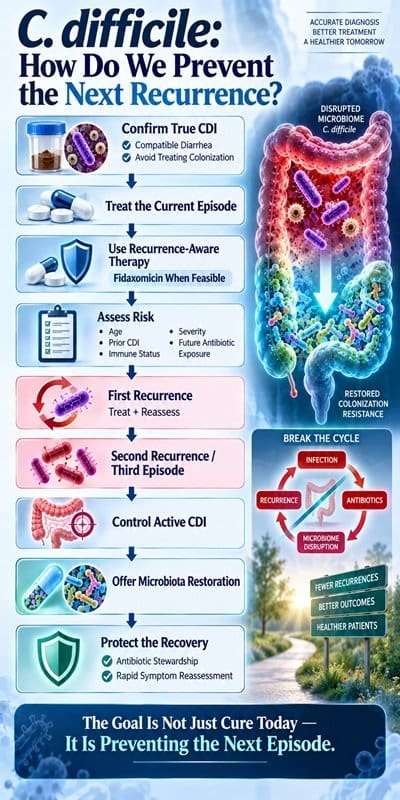
An episode-based clinical approach
| Clinical point | Preferred actions | Main caution |
| Suspected CDI | Confirm compatible diarrhea, review laxatives and alternative causes, and use an institutional multistep testing algorithm when available. Isolate suspected inpatients and reassess non-CDI antibiotics.[3,17] | Do not diagnose or treat colonization solely because a nucleic acid amplification test is positive. |
| Initial nonfulminant episode | Use fidaxomicin when feasible; vancomycin remains acceptable. Stop or narrow the inciting antibiotic when safe. Document recurrence risk and give return instructions.[3,4] | Do not use a routine test of cure. Do not assume that acute response equals durable cure. |
| First recurrence | Use fidaxomicin or a tapering vancomycin regimen, depending on prior therapy and access. Reassess risk and consider early referral for microbiota restoration in selected high-risk or unusually morbid cases.[3,4] | Evidence does not justify automatically extending vancomycin after every initial episode.[5] |
| Second recurrence, third episode | After antibacterial control, actively offer fecal microbiota-based therapy and select among FDA-approved products or conventional FMT based on patient factors, regulatory conditions, expertise, route, and access.[3,6,8,10,11] | Microbiota products are not acute CDI treatments. Avoid indirect product rankings from separate trials.[6,8] |
| Multiple recurrences with no feasible microbiota option | Specialist-directed prolonged low-dose suppressive vancomycin may be considered for selected patients with ongoing comorbidity, limited life expectancy, frequent systemic antibiotics, or failed microbiota therapies.[3] | This is a narrow, individualized strategy with resistance, microbiome, and indefinite-exposure concerns.[3] |
| Severe or fulminant disease | Escalate urgently to multidisciplinary management involving infectious diseases, gastroenterology, surgery, and critical care as indicated.[3] | VOWST and REBYOTA have not been studied or approved to treat severe or fulminant active CDI.[3,6,8] |
What should not be routine?
- Test of cure: Patients can remain colonized and test positive after clinical recovery. Retest only for compatible recurrent or worsening symptoms.[3,17]
- Probiotics for primary or secondary CDI prevention: The 2026 AGA expert update does not advise them for this purpose.[3]
- Unnecessary proton pump inhibitor withdrawal: Review the indication, but do not stop a proton pump inhibitor solely because of CDI when a legitimate indication remains.[3]
- Automatic prophylactic vancomycin with every later antibiotic course: Current randomized evidence is small and inconclusive, and routine use is not advised.[3,14,15,16]
- Assuming all post-treatment diarrhea is recurrence: Consider medication effects, post-infectious bowel dysfunction, inflammatory bowel disease, and other infectious or noninfectious causes before repeating CDI-directed therapy.[3]
Special populations and safety boundaries
Immunocompromised patients
Immunocompromise is a recurrence risk factor, but it is not a single category. The 2024 AGA guideline allows select conventional FMT use in mildly or moderately immunocompromised adults and suggests against fecal microbiota-based therapies in severely immunocompromised adults. Product trial exclusions, current immune status, neutropenia, transplant timing, active infection, and the consequences of another CDI episode should be reviewed with the relevant specialists.[10]
Pregnancy, lactation, and pediatrics
Neither VOWST nor REBYOTA has established safety and effectiveness in patients younger than 18 years. VOWST has no pregnancy-use data in its label. REBYOTA is not systemically absorbed, and its label states that maternal use is not expected to result in fetal or breastfeeding exposure, but patient-specific decisions still require obstetric and infectious-disease judgment.[6,8]
Allergy and transmissible-agent risk
Both products are made from human fecal material and carry warnings about possible transmissible infectious agents and food allergens. REBYOTA is contraindicated in patients with a history of severe allergic reaction to a component, and facilities administering it must be prepared to manage an acute allergic reaction.[6,8]
What the evidence still cannot answer
Several gaps prevent a simple declaration that recurrent CDI has been solved:
- No head-to-head randomized trial establishes which microbiota product, conventional FMT method, antibiotic strategy, or sequence is best for a particular patient.[3,6,8,10]
- The pivotal microbiota trials enrolled selected adults after antibacterial control. Their results do not automatically apply to active fulminant disease, children, pregnancy, profound neutropenia, or every form of severe immunosuppression.[6,8,10]
- Many pivotal endpoints center on 8-week recurrence. Longer follow-up is helpful, but the clinical trajectory can change after a new systemic antibiotic exposure.[6,8,14,15,16]
- The 2026 AGA update is timely expert advice based on literature review and expert opinion, not a formal systematic review with graded certainty.[3]
- Access, coverage, referral pathways, product logistics, and local expertise can determine whether an evidence-based option is delivered at the clinically useful time.
- Randomized evidence for oral vancomycin prophylaxis during later antibiotics remains limited to two small trials, with uncertain benefit and unresolved resistance tradeoffs.[14,15,16]
Clinical implications for 2026
The field has moved from repeatedly treating relapse to designing a prevention pathway. The decisive question is no longer only, “Which antibiotic should treat this episode?” It is also, “What is this patient’s probability and consequence of another episode, and what intervention should occur immediately after antibacterial control?”[3]
That shift changes workflow. Recurrence history, prior CDI therapies, immune status, future antibiotic likelihood, access barriers, and patient preferences should be collected early. Start referral for microbiota restoration before the next relapse, not after another emergency visit. A later systemic antibiotic should trigger stewardship review and rapid symptom follow-up, not automatic prophylaxis for every patient.[2,3,14,15,16,18]
By 2026, clinicians can prevent recurrent C. difficile more effectively than they could a few years ago. Fidaxomicin has made the initial antibiotic choice more recurrence-aware. FDA-approved microbiota products have created standardized preventive options after recurrent disease. Current expert guidance moves microbiota restoration into an earlier, risk-stratified conversation rather than reserving it indefinitely for therapeutic exhaustion.[3,4,6,8]
But “more effective” is not the same as solved. Recurrence still follows diagnostic error, delayed referral, restricted access, severe immunocompromise, and unavoidable antibiotic re-exposure. The most defensible 2026 strategy is a coordinated sequence: diagnose accurately, minimize unnecessary antibiotics, choose recurrence-sparing therapy when feasible, assess risk after every episode, and offer microbiota restoration promptly when the recurrence threshold or clinical severity justifies it.[1,3,4,6,8,10,14,15,16,17,18]
Clinical Update Disclaimer
This clinician-facing review reflects U.S. sources verified through August 19, 2026. Guidelines, product labeling, availability, safety communications, and institutional protocols can change. Confirm current FDA labeling and specialty guidance before making patient-specific decisions. This educational article does not replace diagnosis, treatment, or specialist consultation.
References
- Centers for Disease Control and Prevention. About C. diff. Updated May 13, 2026. Accessed August 19, 2026. https://www.cdc.gov/c-diff/about/index.html
- Centers for Disease Control and Prevention. After C. diff: Caring for Yourself and Others. Updated December 13, 2024. Accessed August 19, 2026. https://www.cdc.gov/c-diff/after/index.html
- Fischer M, Vaughn BP, Peery AF, Kelly CR. AGA Clinical Practice Update on Management of Clostridioides difficile Infection in Adults: Expert Review. Clin Gastroenterol Hepatol. Published online June 30, 2026. https://doi.org/10.1016/j.cgh.2026.05.007 PMID: 42383946.
- Johnson S, Lavergne V, Skinner AM, et al. Clinical Practice Guideline by the Infectious Diseases Society of America and Society for Healthcare Epidemiology of America: 2021 Focused Update Guidelines on Management of Clostridioides difficile Infection in Adults. Clin Infect Dis. 2021;73(5):e1029-e1044. https://doi.org/10.1093/cid/ciab549 PMID: 34164674.
- McDonald EG, Butler-Laporte G, Brophy JM, et al. Initial Vancomycin Taper for the Prevention of Recurrent Clostridioides difficile Infection: A Randomized Clinical Trial. JAMA Netw Open. 2026;9(2):e2560495. https://doi.org/10.1001/jamanetworkopen.2025.60495 PMID: 41758514.
- DailyMed. VOWST (fecal microbiota spores, live-brpk) capsules, prescribing information. Label updated April 23, 2026; prescribing information revised February 2025. Accessed August 19, 2026. https://dailymed.nlm.nih.gov/dailymed/drugInfo.cfm?setid=99e5a37a-930c-4641-bcdd-7013ec1c15fe
- Feuerstadt P, Louie TJ, Lashner B, et al. SER-109, an Oral Microbiome Therapy for Recurrent Clostridioides difficile Infection. N Engl J Med. 2022;386(3):220-229. https://doi.org/10.1056/NEJMoa2106516 PMID: 35045228.
- DailyMed. REBYOTA (fecal microbiota, live-jslm) suspension, prescribing information. Label updated December 23, 2024; prescribing information revised November 2022. Accessed August 19, 2026. https://dailymed.nlm.nih.gov/dailymed/drugInfo.cfm?setid=7af8a7f6-a441-4dc6-a151-138a89166fbb
- Khanna S, Assi M, Lee C, et al. Efficacy and Safety of RBX2660 in PUNCH CD3, a Phase III, Randomized, Double-Blind, Placebo-Controlled Trial with a Bayesian Primary Analysis for the Prevention of Recurrent Clostridioides difficile Infection. Drugs. 2022;82(15):1527-1538. https://doi.org/10.1007/s40265-022-01797-x PMID: 36287379; PMCID: PMC9607700.
- Peery AF, Kelly CR, Kao D, et al. AGA Clinical Practice Guideline on Fecal Microbiota-Based Therapies for Select Gastrointestinal Diseases. Gastroenterology. 2024;166(3):409-434. https://doi.org/10.1053/j.gastro.2024.01.008 PMID: 38395525.
- U.S. Food and Drug Administration. Enforcement Policy Regarding Investigational New Drug Requirements for Use of Fecal Microbiota for Transplantation to Treat Clostridioides difficile Infection Not Responsive to Standard Therapies: Guidance for Industry. November 29, 2022. Accessed August 19, 2026. FDA guidance.
- U.S. Food and Drug Administration. Safety Alert Regarding Use of Fecal Microbiota for Transplantation and Risk of Serious Adverse Events Likely Due to Transmission of Pathogenic Organisms. March 12, 2020. Accessed August 19, 2026. FDA safety alert.
- American Society of Health-System Pharmacists. Drug Shortage Detail: Bezlotoxumab Injection. Created February 5, 2025. Accessed August 19, 2026. ASHP drug-shortage record.
- Keating JA, Xu T, Graham MB, et al. Oral Vancomycin for Prevention of Recurrent Clostridioides difficile Infection: A Randomized Clinical Trial. JAMA Netw Open. 2025;8(7):e2517834. https://doi.org/10.1001/jamanetworkopen.2025.17834 PMID: 40601321.
- San-Juan R, Origüen J, Fernández-Ruiz M, et al. Randomized Double-Blind Clinical Trial Evaluating the Effectiveness and Safety of Secondary Prophylaxis with Oral Vancomycin Versus Placebo in the Prevention of Recurrence of Clostridioides difficile Infection in Patients Receiving Systemic Antibiotic Therapy: PREVAN Trial. JAC Antimicrob Resist. 2026;8(2):dlag032. https://doi.org/10.1093/jacamr/dlag032 PMID: 41809590.
- Prosty C, Sorin M, McDonald EG, Lee TC. Secondary Vancomycin Prophylaxis During Antibiotic Re-exposure for the Prevention of Recurrent Clostridioides difficile Infections: A Systematic Review and Bayesian Meta-analysis. JAC Antimicrob Resist. 2026;8(4):dlag141. https://doi.org/10.1093/jacamr/dlag141 PMID: 42495450.
- Centers for Disease Control and Prevention. Clinical Guidance for C. diff Infection Prevention in Acute Care Facilities. Updated May 13, 2026. Accessed August 19, 2026. https://www.cdc.gov/c-diff/hcp/clinical-guidance/index.html
- Centers for Disease Control and Prevention. Preventing C. diff. Updated December 18, 2024. Accessed August 19, 2026. https://www.cdc.gov/c-diff/prevention/index.html
Recent Articles


Integrative Perspectives on Cognition, Emotion, and Digital Behavior

Sleep-related:
Longevity/Nutrition & Diet:
Philosophical / Happiness / Social:
Other:
Modern Mind Unveiled
Developed under the direction of David McAuley, Pharm.D., this collection explores what it means to think, feel, and connect in the modern world. Drawing upon decades of clinical experience and digital innovation, Dr. McAuley and the GlobalRPh initiative translate complex scientific ideas into clear, usable insights for clinicians, educators, and students.
The series investigates essential themes–cognitive bias, emotional regulation, digital attention, and meaning-making—revealing how the modern mind adapts to information overload, uncertainty, and constant stimulation.
At its core, the project reflects GlobalRPh’s commitment to advancing evidence-based medical education and clinical decision support. Yet it also moves beyond pharmacotherapy, examining the psychological and behavioral dimensions that shape how healthcare professionals think, learn, and lead.
Through a synthesis of empirical research and philosophical reflection, Modern Mind Unveiled deepens our understanding of both the strengths and vulnerabilities of the human mind. It invites readers to see medicine not merely as a science of intervention, but as a discipline of perception, empathy, and awareness–an approach essential for thoughtful practice in the 21st century.
The Six Core Themes
I. Human Behavior and Cognitive Patterns
Examining the often-unconscious mechanisms that guide human choice-how we navigate uncertainty, balance logic with intuition, and adapt through seemingly irrational behavior.
II. Emotion, Relationships, and Social Dynamics
Investigating the structure of empathy, the psychology of belonging, and the influence of abundance and selectivity on modern social connection.
III. Technology, Media, and the Digital Mind
Analyzing how digital environments reshape cognition, attention, and identity- exploring ideas such as gamification, information overload, and cognitive “nutrition” in online spaces.
IV. Cognitive Bias, Memory, and Decision Architecture
Exploring how memory, prediction, and self-awareness interact in decision-making, and how external systems increasingly serve as extensions of thought.
V. Habits, Health, and Psychological Resilience
Understanding how habits sustain or erode well-being-considering anhedonia, creative rest, and the restoration of mental balance in demanding professional and personal contexts.
VI. Philosophy, Meaning, and the Self
Reflecting on continuity of identity, the pursuit of coherence, and the construction of meaning amid existential and informational noise.
Keywords
Cognitive Science • Behavioral Psychology • Digital Media • Emotional Regulation • Attention • Decision-Making • Empathy • Memory • Bias • Mental Health • Technology and Identity • Human Behavior • Meaning-Making • Social Connection • Modern Mind
Video Section