
Evidence-based clinical review
Blood-Based Colorectal Cancer Screening in Family Practice: Where Shield Fits Among FIT, Stool DNA, and Colonoscopy
A practical framework for average-risk adults who remain unscreened or decline preferred modalities

Abstract
Background: The U.S. Food and Drug Administration approved Shield in July 2024 for colorectal cancer screening in average-risk adults aged 45 years or older. However, the 2026 American Cancer Society guideline places blood-based screening below preferred stool-based and structural examinations. [1,2]
Objective: To provide family-practice clinicians with a practical framework for selecting patients, counseling about tradeoffs, and closing the loop after Shield testing.
Key Findings: In the ECLIPSE validation population, Shield detected 83.1% of colorectal cancers, 13.2% of advanced adenomas, and correctly returned a negative result in 89.6% of people without advanced neoplasia. [2,3] Annual fecal immunochemical testing, triennial multitarget stool DNA testing, and colonoscopy every 10 years after a normal high-quality examination remain preferred options. These modalities retain their preferred status because they have stronger evidence or a greater ability to identify precancerous lesions. [1,4-6] A positive Shield result is not a cancer diagnosis and requires timely colonoscopy, preferably within 6 months. Repeating Shield or another noncolonoscopy test is not an appropriate confirmation strategy. [1,2]
Conclusion: Shield is best positioned as an informed, nonpreferred alternative for an average-risk patient who declines or does not complete preferred screening and who is willing to undergo colonoscopy after a positive result. [1,7] Its value is greatest when it converts persistent nonparticipation into completed screening rather than replacing a test with greater preventive potential. [1]
The Clinical Relevance of Blood-Based Screening in Family Practice
Primary care already has several effective colorectal cancer screening options, yet the practical failure point is often completion rather than test availability. [1,7] A blood draw can lower the immediate burden for a patient who will not return a stool kit or schedule a colonoscopy. Convenience, however, does not erase clinically important differences in what each modality detects. [1,3-5]
The central question is therefore not whether Shield has regulatory authorization or whether it detects colorectal cancer. The real question is whether a particular unscreened patient is more likely to benefit from accepting Shield than from continuing to decline all screening. This must be done without leading the patient to believe that a blood test is equivalent to a preferred modality. [1,2,7]
Core positioning statement: Offer Shield to expand screening among appropriately selected average-risk adults who decline or do not complete preferred options. Do not present it as an easier equivalent to FIT, multitarget stool DNA, or colonoscopy. [1]
Confirming Screening Eligibility Before Choosing a Modality
The ACS guideline applies to asymptomatic, average-risk adults beginning at age 45 years. It recommends continued screening through age 75 for people in good health with a life expectancy greater than 10 years. Decisions should be individualized from ages 76 through 85, and screening is generally discouraged after age 85. [1] The USPSTF similarly recommends screening for adults aged 45 through 75 and selective screening from ages 76 through 85. [9]
Screening is not the correct pathway for a patient with rectal bleeding, iron-deficiency anemia, unexplained weight loss, persistent change in bowel habits, concerning abdominal pain, or a previous positive screening result. Those findings require diagnostic evaluation rather than another screening test. [2,8,9]
For Shield specifically, the FDA Summary of Safety and Effectiveness Data lists the test as not indicated for people with a personal history of colorectal cancer or adenomas. It is also not indicated for anyone with a first-degree relative who had colorectal cancer at any age, inflammatory bowel disease, familial adenomatous polyposis, Lynch syndrome, another listed hereditary cancer syndrome, or a recent positive result from another colorectal cancer screening method. [2] These label-specific exclusions are stricter than some general descriptions of average risk and should be carefully checked before ordering. [1,2]
- Use a screening pathway only for an asymptomatic patient who is due for average-risk screening. [1,2,9]
- Use a diagnostic pathway when symptoms, anemia, or a prior positive screening test are present. [2,8,9]
- Use a surveillance or high-risk pathway for prior colorectal neoplasia, inflammatory bowel disease, hereditary syndromes, or a clinically significant family history. [1,2]
- Confirm that the patient is willing and medically able to complete a colonoscopy if the noncolonoscopy test is positive. [1,2]
Understanding Shield and the Limits of FDA Approval
Shield is a qualitative in vitro diagnostic assay that evaluates colorectal cancer-associated alterations in cell-free DNA from peripheral blood. The FDA indication covers colorectal cancer screening in average-risk adults aged 45 years or older. A positive result should be followed by a colonoscopy, and the test is not a replacement for diagnostic colonoscopy or surveillance colonoscopy in high-risk individuals. [2]
FDA approval establishes reasonable assurance of safety and effectiveness for the labeled use. It does not establish that Shield is clinically equivalent to other screening tests. It does not make a positive result diagnostic, and it does not determine the preferred order in which clinicians should offer screening modalities. [1,2] The 2026 ACS guideline supplies that clinical positioning by recommending blood-based tests only after a preferred high-sensitivity stool test or structural examination is declined or not completed. [1]
The blood-test landscape is also no longer limited to Shield. The FDA approved SimpleScreen CRC for average-risk adults aged 45 years or older on July 24, 2026. This newer test carries the same requirement for colonoscopy after a positive result and the same limitation that it does not replace diagnostic or high-risk surveillance colonoscopy. [10] This article focuses on Shield because its pivotal data and current primary-care implementation are more established, not because it is the only FDA-approved blood-based option. [2,10]
Evaluating Shield Performance and the Detection-Versus-Prevention Gap
ECLIPSE was a prospective, blinded, cross-sectional validation study in which participants completed blood testing before screening colonoscopy. Among 7,861 evaluable average-risk adults, 65 had colorectal cancer. Of those cancers, 54 produced a positive Shield result, yielding a sensitivity of 83.1% with a 95% confidence interval of 72.2% to 90.3%. [2,3] Among 1,116 participants with advanced adenomas, 147 had a positive test, resulting in a sensitivity of 13.2%. [2,3] Specificity among participants without colorectal cancer or advanced adenoma was 89.6%. [2,3]
The FDA analysis also reported substantially lower sensitivity for stage I cancer than for later-stage disease. Sensitivity was just 54.5% in a subgroup of 22 stage I cancers, accompanied by a wide confidence interval. [2] That subgroup estimate should not be used as a precise prediction for an individual patient, but it reinforces the direction of the concern identified by the ACS guideline. [1,2]
This pattern creates a clinically important distinction. Shield has meaningful single-round sensitivity for existing colorectal cancer, but its low detection of advanced precancerous lesions limits its capacity to prevent cancer through the identification and removal of precursor lesions. [1-3] Colonoscopy directly visualizes the colon and allows polypectomy during the same procedure. Meanwhile, FIT and multitarget stool DNA testing identify more advanced precancerous lesions than Shield in available studies. [1,4,5]
ECLIPSE measured one screening round against colonoscopy and was funded by Guardant Health. [3] It did not establish the cumulative performance of repeated Shield testing, nor did it demonstrate reductions in colorectal cancer incidence or mortality. [1-3] The FDA therefore required a longitudinal post-approval study that includes repeat testing at approximately 3 years. [2]
Comparing Shield With Common Family-Practice Screening Options
| Modality | Typical interval | Single-round evidence | Family-practice implications |
| Shield blood test | No manufacturer interval specified; Medicare national framework uses once every 3 years for qualifying tests and beneficiaries. [1,8] | CRC sensitivity 83.1%; advanced adenoma sensitivity 13.2%; specificity 89.6% for absence of advanced neoplasia. [2,3] | Simple blood draw. Lower detection of precancer and stage I cancer. Positive result requires colonoscopy. ACS classifies blood testing as nonpreferred. [1,2] |
| Fecal immunochemical test (FIT) | Every year. [1,9] | Pooled CRC sensitivity 74% and specificity 94% in the USPSTF evidence review. In BLUE-C, the study FIT comparator detected 23.3% of advanced precancerous lesions. [4,5] | Low-cost home sample with no bowel preparation. Requires annual recall and reliable return systems. Positive result requires colonoscopy. [1] |
| Next-generation multitarget stool DNA | Every 3 years. [1,6] | BLUE-C reported CRC sensitivity 93.9%, advanced precancerous lesion sensitivity 43.4%, and specificity 90.6%. [5] | Higher single-round sensitivity than FIT for cancer and advanced precancerous lesions, but requires collection of a full stool sample and produces more false positives than FIT. Positive result requires colonoscopy. [1,5,6] |
| Colonoscopy | Every 10 years after a normal high-quality examination in an average-risk patient. [1,9] | Direct visualization with biopsy and polypectomy; a single screening sensitivity estimate is not used here because performance depends on preparation quality and endoscopist factors. [1,4] | Offers detection and prevention in one procedure. Requires preparation, procedural access, and often sedation. The USPSTF evidence review estimated 3.1 perforations and 14.6 major bleeding events per 10,000 screening colonoscopies. [4] |
Interpretation note: Cross-study single-round estimates are not directly interchangeable. Only next-generation multitarget stool DNA and FIT were compared head-to-head within the BLUE-C trial. Screening-program effectiveness also depends on repeated adherence and completion of diagnostic colonoscopy after a positive noncolonoscopy test. [1,4,5]
Integrating Shield Into a Family-Practice Screening Strategy
Shield is most defensible when it adds a screened patient to the practice registry, not when it substitutes for a preferred test that the patient would otherwise complete. [1] The ACS guideline explicitly warns that replacing more effective modalities with blood testing may reduce the population benefit of screening because advanced precancerous lesions are detected less often. [1]
A randomized trial in an integrated health system illustrates both the potential and the limitation of this approach. Among adults who had not completed prior screening, offering a blood-based test increased short-term screening completion to 30.5% compared with 13.0% under usual care. [7] The trial assessed participation rather than cancer incidence or mortality. Furthermore, increased initial completion does not guarantee repeat adherence or colonoscopy completion after a positive result. [1,7]

Identifying Appropriate and Inappropriate Candidates for Shield
Characteristics of a Reasonable Shield Candidate
- Is asymptomatic, average risk, at least 45 years old, and due for screening. [1,2]
- Has declined or repeatedly failed to complete colonoscopy, FIT, or multitarget stool DNA testing after barriers have been addressed. [1,7]
- Understands that a blood draw is easier but is substantially less likely to detect advanced precancerous lesions. [1-5]
- Agrees in advance to timely colonoscopy if the result is positive. [1,2]
- Understands that a negative result does not rule out colorectal cancer or precancer and does not override later symptoms. [2]
Characteristics of a Poor Shield Candidate
- Has gastrointestinal symptoms, iron-deficiency anemia, or a prior positive screening test that requires diagnostic evaluation. [2,8,9]
- Needs surveillance because of prior colorectal cancer, adenomas, inflammatory bowel disease, hereditary risk, or a disqualifying family history. [1,2]
- Would accept a preferred modality but is being steered toward Shield solely because it is easier to order. [1]
- Is unwilling or unable to undergo colonoscopy after a positive result. [1,2]
- Believes a negative blood test provides the same preventive assurance as a normal colonoscopy or a completed longitudinal screening program. [1-4]
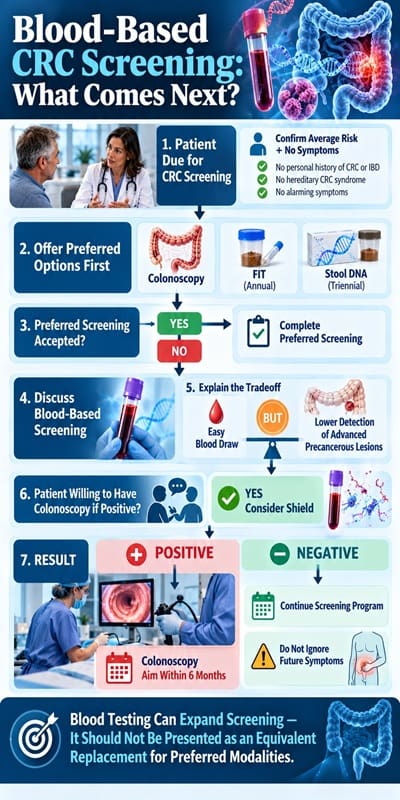
A Four-Step Counseling and Ordering Ladder for the Office Visit
| Step | Clinical action | What to document |
| 1. Establish the pathway | Confirm that the patient is asymptomatic, average risk, due for screening, and not in a surveillance pathway. [1,2,9] | Age, prior testing, symptoms, personal and family history, and reason screening is due. [1,2,9] |
| 2. Offer preferred options first | Present colonoscopy, annual FIT, and triennial multitarget stool DNA with concise tradeoffs. [1,4-6] | Options discussed, patient preference, practical barriers, and the chosen preferred test when accepted. [1,4-6] |
| 3. Offer Shield when preferred testing is declined or not completed | Explain lower advanced precancerous lesion and stage I sensitivity, the need for colonoscopy after a positive result, and interval uncertainty. [1-3] | Why preferred tests were declined or not completed, counseling provided, and agreement to colonoscopy if positive. [1-3] |
| 4. Close the loop | Track specimen completion, result communication, diagnostic colonoscopy after a positive result, and recall after a negative result. [1,2,8] | Result date, patient notification, referral status, colonoscopy completion, and next recall date or interval decision. [1,2,8] |
Clinical Management Following a Positive Shield Result
A positive Shield result is an abnormal screening result, not a diagnosis of colorectal cancer. [2] In the FDA analysis of ECLIPSE, the positive predictive value for colorectal cancer was 3.1%. This prevalence-dependent estimate illustrates why the result must be resolved by colonoscopy rather than communicated as a cancer diagnosis. [2]
Clinicians should refer the patient for colonoscopy promptly and aim for completion within 6 months. [1] Do not repeat Shield, order FIT, or use another noncolonoscopy screening test to confirm or negate the positive result. [1] The screening process remains incomplete until a colonoscopy is performed. [1,2]
- Notify the patient using language that clearly distinguishes an abnormal screening result from a cancer diagnosis. [2]
- Place the colonoscopy referral at the time of result communication and document the intended completion window. [1]
- Use a closed-loop registry, referral queue, or staff work list until the colonoscopy is completed or a documented barrier is resolved. [1,8]
- Address transportation, preparation, anticoagulation planning, procedural access, and out-of-pocket concerns early rather than waiting for a missed appointment. [1,8]
- Base subsequent management on colonoscopy findings and specialist recommendations, as another screening test is not a substitute for diagnostic resolution. [1]
Clinical Management Following a Negative Shield Result
A negative Shield result does not exclude colorectal cancer or advanced precancerous lesions. [2] The FDA labeling states that patients with negative results should continue participating in screening programs. The low advanced adenoma sensitivity is the main reason a negative result cannot be treated as equivalent to a normal colonoscopy. [1,2]
New rectal bleeding, iron-deficiency anemia, weight loss, persistent bowel-habit change, or other concerning findings after a negative test still require diagnostic evaluation. [2,8,9] The prior negative screening result should not delay that workup. [2]
The repeat-testing strategy remains less settled than for established modalities. Manufacturers had not specified an optimal blood-test interval in the 2026 ACS guideline. Meanwhile, the Medicare national framework covers qualifying noninvasive biomarker tests once every 3 years when its patient, ordering, and test criteria are met. [1,8] Practices should verify the current label, guideline, payer rules, and local workflow before setting a recall interval for a specific patient. [1,2,8]

Navigating Coverage and Implementation Details
CMS finalized a national framework in June 2026 for qualifying noninvasive biomarker colorectal cancer screening tests once every 3 years. Covered patients must be 45 through 85 years old, asymptomatic, at average risk, and informed about test performance and the importance of follow-up colonoscopy after a positive result. [8] The test must also satisfy FDA authorization, post-approval study, laboratory, and performance requirements, and it must be ordered by an eligible treating clinician. [8]
That national framework should not be translated into a universal promise of payment. Coverage may differ by test, beneficiary eligibility, plan type, network, coding, and the timing of policy implementation. Verify the specific payer and patient before collection, and do not assume that private insurers must apply the same interval or cost-sharing rules. [1,8]
Practice Implementation Checklist for Blood-Based Screening
- Create an eligibility screen that separates average-risk screening from symptoms, prior positive tests, high-risk conditions, and surveillance. [1,2,9]
- Make preferred modalities the default order set and place Shield in a clearly labeled nonpreferred-alternative pathway. [1]
- Embed a brief counseling script on lower advanced precancerous lesion and stage I detection, colonoscopy after a positive result, and interval uncertainty. [1-3]
- Require a documented colonoscopy contingency before ordering any noncolonoscopy screening test. [1,2]
- Track ordered, collected, resulted, referred, and colonoscopy-completed states separately. [1,8]
- Build recall logic for negative results that can be updated when labels, guidelines, or payer policies change. [1,2,8]
- Audit whether Shield is reaching previously unscreened patients rather than displacing FIT, stool DNA, or colonoscopy among patients who would complete them. [1,7]
Acknowledging Evidence Limitations and Future Research Directions
Current Shield evidence is strongest for single-round diagnostic performance in average-risk adults undergoing colonoscopy. [2,3] Evidence remains limited for repeated testing, long-term adherence, completion of colonoscopy after positive results, interval cancer rates, comparative effectiveness, and reductions in colorectal cancer incidence or mortality. [1-3,7]
The required post-approval study is designed to evaluate longitudinal performance with repeat testing at approximately 3 years. [2] Future evidence should clarify cumulative false-positive rates, interval cancers, real-world follow-up, age-specific tradeoffs, equity, cost, and whether blood testing adds participation without replacing modalities that detect more precancerous disease. [1,2,8]
Conclusion: Finding the Right Role for Blood-Based Screening
Shield gives family physicians a useful additional way to engage an average-risk adult who otherwise remains unscreened. [1,2,7] Its appropriate role is narrow but important. Clinicians should offer preferred stool-based or structural screening first and use Shield only after those options are declined or not completed. It is vital to counsel explicitly about its low advanced precancerous lesion detection and lower stage I sensitivity, and to guarantee closed-loop colonoscopy after a positive result. [1-3] A blood test that a persistently unscreened patient completes can be clinically valuable, but it should never be promoted as a preventive equivalent to FIT, multitarget stool DNA, or colonoscopy. [1,4,5]
Clinical Update Disclaimer
Evidence, FDA labeling, professional recommendations, coverage rules, and test availability were reviewed through August 20, 2026. These items can change. Clinicians should confirm current FDA documents, professional guidance, payer policies, and local diagnostic pathways before applying this material to an individual patient.
References
- Wolf AMD, et al. Colorectal cancer screening: An update to the American Cancer Society guideline, 2026. CA Cancer J Clin. 2026;76(3):e70083. DOI | PubMed. DOI: 10.3322/caac.70083. PMID: 42200680.
- U.S. Food and Drug Administration. Summary of Safety and Effectiveness Data: Shield, PMA P230009. Approved July 26, 2024. Accessed August 20, 2026. FDA PMA | SSED.
- Chung DC, Gray DM II, Singh H, et al. A Cell-free DNA Blood-Based Test for Colorectal Cancer Screening. N Engl J Med. 2024;390(11):973-983. DOI | PubMed. DOI: 10.1056/NEJMoa2304714. PMID: 38477985.
- Lin JS, Perdue LA, Henrikson NB, Bean SI, Blasi PR. Screening for Colorectal Cancer: Updated Evidence Report and Systematic Review for the US Preventive Services Task Force. JAMA. 2021;325(19):1978-1998. DOI | PubMed. DOI: 10.1001/jama.2021.4417. PMID: 34003220.
- Imperiale TF, Porter K, Zella J, et al. Next-Generation Multitarget Stool DNA Test for Colorectal Cancer Screening. N Engl J Med. 2024;390(11):984-993. DOI | PubMed. DOI: 10.1056/NEJMoa2310336. PMID: 38477986.
- U.S. Food and Drug Administration. Premarket Approval P230043: Cologuard Plus. Approved October 3, 2024. Accessed August 20, 2026. FDA PMA.
- Coronado GD, et al. Blood-based colorectal cancer screening in an integrated health system: a randomised trial of patient adherence. Gut. 2024;73(4):622-628. DOI | PubMed. DOI: 10.1136/gutjnl-2023-330980. PMID: 38176899.
- Centers for Medicare & Medicaid Services. Decision Memo for Screening for Colorectal Cancer-Non-Invasive Biomarker Tests (CAG-00440R). June 8, 2026. Accessed August 20, 2026. CMS Decision Memo.
- U.S. Preventive Services Task Force. Screening for Colorectal Cancer: US Preventive Services Task Force Recommendation Statement. JAMA. 2021;325(19):1965-1977. DOI | PubMed. DOI: 10.1001/jama.2021.6238. PMID: 34003218.
- U.S. Food and Drug Administration. Premarket Approval P250029: SimpleScreen CRC. Approved July 24, 2026. Accessed August 20, 2026. FDA PMA.
Recent Articles


Integrative Perspectives on Cognition, Emotion, and Digital Behavior

Sleep-related:
Longevity/Nutrition & Diet:
Philosophical / Happiness / Social:
Other:
Modern Mind Unveiled
Developed under the direction of David McAuley, Pharm.D., this collection explores what it means to think, feel, and connect in the modern world. Drawing upon decades of clinical experience and digital innovation, Dr. McAuley and the GlobalRPh initiative translate complex scientific ideas into clear, usable insights for clinicians, educators, and students.
The series investigates essential themes–cognitive bias, emotional regulation, digital attention, and meaning-making—revealing how the modern mind adapts to information overload, uncertainty, and constant stimulation.
At its core, the project reflects GlobalRPh’s commitment to advancing evidence-based medical education and clinical decision support. Yet it also moves beyond pharmacotherapy, examining the psychological and behavioral dimensions that shape how healthcare professionals think, learn, and lead.
Through a synthesis of empirical research and philosophical reflection, Modern Mind Unveiled deepens our understanding of both the strengths and vulnerabilities of the human mind. It invites readers to see medicine not merely as a science of intervention, but as a discipline of perception, empathy, and awareness–an approach essential for thoughtful practice in the 21st century.
The Six Core Themes
I. Human Behavior and Cognitive Patterns
Examining the often-unconscious mechanisms that guide human choice-how we navigate uncertainty, balance logic with intuition, and adapt through seemingly irrational behavior.
II. Emotion, Relationships, and Social Dynamics
Investigating the structure of empathy, the psychology of belonging, and the influence of abundance and selectivity on modern social connection.
III. Technology, Media, and the Digital Mind
Analyzing how digital environments reshape cognition, attention, and identity- exploring ideas such as gamification, information overload, and cognitive “nutrition” in online spaces.
IV. Cognitive Bias, Memory, and Decision Architecture
Exploring how memory, prediction, and self-awareness interact in decision-making, and how external systems increasingly serve as extensions of thought.
V. Habits, Health, and Psychological Resilience
Understanding how habits sustain or erode well-being-considering anhedonia, creative rest, and the restoration of mental balance in demanding professional and personal contexts.
VI. Philosophy, Meaning, and the Self
Reflecting on continuity of identity, the pursuit of coherence, and the construction of meaning amid existential and informational noise.
Keywords
Cognitive Science • Behavioral Psychology • Digital Media • Emotional Regulation • Attention • Decision-Making • Empathy • Memory • Bias • Mental Health • Technology and Identity • Human Behavior • Meaning-Making • Social Connection • Modern Mind
Video Section