Evidence-based clinical review
Recurrent Pregnancy Loss Evidence-Based Evaluation, Treatment, and Legacy Practices
A 2026 guide to high-value testing, targeted treatment, and low-value add-ons

Abstract
Background: Recurrent pregnancy loss creates intense pressure to find a correctable cause. However, the syndrome actually encompasses several distinct biological pathways. Relying on broad test panels and empiric treatments can therefore generate false-positive results, unnecessary procedures, medication harms, and avoidable costs.[1-3]
Objective: To distinguish high-value evaluation and treatment from practices that persist despite weak, indirect, or negative evidence.
Key Findings: Current U.S. guidance defines recurrent pregnancy loss (RPL) as two or more spontaneous pregnancy losses, excluding confirmed ectopic and molar pregnancies.[1] The most informative early steps are chromosome analysis of miscarriage tissue, when feasible, and assessment of the uterine cavity.[1-3] Additional testing should be driven by the loss phenotype, tissue result, medical history, and symptoms.[1-3] Anticoagulation is appropriate for carefully defined antiphospholipid syndrome (APS) or a separate maternal thrombosis indication, but it is not indicated for unexplained RPL or inherited thrombophilia alone.[1,3,10,11] Progesterone is not a universal treatment for asymptomatic unexplained RPL, though vaginal micronized progesterone is supported by U.K. guidance for early-pregnancy bleeding in a patient with a prior miscarriage.[1,3,6-9] Uterine surgery, preimplantation genetic testing for aneuploidy (PGT-A), chronic endometritis testing, and sperm DNA fragmentation testing require selective use and careful counseling.[1-5] Routine inherited thrombophilia panels, MTHFR testing, immune panels, endometrial receptivity tests, microbiome panels, empiric antibiotics, and unselected immune therapies are considered low-value practices.[1-3,11]
Conclusion: The evidence-based approach is not simply to “do nothing.” Rather, it is to explain the loss whenever possible, identify the small number of actionable diagnoses, avoid treating incidental findings, and provide an explicit, supportive plan for the next pregnancy.[1-3]
Introduction
Understanding Recurrent Pregnancy Loss as a Syndrome Rather Than a Single Disease
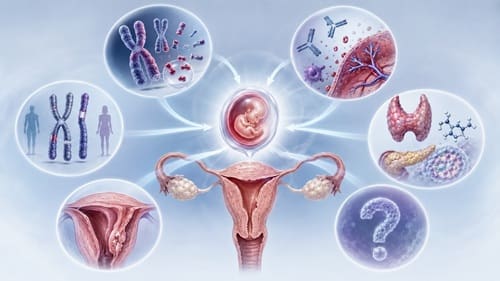
The term RPL describes an outcome pattern, but it does not identify a single underlying mechanism. Embryonic aneuploidy, a parental structural chromosome rearrangement, a uterine cavity abnormality, APS, uncontrolled endocrine disease, and unexplained euploid loss are all clinically distinct problems. Treating them as one uniform disease encourages the use of the same broad test panel and the same empiric prescription for every patient.[1-3]
The American Society for Reproductive Medicine (ASRM) now defines RPL as two or more spontaneous pregnancy losses, including pregnancies documented by urine or serum human chorionic gonadotropin, while explicitly excluding confirmed ectopic and molar pregnancies. Importantly, these losses do not need to be consecutive. The European Society of Human Reproduction and Embryology (ESHRE) similarly uses a two-loss definition. The Royal College of Obstetricians and Gynaecologists (RCOG) retains three first-trimester miscarriages as its formal definition, but it explicitly permits evaluation after two losses when the pattern may be pathologic rather than sporadic.[1-3]
For a U.S.-anchored practice algorithm in 2026, initiating an evaluation after the second documented loss is entirely reasonable. The depth of that evaluation should still reflect maternal age, gestational timing, whether the losses were consecutive, tissue chromosome results, prior live births, comorbid diseases, and the patient’s overall reproductive timeline.[1-3]
The Diagnostic Pivot: Starting the Evaluation With the Loss Itself
The most important change in the 2026 ASRM approach is sequencing. Instead of ordering a broad “RPL panel” right out of the gate, clinicians should evaluate miscarriage tissue for a chromosomal explanation when feasible, and then add tests that remain relevant after that result is known. Array-based chromosome testing avoids some of the limitations of conventional culture-based karyotyping and can provide a definitive explanation for many first-trimester losses. ASRM recommends offering tissue testing at the second miscarriage or in a patient who already meets criteria for RPL.[1]
An aneuploid result usually identifies the proximate explanation for that specific loss. It does not prove that every prior loss was aneuploid, nor does it erase clinically important history. Conversely, a euploid result, an unbalanced structural rearrangement, or the absence of usable tissue completely changes the next diagnostic branch.[1-3]
Table 1. High-value testing after recurrent pregnancy loss
| Evaluation | 2026 role | Practical limit |
| Miscarriage-tissue chromosome analysis | Core first step when tissue is available | Prefer an array-based method; no platform detects every abnormality.[1-3] |
| Uterine cavity assessment | Core anatomic evaluation | Use 3D transvaginal ultrasound, saline infusion sonography, HSG, or hysteroscopy according to the question.[1-3] |
| Parental karyotypes | Selective | Highest yield after an unbalanced tissue result or when tissue testing is unavailable.[1-3] |
| APS laboratory testing | Criteria-driven or guideline-directed | A single low-titer positive result is not APS; persistence is required.[1,3] |
| Serum TSH | Reasonable, especially after euploid or untested loss or with thyroid risk | Treat thyroid dysfunction, not antibody status alone.[1,3,12,13] |
| HbA1c | Risk-based | Use for diabetes risk, symptoms, obesity, prior gestational diabetes, or other metabolic concern.[1] |
| Prolactin | Symptom-based | Reserve for galactorrhea, anovulation, or another clinical indication.[1] |
| Chronic endometritis evaluation | Selective or investigational | Diagnostic thresholds vary; routine antibiotics have not shown clear live-birth benefit.[1,3] |
| Sperm DNA fragmentation | Selective | May be discussed in otherwise unexplained RPL or coexisting infertility; treatment benefit is unproven.[1,3] |
| Inherited thrombophilia panel, including MTHFR | Not routine | Test only for a separate thrombosis-related indication or selected second-trimester context.[1,3,11] |
| Immune, receptivity, and microbiome panels | Not routine | Results are poorly standardized and do not identify a validated treatment pathway.[1-3] |
| AMH or ovarian reserve testing | Not an RPL test | Use only when the result would answer a separate fertility-management question.[1] |
Building the Clinical Phenotype Before Ordering Broad Test Panels
A high-value history should reconstruct each pregnancy rather than simply recording the total number of losses. Useful details include whether the pregnancy was biochemical or ultrasound-confirmed, the gestational age, the presence of fetal cardiac activity, fetal or placental findings, pathology reports, tissue genetics, the medical or surgical treatment of the loss, any post-procedure infections or adhesions, and whether a live birth occurred before or between the losses.[1-3]
This same review should actively look for features that might redirect the diagnostic algorithm. These include a history of thrombosis, later fetal death, severe placental disease, preterm preeclampsia, autoimmune disease, thyroid symptoms, diabetes risk, galactorrhea, anovulation, infertility, congenital anomaly history, and medication or toxic exposures.
A second-trimester loss should never be treated as merely a later version of an early aneuploid miscarriage. It warrants a phenotype-specific obstetric or maternal-fetal medicine evaluation, with close attention to fetal, placental, cervical, anatomic, and APS-related causes.[1,3]
Uterine Evaluation Is Evidence-Based, but Reflex Surgery Is Not
Assessment of the uterine cavity is a standard component of the RPL evaluation. Three-dimensional transvaginal ultrasound or saline infusion sonography often provides all the information needed, while hysteroscopy is highly valuable when direct visualization or concurrent treatment is likely. MRI is usually reserved for complex anomaly classification rather than being used as a first-line test.[1-3]
However, finding an anatomic abnormality does not automatically prove causation. A septum, adhesion, retained tissue, endometrial polyp, or submucosal fibroid may be relevant, but the expected benefit of surgery differs drastically based on the specific lesion, the degree of cavity distortion, patient symptoms, prior procedures, and the actual evidence supporting the intervention.[1,3-5]
A randomized trial evaluating septum resection enrolled women with a septate uterus and a history of subfertility, pregnancy loss, or preterm birth. Live birth occurred in 31% of patients after septum resection compared to 35% with expectant management. The confidence interval was wide, and one uterine perforation occurred. Because the study was small and heterogeneous, it does not prove that surgery is never useful. It does, however, perfectly illustrate why septum incision should be a shared decision rather than an automatic reflex to an imaging finding.[1,3,5]
Similarly, the 2026 HELP Fertility? randomized trial attempted to test the hysteroscopic removal of small polyps and submucosal fibroids in patients with infertility or recurrent miscarriage. Recruitment stopped at just 35 of a planned 1,120 participants. Live birth rates were 15.8% with resection and 18.8% without resection, but the trial was far too underpowered to establish definitive benefit or harm. The appropriate clinical conclusion here is uncertainty, not equivalence, and certainly not proof of futility.[4]
Antiphospholipid Syndrome Is Actionable, but the Diagnosis Must Be Rigorously Earned
APS is the clearest example of a diagnosis in which targeted treatment can fundamentally change management. Testing thresholds do differ slightly across guidelines. RCOG recommends acquired thrombophilia testing in recurrent miscarriage, whereas ASRM emphasizes testing patients who meet compatible clinical criteria. Regardless of the initial screening threshold, a true APS diagnosis requires an appropriate clinical history plus persistent antiphospholipid antibodies, never just one isolated laboratory result.[1,3]
The laboratory evaluation includes lupus anticoagulant, anticardiolipin IgG and IgM, and anti-beta-2 glycoprotein I IgG and IgM. A preliminarily positive result must be repeated at least 12 weeks later to establish persistence. False-positive and low-titer results are common enough that indiscriminate testing can easily create a diagnosis that the patient does not actually have.[1]
For confirmed obstetric APS, low-dose aspirin plus prophylactic heparin or low-molecular-weight heparin is strongly guideline-supported. Patients with thrombotic APS may require full therapeutic anticoagulation. Hematology, rheumatology, reproductive endocrinology, maternal-fetal medicine, and obstetric teams may all need to be involved, because dosing, timing, bleeding risk, delivery planning, neuraxial anesthesia, and postpartum thromboprophylaxis are highly patient-specific.[1,3]
Why Inherited Thrombophilia Testing and Empiric Anticoagulation Are Usually Legacy Practices
Factor V Leiden, prothrombin variants, protein C, protein S, antithrombin, homocysteine, and MTHFR frequently appear on commercial RPL panels. For recurrent first-trimester loss, routine testing for these is simply not supported. MTHFR testing is particularly unhelpful because it does not identify an evidence-based miscarriage treatment.[1,3]
The ALIFE trial found no live-birth benefit from aspirin alone or aspirin plus low-molecular-weight heparin in unexplained recurrent miscarriage. The subsequent ALIFE2 trial specifically addressed patients with inherited thrombophilia and recurrent miscarriage. Live birth occurred in 72% of patients receiving low-molecular-weight heparin and 71% of those receiving standard care. Anticoagulation may still be indicated to prevent maternal venous thromboembolism in a patient with a personal thrombosis history or a high-risk thrombophilia, but that is a completely separate indication from treating RPL.[10,11]
This distinction matters immensely because aspirin and heparin are not benign symbols of simply “doing something.” They add bruising, bleeding, injection-site reactions, financial cost, monitoring burdens, and significant periprocedural and delivery-management consequences.[1,3]
Ensuring Thyroid and Metabolic Testing Identifies Truly Treatable Disease
Serum TSH is a reasonable component of the evaluation, especially when miscarriage tissue is euploid or untested, or when the patient has thyroid symptoms or risk factors. Overt hypothyroidism should always be treated. ASRM recommends treatment when TSH exceeds 4 mIU/L or the laboratory upper limit in the relevant RPL setting, while clinicians should also follow current pregnancy-specific thyroid guidance and laboratory ranges.[1]
Thyroid peroxidase (TPO) antibody testing illustrates a genuine guideline disagreement. RCOG recommends thyroid function and TPO antibody testing, whereas ASRM does not recommend routine antibody screening. The practical takeaway is much more stable than the screening debate itself: levothyroxine has not improved live-birth rates in euthyroid, TPO antibody-positive patients in either the TABLET or T4LIFE randomized trials.[1,3,12,13]
HbA1c should be targeted to diabetes risk or symptoms. Glycemic control before conception is vital when diabetes is present. Prolactin belongs in the workup only when galactorrhea, anovulation, or another clinical clue exists, never as a universal RPL test. Metformin should be prescribed for an established metabolic or ovulatory indication, not simply because the patient has experienced recurrent losses.[1]
Progesterone Supplementation Depends Entirely on the Clinical Phenotype
Asking whether we should use “progesterone for RPL” is too broad a question. The evidence differs drastically between an asymptomatic patient with unexplained recurrent miscarriage and a patient experiencing vaginal bleeding in a new intrauterine pregnancy.[1,3,6-9]
For asymptomatic unexplained RPL, the PROMISE trial did not show a significant live-birth benefit from first-trimester vaginal progesterone. Furthermore, a 2025 Cochrane review concluded that progestogen probably makes little or no difference to live birth in recurrent miscarriage of unclear cause. Routine serum progesterone testing in unassisted pregnancies, followed by supplementation based on that single level, is also completely unsupported.[1,6,7]
However, for early-pregnancy bleeding in a patient with at least one previous miscarriage, the PRISM trial’s prespecified subgroup findings support a very different approach. NICE recommends vaginal micronized progesterone at 400 mg twice daily after ultrasound confirmation of an intrauterine pregnancy in a patient with bleeding and a prior miscarriage. If fetal cardiac activity is confirmed, NICE advises continuing the treatment through 16 completed weeks. RCOG provides a similar recommendation for recurrent miscarriage accompanied by early bleeding.[3,8,9]
This specific regimen should not be generalized to every patient with RPL, every low serum progesterone value, a pregnancy of unknown location, or a suspected ectopic pregnancy. Product labeling, formulation availability, contraindications, and approved indications vary by jurisdiction, so clinicians must verify local prescribing information.[3,9]

Genetic Counseling Is High Value, whereas Routine PGT-A Is Not
When miscarriage tissue shows an unbalanced structural rearrangement, or when tissue testing is repeatedly unavailable, parental karyotyping can identify a balanced rearrangement in one partner. This result should immediately trigger genetic counseling that addresses recurrence risk, natural conception, prenatal diagnosis, donor gametes, and preimplantation genetic testing for structural rearrangements (PGT-SR).[1-3]
It is vital to understand that PGT-SR for a known rearrangement is not the same as PGT-A for unexplained RPL. Routine IVF with PGT-A has not been shown prospectively to improve live birth or shorten the time to a successful pregnancy compared with expectant management in RPL. It can be discussed selectively, including with some patients older than 40 who have a proven aneuploid loss, but counseling must include a frank discussion of ovarian response, embryo attrition, mosaic results, biopsy and laboratory limitations, high costs, and the absence of proven overall live-birth superiority.[1,3]
Chronic Endometritis and Male-Factor Testing Should Remain Highly Selective
Chronic endometritis has been associated with RPL, but studies frequently use inconsistent biopsy timing, plasma-cell thresholds, staining methods, and definitions. ASRM permits selective consideration in otherwise unexplained RPL or concurrent infertility. The society also cites a high-quality randomized trial, presented in abstract form, in which two weeks of doxycycline did not improve miscarriage or live-birth outcomes. Routine endometrial biopsy, broad microbiome testing, Mycoplasma or Ureaplasma panels, and empiric antibiotics therefore should not become a default branch of the diagnostic algorithm.[1,3]
Male health still absolutely belongs in the clinical assessment. Smoking, febrile illness, environmental exposures, advanced age, metabolic disease, medications, varicocele, and coexisting infertility may all matter. Standard semen parameters do not appear to predict RPL. ASRM allows sperm DNA fragmentation testing to be considered in otherwise unexplained RPL or concurrent infertility, but RCOG does not recommend routine sperm DNA testing outside of research settings. Even when fragmentation is high, evidence that a specific intervention improves live birth remains limited.[1,3]
Immune Panels and Unproven Add-On Therapies Should Stay Outside Routine Care
Natural killer cell assays, HLA matching, cytokine panels, broad autoantibody testing outside of APS, endometrial receptivity tests, and proprietary immune profiles lack sufficient standardization and validated treatment pathways for routine RPL care. The exact same caution applies to empiric intralipid infusions, intravenous immunoglobulin, glucocorticoids, granulocyte colony-stimulating factor, and other immune or endometrial add-ons when used outside a clinical trial or a separate established medical indication.[1-3]
A plausible biologic mechanism is not proof of clinical benefit. An abnormal result from a poorly validated assay can easily create a false diagnosis, leading to repeated treatment cycles and substantial financial cost without ever improving the outcome that actually matters: a healthy live birth.[1-3]
Matching Treatment to the Diagnosis or Phenotype
Table 2. Treatment matched to diagnosis or phenotype
| Finding or scenario | Evidence-based action | What to avoid |
| Confirmed obstetric APS | Low-dose aspirin plus prophylactic heparin or LMWH with specialist coordination.[1,3] | Treating one transient or low-titer antibody result |
| Maternal thrombosis indication | Anticoagulate according to thrombosis and pregnancy guidance.[1,3] | Presenting VTE prophylaxis as an RPL treatment |
| Overt thyroid disease or diabetes | Optimize disease before conception and during pregnancy.[1,3,12,13] | Treating euthyroid antibody positivity as though it were hypothyroidism |
| Early bleeding plus prior miscarriage | Consider the NICE/RCOG vaginal micronized progesterone regimen where applicable.[3,8,9] | Routine progesterone for every asymptomatic RPL pregnancy |
| Septum, adhesion, retained tissue, polyp, or submucosal fibroid | Individualize by anatomy, symptoms, cavity distortion, evidence, and procedural risk.[1,3-5] | Automatic surgery based only on an imaging label |
| Unbalanced tissue result or parental rearrangement | Genetic counseling; discuss natural conception, prenatal diagnosis, and PGT-SR.[1-3] | Equating PGT-SR with routine PGT-A |
| Unexplained RPL | Prognostic counseling, preconception optimization, early-access plan, and supportive care.[1-3,10,11] | Empiric aspirin, LMWH, antibiotics, or immune add-ons |
| Coexisting infertility | Evaluate and treat infertility on its own merits.[1,3] | Assuming IVF or ovarian reserve testing treats RPL |
A Practical Step-by-Step Algorithm for 2026
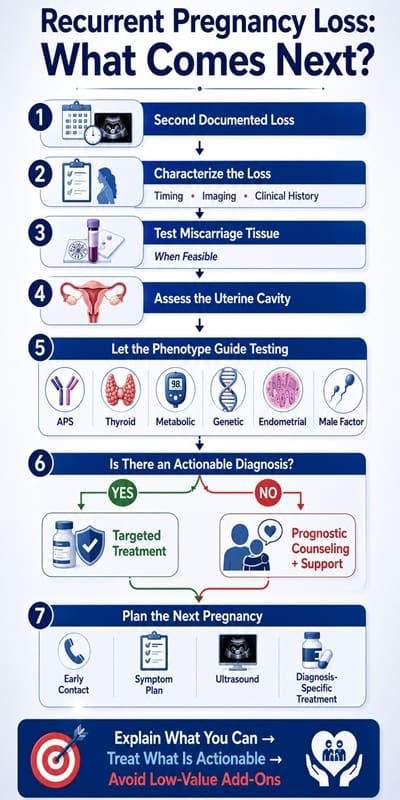
- At or immediately after the second loss: Confirm that the event meets the working RPL definition. Document gestational timing and imaging findings. Arrange chromosome analysis of miscarriage tissue when feasible, including a concrete plan for tissue collection if surgical management is not chosen. Review warning signs for ectopic pregnancy and address acute clinical needs first.[1]
- During the interval evaluation: Review the complete reproductive and medical phenotype. Assess the uterine cavity. Use the tissue result to direct genetic counseling and determine the intensity of further testing. Order TSH and other endocrine tests according to current guidance and clinical context. Test for APS according to the patient’s pregnancy and thrombosis history and the specific practice guideline being followed, then confirm persistence before formally assigning the diagnosis. Reserve parental karyotypes, HbA1c, prolactin, chronic endometritis evaluation, and sperm DNA fragmentation strictly for their defined indications.[1-3]
- Before the next conception: Optimize chronic disease, medications, folate intake, tobacco exposure, and other modifiable health factors. Document clearly in the chart which treatments are indicated, which have been considered and declined, and which are explicitly not recommended. Build a contact plan for a positive pregnancy test, pain, bleeding, and early ultrasound.[1-3]
- In the next pregnancy: Use diagnosis-specific treatment. Confirm pregnancy location when clinically appropriate. For bleeding with a prior miscarriage, consider guideline-supported vaginal micronized progesterone after an intrauterine pregnancy is visualized. For confirmed APS, initiate the agreed-upon anticoagulation plan. Continue ordinary prenatal risk assessment rather than attributing every later obstetric complication to RPL.[1,3,9]
Supportive Care Is a Vital Part of Treatment, but It Must Be Described Honestly
RPL is heavily associated with anxiety, depression, trauma symptoms, guilt, and a profound loss of trust in the body and the healthcare system. A dedicated clinic, continuity of care, rapid access for symptoms, clear communication of results, early ultrasound when appropriate, and mental-health referrals are all evidence-aligned components of comprehensive care.[1-3]
However, psychological support should not be marketed as a biologic cure. Older observational “tender loving care” studies cannot separate the actual effect of surveillance from selection bias, behavioral changes, and other confounding variables. The defensible claim is that structured support provides vital continuity, improves communication, and addresses a serious psychological burden while the ultimate pregnancy outcome remains uncertain.[1-3]
Discussing Prognosis: Reassuring Statistics That Must Not Be Generic
ASRM estimates that 50% to 80% of patients will have a successful subsequent pregnancy without any specific medical intervention. That range is intentionally broad. Maternal age, the number and sequence of losses, prior live births, gestational timing, tissue karyotype, coexisting infertility, and identified diseases all heavily affect an individual’s specific probability.[1]
The correct counseling message is neither that “nothing is wrong” nor that a long, expensive list of add-ons is necessary. The message is that many patients will ultimately have a live birth, a small minority have a specific actionable diagnosis, and unexplained RPL remains a very real, valid clinical condition even when exhaustive testing does not reveal a clear mechanism.[1-3]
Evidence-based RPL care is highly selective, not passive. The high-value sequence is to carefully characterize each loss, obtain miscarriage-tissue chromosome analysis when feasible, evaluate the uterine cavity, and pursue APS, endocrine, metabolic, genetic, endometrial, and male-factor testing only when the clinical phenotype actively supports it.[1-3]
The treatments with the clearest roles are strictly diagnosis-specific: aspirin plus heparin for confirmed APS, correction of overt endocrine disease, individualized treatment of selected uterine pathology, genetic counseling for structural rearrangements, and vaginal micronized progesterone for the specific early-bleeding phenotype covered by NICE and RCOG guidance.
Routine inherited thrombophilia panels, MTHFR testing, empiric anticoagulation, unselected progesterone, immune panels, microbiome testing, empiric antibiotics, automatic uterine surgery, and routine PGT-A should no longer function as default RPL care.[1,3-13]
Clinical Update Disclaimer
This article was reviewed through August 12, 2026. Guidelines, regulatory labeling, safety information, diagnostic standards, and clinical evidence may change. Clinicians should confirm current authoritative guidance, local product labeling, patient-specific contraindications, and specialty recommendations before applying the material to individual patient care.
References
- Practice Committee of the American Society for Reproductive Medicine. Recurrent pregnancy loss: a committee opinion. Fertil Steril. 2026;125(6):1023-1041. https://doi.org/10.1016/j.fertnstert.2026.03.001 PMID: 42062119. Official guidance: https://www.asrm.org/practice-guidance/practice-committee-documents/recurrent-pregnancy-loss-a-committee-opinion-2026/ Accessed August 12, 2026.
- ESHRE Guideline Group on Recurrent Pregnancy Loss; Bender Atik R, Christiansen OB, Elson J, et al. ESHRE guideline: recurrent pregnancy loss: an update in 2022. Hum Reprod Open. 2023;2023(1). https://doi.org/10.1093/hropen/hoad002 PMID: 36873081; PMCID: PMC9982362. Official guidance: https://www.eshre.eu/guidelines-and-legal/guidelines/recurrent-pregnancy-loss Accessed August 12, 2026.
- Regan L, Rai R, Saravelos S, Li TC; Royal College of Obstetricians and Gynaecologists. Recurrent Miscarriage: Green-top Guideline No. 17. BJOG. 2023;130(12). https://doi.org/10.1111/1471-0528.17515 PMID: 37334488. Official guidance: https://www.rcog.org.uk/guidance/browse-all-guidance/green-top-guidelines/recurrent-miscarriage-green-top-guideline-no-17/ Accessed August 12, 2026.
- Metwally M, McKendrick K, Ridsdale K, et al. Removal of small fibroids and polyps in patients with infertility and recurrent miscarriage: The HELP Fertility? RCT. Health Technol Assess. 2026 Feb 25:1-35. https://doi.org/10.3310/GJMM1915 PMID: 41773973; PMCID: PMC12968972. https://pubmed.ncbi.nlm.nih.gov/41773973/ Accessed August 12, 2026.
- Rikken JFW, Kowalik CR, Emanuel MH, et al. Septum resection versus expectant management in women with a septate uterus: an international multicentre open-label randomized controlled trial. Hum Reprod. 2021;36(5):1260-1267. https://doi.org/10.1093/humrep/deab037 PMID: 33793794; PMCID: PMC8058590. https://pubmed.ncbi.nlm.nih.gov/33793794/ Accessed August 12, 2026.
- Haas DM, Bofill Rodriguez M, Hathaway TJ, Ramsey PS. Progestogen for preventing miscarriage in women with recurrent miscarriage of unclear etiology. Cochrane Database Syst Rev. 2025;6. https://doi.org/10.1002/14651858.CD003511.pub6 PMID: 40497447. https://pubmed.ncbi.nlm.nih.gov/40497447/ Accessed August 12, 2026.
- Coomarasamy A, Williams H, Truchanowicz E, et al. A randomized trial of progesterone in women with recurrent miscarriages. N Engl J Med. 2015;373(22):2141-2148. https://doi.org/10.1056/NEJMoa1504927 PMID: 26605928. https://pubmed.ncbi.nlm.nih.gov/26605928/ Accessed August 12, 2026.
- Coomarasamy A, Devall AJ, Cheed V, et al. A randomized trial of progesterone in women with bleeding in early pregnancy. N Engl J Med. 2019;380(19):1815-1824. https://doi.org/10.1056/NEJMoa1813730 PMID: 31067371. https://pubmed.ncbi.nlm.nih.gov/31067371/ Accessed August 12, 2026.
- National Institute for Health and Care Excellence. Ectopic pregnancy and miscarriage: diagnosis and initial management. NICE guideline NG126. Management of miscarriage. Updated June 17, 2026. https://www.nice.org.uk/guidance/ng126/chapter/Management-of-miscarriage Accessed August 12, 2026.
- Kaandorp SP, Goddijn M, van der Post JAM, et al. Aspirin plus heparin or aspirin alone in women with recurrent miscarriage. N Engl J Med. 2010;362(17):1586-1596. https://doi.org/10.1056/NEJMoa1000641 PMID: 20335572. https://pubmed.ncbi.nlm.nih.gov/20335572/ Accessed August 12, 2026.
- Quenby S, Booth K, Hiller L, et al.; ALIFE2 Block Writing Committee and ALIFE2 Investigators. Heparin for women with recurrent miscarriage and inherited thrombophilia (ALIFE2): an international open-label, randomised controlled trial. Lancet. 2023;402(10395):54-61. https://doi.org/10.1016/S0140-6736(23)00693-1 PMID: 37271152. https://pubmed.ncbi.nlm.nih.gov/37271152/ Accessed August 12, 2026.
- Dhillon-Smith RK, Middleton LJ, Sunner KK, et al. Levothyroxine in women with thyroid peroxidase antibodies before conception. N Engl J Med. 2019;380(14):1316-1325. https://doi.org/10.1056/NEJMoa1812537 PMID: 30907987. https://pubmed.ncbi.nlm.nih.gov/30907987/ Accessed August 12, 2026.
- van Dijk MM, Vissenberg R, Fliers E, et al. Levothyroxine in euthyroid thyroid peroxidase antibody-positive women with recurrent pregnancy loss (T4LIFE trial): a multicentre, randomised, double-blind, placebo-controlled, phase 3 trial. Lancet Diabetes Endocrinol. 2022;10(5):322-329. https://doi.org/10.1016/S2213-8587(22)00045-6 PMID: 35298917. https://pubmed.ncbi.nlm.nih.gov/35298917/ Accessed August 12, 2026.
Recent Articles


Integrative Perspectives on Cognition, Emotion, and Digital Behavior

Sleep-related:
Longevity/Nutrition & Diet:
Philosophical / Happiness / Social:
Other:
Modern Mind Unveiled
Developed under the direction of David McAuley, Pharm.D., this collection explores what it means to think, feel, and connect in the modern world. Drawing upon decades of clinical experience and digital innovation, Dr. McAuley and the GlobalRPh initiative translate complex scientific ideas into clear, usable insights for clinicians, educators, and students.
The series investigates essential themes–cognitive bias, emotional regulation, digital attention, and meaning-making—revealing how the modern mind adapts to information overload, uncertainty, and constant stimulation.
At its core, the project reflects GlobalRPh’s commitment to advancing evidence-based medical education and clinical decision support. Yet it also moves beyond pharmacotherapy, examining the psychological and behavioral dimensions that shape how healthcare professionals think, learn, and lead.
Through a synthesis of empirical research and philosophical reflection, Modern Mind Unveiled deepens our understanding of both the strengths and vulnerabilities of the human mind. It invites readers to see medicine not merely as a science of intervention, but as a discipline of perception, empathy, and awareness–an approach essential for thoughtful practice in the 21st century.
The Six Core Themes
I. Human Behavior and Cognitive Patterns
Examining the often-unconscious mechanisms that guide human choice-how we navigate uncertainty, balance logic with intuition, and adapt through seemingly irrational behavior.
II. Emotion, Relationships, and Social Dynamics
Investigating the structure of empathy, the psychology of belonging, and the influence of abundance and selectivity on modern social connection.
III. Technology, Media, and the Digital Mind
Analyzing how digital environments reshape cognition, attention, and identity- exploring ideas such as gamification, information overload, and cognitive “nutrition” in online spaces.
IV. Cognitive Bias, Memory, and Decision Architecture
Exploring how memory, prediction, and self-awareness interact in decision-making, and how external systems increasingly serve as extensions of thought.
V. Habits, Health, and Psychological Resilience
Understanding how habits sustain or erode well-being-considering anhedonia, creative rest, and the restoration of mental balance in demanding professional and personal contexts.
VI. Philosophy, Meaning, and the Self
Reflecting on continuity of identity, the pursuit of coherence, and the construction of meaning amid existential and informational noise.
Keywords
Cognitive Science • Behavioral Psychology • Digital Media • Emotional Regulation • Attention • Decision-Making • Empathy • Memory • Bias • Mental Health • Technology and Identity • Human Behavior • Meaning-Making • Social Connection • Modern Mind
Video Section