The Cervical Screening Shake-Up: Primary HPV Testing, Genotyping, and Real-World Confusion

Abstract
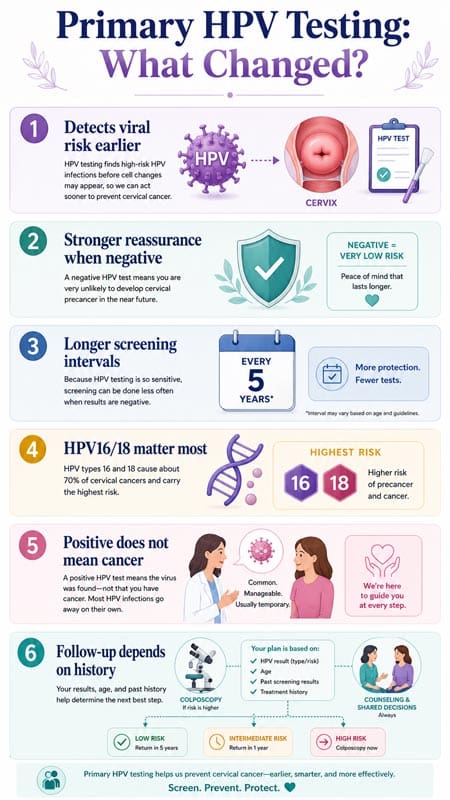
The transition from cytology-centered cervical cancer screening to primary high-risk human papillomavirus testing represents one of the most important changes in preventive gynecologic care. Primary HPV testing is more sensitive than cytology for detecting high-grade cervical pre-cancer and provides stronger reassurance after a negative result, allowing longer screening intervals in average-risk individuals. However, this shift has introduced practical confusion for clinicians and patients. Screening guidelines differ slightly by organization; HPV genotyping now affects triage decisions; self-collected HPV testing is entering clinical practice; and abnormal-result management increasingly depends on individualized risk rather than a simple one-result, one-action algorithm. This review summarizes the evidence supporting primary HPV testing, clarifies the roles of HPV16 and HPV18 and of extended genotyping, reviews current guideline differences, and addresses implementation challenges in patient counseling, workflow, laboratory reporting, and follow-up. The key message is that primary HPV testing is not merely a replacement for the Pap smear. It is part of a more sensitive, risk-based prevention model that requires accurate protocols, clear communication, and reliable follow-up systems. This final draft incorporates corrections to the uploaded article, including nuances of the guidelines, updated self-collection recommendations, expanded genotyping, and reference quality.
Introduction
Cervical cancer screening has changed because the science of cervical carcinogenesis has changed. Persistent infection with oncogenic human papillomavirus is now recognized as the central cause of nearly all cervical cancers. Cytology, traditionally called the Pap smear, detects cellular abnormalities after HPV-related changes have already occurred. Primary HPV testing detects the causal viral risk factor earlier in the disease pathway.
This transition has improved preventive potential but complicated clinical practice. For decades, clinicians and patients understood cervical screening as a Pap test performed at familiar intervals. The modern system is different. Screening may involve primary HPV testing, HPV and cytology co-testing, cytology alone, partial genotyping, extended genotyping, reflex cytology, self-collected vaginal samples, and risk-based management based on current and prior results.
The confusion is not evidence that HPV testing is flawed. It reflects the challenge of moving from a simple cytology-based model to a more sensitive, risk-based model. The clinical task is to use HPV testing in the right age groups, with validated assays, appropriate triage, and follow-up systems that prevent both missed pre-cancer and unnecessary colposcopy.
Why HPV Testing Became Central
Cervical cancer develops through a multistep process in which persistent high-risk HPV infection can lead to cervical intraepithelial neoplasia and, over the years, invasive cancer. Most HPV infections clear spontaneously. The clinical challenge is distinguishing transient infection from infection that is likely to persist and progress.
Cytology has been historically successful and dramatically reduced cervical cancer incidence in screened populations. However, cytology has limitations. It depends on sample adequacy, slide interpretation, and the quality of cytopathology systems. A single cytology test is less sensitive than HPV testing for detecting high-grade cervical pre-cancer.
Primary HPV testing offers two major advantages:
- Higher sensitivity for CIN2+ and CIN3+ than cytology alone.
- Stronger negative predictive value, which supports longer screening intervals after a negative HPV result.
The trade-off is that HPV testing identifies more infections, many of which will never progress. This creates the need for triage strategies that identify patients at the highest immediate risk while avoiding unnecessary procedures in those with transient infection.
Evidence Supporting Primary HPV Testing
Multiple randomized trials and longitudinal studies support HPV-based cervical screening.
The POBASCAM trial in the Netherlands showed that HPV-based screening detected more high-grade disease during the initial screening round and provided better protection against later CIN3+ than cytology-based screening. The NTCC trial in Italy also demonstrated improved detection of clinically significant disease with HPV testing. The ARTISTIC trial in the United Kingdom added important evidence about HPV testing as a predictor of future risk.
Systematic reviews and pooled analyses have consistently shown that HPV-based screening provides greater sensitivity than cytology alone. The improved reassurance after a negative HPV test supports longer screening intervals, typically five years in average-risk individuals when primary HPV testing is used according to guideline recommendations.
However, cytology has higher sensitivity but lower specificity than in some settings. This means more positive tests, more need for triage, and potentially more colposcopy referrals if protocols are not carefully designed. The success of primary HPV screening, therefore, depends not just on the test but on the triage system surrounding it.
U.S. Guideline Nuance: Not All Organizations Say the Same Thing
A major source of confusion is that U.S. organizations have not always issued identical screening recommendations.
American Cancer Society
The American Cancer Society 2020 guideline recommends starting cervical cancer screening at age 25 for average-risk individuals and prefers primary HPV testing every five years through age 65. If primary HPV testing is not available, cotesting every five years or cytology alone every three years is acceptable.
USPSTF
The 2024 USPSTF draft recommendation retains cytology alone every three years for ages 21 to 29. For ages 30 to 65, it recommends primary high-risk HPV testing every five years using clinician-collected or patient-collected samples. It also lists cytology alone every three years or cotesting every five years as options for this age group.
ASCCP
ASCCP guidelines primarily address the management of abnormal results, not the selection of routine screening. The 2019 ASCCP risk-based management framework uses current results plus prior history to estimate immediate and five-year CIN3+ risk. This is why the same HPV result may lead to different management depending on a patient’s screening history, prior colposcopy results, and prior treatment.
Practical interpretation
Clinicians should avoid claiming that there is a single universal U.S. screening rule. A more accurate message is:
Primary HPV testing is increasingly preferred or emphasized for cervical cancer screening, but age thresholds and acceptable alternatives vary by guideline organization and local implementation.
Screening Strategies Compared
| Strategy | Typical age group or use | Strengths | Limitations |
| Cytology alone | Commonly ages 21 to 29 under many guidelines | Familiar, specific, inexpensive | Lower sensitivity than HPV testing |
| Primary HPV testing | Preferred by ACS from 25 to 65; recommended by USPSTF draft from 30 to 65 | Highest simplicity among HPV-based strategies, strong negative reassurance | Requires genotype-aware triage and patient counseling |
| Cotesting | HPV plus cytology | Very high sensitivity | More complex, more positives, may increase unnecessary follow-up |
| HPV with partial genotyping | HPV16 and HPV18 reported separately | Improves risk stratification | Requires clear management algorithms |
| HPV with extended genotyping | Additional high-risk types are reported separately or in groups | More refined risk stratification | Implementation depends on validated assays and guideline-based pathways |
| Self-collected HPV testing | Emerging option for average-risk asymptomatic individuals | May improve access and participation | Follow-up triage and specimen-type rules are essential |
Role of HPV16 and HPV18 Genotyping
Not all high-risk HPV types carry the same risk. HPV16 is the most carcinogenic type and is responsible for the largest proportion of cervical cancers. HPV18 is also highly important, especially because it is associated with adenocarcinoma and may be harder to detect through cytology alone.
Partial genotyping, especially separate reporting of HPV16 and HPV18, is now central to risk-based management. ASCCP guidance emphasizes that HPV16 and HPV18 infections carry the highest risk for CIN3 and occult cancer and therefore require additional evaluation even when cytology is negative.
A simplified management concept is:
| Result | General management concept |
| HPV negative | Return to the routine screening interval |
| HPV16 positive | Colposcopy or additional evaluation, even if cytology is negative |
| HPV18 positive | Colposcopy or additional evaluation, even if cytology is negative |
| Other high-risk HPV-positive individuals with abnormal cytology | Usually, colposcopy, depending on the abnormality and history |
| Other high-risk HPV positive with NILM cytology | Often, one-year surveillance, but history and genotype may modify management |
| Persistent HPV positivity | Risk increases and often leads to colposcopy |
This table is simplified. Final management should use ASCCP risk-based tools and account for prior screening history.
Extended Genotyping: Moving Into Clinical Management
The original article described extended genotyping as largely investigational. That is no longer fully accurate. Extended genotyping is increasingly being incorporated into clinical management as FDA-approved assays provide more type-specific information beyond HPV16 and HPV18.
The 2025 Enduring Consensus recommendations provide management guidance for extended genotyping results. These recommendations recognize that HPV types such as HPV31, HPV33, HPV45, HPV52, and HPV58 carry different risk levels than pooled “other high-risk HPV” categories. Extended genotyping can help determine which patients need colposcopy and which can be followed with surveillance.
The practical message is:
Extended genotyping should not be interpreted ad hoc. It should be used only with validated assays and guideline-based management pathways.
Self-Collected HPV Testing
Self-collection is one of the most important recent developments in cervical screening. HPV testing can be performed on vaginal samples collected by the patient, which may reduce barriers for individuals who are underscreened, live far from clinical services, have trauma histories, lack transportation, or avoid pelvic examinations.
The 2025 Enduring Consensus recommendations state that clinician-collected cervical specimens are preferred, but self-collected vaginal specimens are acceptable for primary HPV screening of asymptomatic average-risk individuals. Management depends on HPV results and genotype. HPV16 or HPV18 positivity on a self-collected sample generally warrants colposcopy with cytology collection, whereas other high-risk HPV results may require triage or repeat testing, depending on the specific genotype and assay.
Self-collection is not simply mailing any swab to any lab. It requires:
- Approved or validated HPV assays.
- Clear patient instructions.
- Reliable specimen handling.
- Result reporting that supports management.
- Follow-up systems for positive results.
- Access to clinician-collected cytology or colposcopy when indicated.
Self-collection expands access, but it does not eliminate the need for organized follow-up.
Why Real-World Confusion Happens
1. Patients still think in terms of Pap smears
Many patients equate cervical screening with “getting a Pap.” They may not understand that HPV testing is different, more sensitive, and often allows longer intervals after a negative result.
2. A positive HPV result can feel stigmatizing
HPV is sexually transmitted, common, often transient, and usually cleared by the immune system. Yet patients may interpret a positive result as evidence of infidelity, promiscuity, or imminent cancer. Counseling must be careful, factual, and nonjudgmental.
3. Longer screening intervals feel unsafe to some patients
Patients accustomed to annual Pap smears may worry that five-year intervals are too long. Clinicians should explain that a negative HPV test provides stronger reassurance than a negative cytology result.
4. Clinicians may confuse screening and management guidelines
Screening guidelines answer the question: “Which test, at what age, and how often?”
Management guidelines answer the question: “What do we do with this result, given this patient’s history?”
Mixing these two categories creates confusion.
5. EHR systems may not support risk-based management
ASCCP management depends on current results and prior history. If electronic health records do not clearly display prior HPV, cytology, colposcopy, and treatment history, clinicians may make overly aggressive or insufficient follow-up decisions.
Patient Counseling: Better Language
Clinicians need clear language for HPV results.
For a negative HPV test
Your HPV test is negative. That means we did not detect the high-risk HPV types that cause most cervical cancers. This gives strong reassurance, which is why the screening interval can be longer than it was with older Pap-only testing.
For a positive high-risk HPV test
This does not mean you have cancer. HPV is very common, and most infections clear on their own. The reason we follow it carefully is that persistent high-risk HPV can cause cervical cell changes over time.
For HPV16 or HPV18 positivity
HPV16 and HPV18 are higher-risk types. Because they carry a higher chance of significant cervical changes, we usually evaluate more closely with colposcopy or additional testing, even if the Pap result is normal.
For other high-risk HPVs with normal cytology
Your result shows a high-risk HPV type, but your cells look normal. In many cases, the safest approach is repeat testing in about one year to see whether the infection clears or persists.
For self-collected testing
Self-collection can be a valid way to screen for HPV, but if the result is positive, you may still need a clinician-collected sample, cytology, or colposcopy, depending on the type of HPV detected.
Implementation Requirements
Primary HPV screening works best as a system, not just a lab order.
Successful implementation requires:
- Validated HPV assays.
- Clear age-based screening protocols.
- Reflex cytology workflows when needed.
- Genotyping result reporting.
- ASCCP-compatible management tools.
- EHR reminders and result tracking.
- Patient education materials.
- Colposcopy capacity planning.
- Follow-up systems for abnormal results.
- Quality assurance monitoring.
Without these supports, primary HPV testing can produce confusion, over-referral, under-follow-up, patient anxiety, and inconsistent care.

Cost-Effectiveness
Primary HPV testing can be cost-effective when implemented correctly. The key conditions are:
- Appropriate screening intervals.
- Avoidance of unnecessary annual testing.
- Evidence-based triage of HPV-positive results.
- Reliable follow-up of abnormal results.
- Avoidance of excessive cotesting when primary HPV alone is sufficient.
- Adequate screening participation.
If health systems continue annual screening or overuse cotesting, many of the economic advantages of primary HPV testing are lost. The value of HPV testing depends on trusting its negative predictive value and following guideline-based intervals.
High-Risk and Special Populations
Average-risk screening recommendations do not apply to everyone. Modified screening may be needed for:
- Individuals with HIV.
- Immunocompromised patients.
- Organ transplant recipients.
- Patients with prior CIN2, CIN3, AIS, or cervical cancer.
- Patients exposed to diethylstilbestrol in utero.
- Patients with prior abnormal results requiring surveillance.
- Patients after treatment for high-grade lesions.
These groups often require more intensive surveillance and should be managed in accordance with specialty guidance.
Emerging Biomarkers and Future Directions
p16/Ki-67 dual stain
Dual-stain testing can help identify HPV-positive patients whose cells show markers of transforming infection. It may reduce unnecessary colposcopy while identifying patients at higher risk.
Methylation testing
DNA methylation markers are being studied as triage tools for HPV-positive individuals. These tests may help distinguish transient infection from lesions more likely to progress.
Artificial intelligence
AI tools may improve cytology interpretation, colposcopy image assessment, risk prediction, and workflow support. These technologies require careful validation before widespread implementation.
Vaccination-informed screening
As HPV-vaccinated cohorts age into screening programs, future recommendations may more explicitly incorporate vaccination status. Vaccinated individuals remain in need of screening because current vaccines do not eliminate all oncogenic HPV risk, but their overall risk profile may differ.
Common Clinical Mistakes
| Mistake | Why it matters |
| Treating HPV positivity as cancer | Increases patient anxiety and miscommunication |
| Ignoring HPV16 or HPV18 genotype | Misses higher-risk results requiring evaluation |
| Sending all HPV-positive patients directly to colposcopy | Causes unnecessary procedures |
| Repeating HPV tests too soon without indication | Increases cost and anxiety |
| Continuing annual screening after a negative primary HPV | Reduces cost-effectiveness and increases harms |
| Using screening guidelines for abnormal result management | Management should follow ASCCP risk-based algorithms |
| Failing to track abnormal results | Positive HPV tests require reliable follow-up |
| Assuming vaccinated patients need no screening | Vaccination reduces risk but does not eliminate the need for screening |
| Treating self-collection as a stand-alone solution | Positive results still require structured follow-up |
| Using extended genotyping without a guideline pathway | Creates inconsistent management |
Practical Clinical Algorithm
Step 1: Determine eligibility
Confirm age, cervix status, prior hysterectomy details, pregnancy status if relevant, immunosuppression, HIV status, prior CIN2+ history, and prior cervical cancer treatment.
Step 2: Select the screening strategy
Use local guideline-based options. For average-risk individuals, primary HPV testing is increasingly preferred where available. Cytology or cotesting may remain acceptable depending on age, guidelines, and system capacity.
Step 3: Interpret genotype
Identify HPV16, HPV18, and, where available, extended genotyping categories. Do not treat all high-risk HPV types as identical.
Step 4: Apply risk-based management
Use ASCCP risk-based tools when results are abnormal. Prior results matter.
Step 5: Counsel clearly
Explain that HPV is common, often clears, and only a persistent high-risk infection increases cancer risk.
Step 6: Track follow-up
Every positive screen should have a documented follow-up plan and tracking mechanism.
Primary HPV testing is more sensitive than cytology alone for detecting high-grade cervical pre-cancer.
A negative HPV test provides strong reassurance and supports longer screening intervals in average-risk individuals.
U.S. guidelines differ slightly across organizations, especially regarding starting age and preferred strategy.
HPV16 and HPV18 carry the highest risk and usually require colposcopy or additional evaluation even when cytology is negative.
Extended genotyping is increasingly entering guideline-based management and should be interpreted using validated algorithms.
Self-collected HPV testing is now an acceptable option for primary HPV screening of asymptomatic average-risk individuals when approved assays and follow-up systems are in place.
ASCCP management is risk-based, meaning prior history changes the recommended action.
The major challenge is not test performance. It is implementation, communication, and follow-up.
The shift to primary HPV testing is a major advance in cervical cancer prevention. It detects risk earlier than cytology, provides stronger reassurance after a negative result, and allows longer screening intervals when used correctly. But the shift also creates confusion because clinicians and patients must move from a familiar Pap-centered model to a more sensitive, genotype-aware, risk-based approach.
The future of cervical screening will likely include broader primary HPV testing, self-collection, extended genotyping, molecular triage, and more personalized risk assessment. These tools can reduce cervical cancer only if health systems support correct use, clear counseling, and reliable follow-up.
The practical message is straightforward: primary HPV testing is powerful, but it is not self-explanatory. Its success depends on validated assays, age-appropriate screening, genotype-aware triage, ASCCP risk-based management, patient-centered communication, and systems that ensure no abnormal result is lost.
Frequently Asked Questions
What is the difference between HPV testing and a Pap smear?
HPV testing detects high-risk HPV types that can cause cervical cancer. A Pap smear examines cervical cells for abnormalities. HPV testing identifies risk earlier in the disease pathway.
Is HPV testing more accurate than cytology?
HPV testing is more sensitive for detecting high-grade cervical pre-cancer. Cytology is more specific in some settings, which is why HPV-positive results often need triage.
Why can screening intervals be longer with HPV testing?
A negative high-risk HPV test provides strong reassurance that the near-term risk of cervical pre-cancer is low. This supports longer screening intervals in average-risk individuals.
What does a positive HPV test mean?
It means high-risk HPV was detected. It does not mean cancer is present. Most HPV infections clear naturally, but persistent infection requires follow-up.
Why are HPV16 and HPV18 important?
HPV16 and HPV18 carry a higher cancer risk than many other high-risk types. Positive results usually require colposcopy or additional evaluation, even if cytology is normal.
What is extended genotyping?
Extended genotyping reports additional high-risk HPV types beyond HPV16 and HPV18. It can refine risk assessment, but management should follow validated guideline algorithms.
Can patients collect their own HPV sample?
Yes, self-collected vaginal specimens are now acceptable for primary HPV screening of asymptomatic average-risk individuals when appropriate assays and follow-up systems are used. Clinician-collected cervical specimens remain preferred.
Do vaccinated individuals still need screening?
Yes. HPV vaccination reduces risk but does not eliminate the need for cervical cancer screening.
Should all HPV-positive patients go to colposcopy?
No. Management depends on genotype, cytology, prior history, and ASCCP risk estimates.
Why is there so much confusion?
The field is moving from a simple Pap-centered model to a risk-based model that incorporates HPV status, genotype, cytology, prior history, and sometimes self-collection. Better systems and counseling are needed.
References
American Cancer Society. (2020). Cervical cancer screening for individuals at average risk: 2020 guideline update. American Cancer Society.
Arbyn, M., Ronco, G., Anttila, A., Meijer, C. J. L. M., Poljak, M., Ogilvie, G., Koliopoulos, G., Naucler, P., Sankaranarayanan, R., & Peto, J. (2012). Evidence regarding human papillomavirus testing in secondary prevention of cervical cancer. Vaccine, 30(Suppl 5), F88–F99.
Arbyn, M., Snijders, P. J. F., Meijer, C. J. L. M., Berkhof, J., Cuschieri, K., Kocjan, B. J., & Poljak, M. (2014). Which high-risk HPV assays fulfil criteria for use in primary cervical cancer screening? Clinical Microbiology and Infection, 21(9), 817–826.
Arbyn, M., Smith, S. B., Temin, S., Sultana, F., Castle, P. E., & Collaboration on Self-Sampling and HPV Testing. (2018). Detecting cervical pre-cancer and reaching underscreened women by using HPV testing on self samples: Updated meta-analyses. BMJ, 363, k4823.
Arbyn, M., Verdoodt, F., Snijders, P. J. F., Verhoef, V. M. J., Suonio, E., Dillner, L., Minozzi, S., Bellisario, C., Banzi, R., Zhao, F. H., Hillemanns, P., & Anttila, A. (2017). Accuracy of human papillomavirus testing on self-collected versus clinician-collected samples: A meta-analysis. The Lancet Oncology, 18(2), 269–280.
Burger, E. A., Ortendahl, J. D., Sy, S., Kristiansen, I. S., & Kim, J. J. (2017). Cost-effectiveness of cervical cancer screening with primary human papillomavirus testing in Norway. British Journal of Cancer, 117(2), 1571–1578.
Fontham, E. T. H., Wolf, A. M. D., Church, T. R., Etzioni, R., Flowers, C. R., Herzig, A., Guerra, C. E., Oeffinger, K. C., Shih, Y. C. T., Walter, L. C., Kim, J. J., Andrews, K. S., DeSantis, C. E., Fedewa, S. A., Manassaram-Baptiste, D., Saslow, D., Wender, R. C., & Smith, R. A. (2020). Cervical cancer screening for individuals at average risk: 2020 guideline update from the American Cancer Society. CA: A Cancer Journal for Clinicians, 70(5), 321–346.
Kitchener, H. C., Almonte, M., Thomson, C., Wheeler, P., Sargent, A., Stoykova, B., Gilham, C., Baysson, H., Roberts, C., Dowie, R., Desai, M., Mather, J., Bailey, A., Turner, A., Moss, S., & ARTISTIC Trial Study Group. (2009). HPV testing in combination with liquid-based cytology in primary cervical screening: ARTISTIC, a randomised controlled trial. The Lancet Oncology, 10(7), 672–682.
Lew, J. B., Simms, K. T., Smith, M. A., Hall, M., Kang, Y. J., Xu, X. M., Caruana, M., Velentzis, L. S., Bessell, T., Saville, M., Hammond, I., & Canfell, K. (2019). Primary HPV testing versus cytology-based cervical screening in women in Australia vaccinated for HPV and unvaccinated: Effectiveness and economic assessment for the National Cervical Screening Program. The Lancet Public Health, 4(2), e96–e107.
Luttmer, R., De Strooper, L. M. A., Berkhof, J., Snijders, P. J. F., Dijkstra, M. G., Uijterwaal, M. H., Steenbergen, R. D. M., & Meijer, C. J. L. M. (2016). Comparing the performance of FAM19A4 methylation analysis, cytology and HPV16/18 genotyping for the detection of cervical pre-cancer and cancer in high-risk HPV-positive women. International Journal of Cancer, 138(4), 992–1002.
McCaffery, K., Waller, J., Forrest, S., Cadman, L., Szarewski, A., & Wardle, J. (2004). Testing positive for human papillomavirus in routine cervical screening: Examination of psychosocial impact. BJOG: An International Journal of Obstetrics and Gynaecology, 111(12), 1437–1443.
Nayar, R., Chhieng, D. C., Crothers, B. A., Darragh, T. M., Davey, D. D., Eisenhut, C., Goulart, R. A., Huang, E. C., Kurtycz, D. F. I., Maygarden, S. J., Moriarty, A. T., Shidham, V. B., & Wilbur, D. C. (2021). Moving forward, the 2019 ASCCP risk-based management consensus guidelines for abnormal cervical cancer screening tests and cancer precursors and beyond. Journal of the American Society of Cytopathology, 10(6), 562–570.
Perkins, R. B., Guido, R. S., Castle, P. E., Chelmow, D., Einstein, M. H., Garcia, F., Huh, W. K., Kim, J. J., Moscicki, A. B., Nayar, R., Saraiya, M., Sawaya, G. F., Wentzensen, N., Schiffman, M., & 2019 ASCCP Risk-Based Management Consensus Guidelines Committee. (2020). 2019 ASCCP risk-based management consensus guidelines for abnormal cervical cancer screening tests and cancer precursors. Journal of Lower Genital Tract Disease, 24(2), 102–131.
Rijkaart, D. C., Berkhof, J., Rozendaal, L., van Kemenade, F. J., Bulkmans, N. W. J., Heideman, D. A. M., Kenter, G. G., Cuzick, J., Snijders, P. J. F., & Meijer, C. J. L. M. (2012). Human papillomavirus testing for the detection of high-grade cervical intraepithelial neoplasia and cancer: Final results of the POBASCAM randomised controlled trial. The Lancet Oncology, 13(1), 78–88.
Ronco, G., Giorgi-Rossi, P., Carozzi, F., Confortini, M., Dalla Palma, P., Del Mistro, A., Ghiringhello, B., Girlando, S., Gillio-Tos, A., De Marco, L., Naldoni, C., Pierotti, P., Rizzolo, R., Schincaglia, P., Zorzi, M., Zappa, M., Segnan, N., Cuzick, J., & New Technologies for Cervical Cancer Screening Working Group. (2010). Efficacy of human papillomavirus testing for the detection of invasive cervical cancers and cervical intraepithelial neoplasia: A randomised controlled trial. The Lancet Oncology, 11(3), 249–257.
Saville, M., Hawkes, D., Keung, M. H. T., Ip, E. L. Y., Silvers, J., Sultana, F., Malloy, M. J., Velentzis, L., Ip, E., & Garland, S. M. (2018). Analytical performance of HPV assays on vaginal self-collected versus practitioner-collected cervical samples: The SCreenWell study. Journal of Clinical Virology, 107, 52–60.
Schiffman, M., Burk, R. D., Boyle, S., Raine-Bennett, T., Katki, H. A., Gage, J. C., Wentzensen, N., Kornegay, J. R., Aldrich, C., Tam, T., Erlich, H., Apple, R., Befano, B., Castle, P. E., & Raine-Bennett, T. (2015). A study of genotyping for management of human papillomavirus-positive, cytology-negative cervical screening results. Journal of Clinical Microbiology, 53(1), 52–59.
Schiffman, M., Kinney, W. K., Cheung, L. C., Gage, J. C., Fetterman, B., Poitras, N. E., Lorey, T., Wentzensen, N., Castle, P. E., & Befano, B. (2018). Relative performance of HPV and cytology components of cotesting in cervical screening. Journal of the National Cancer Institute, 110(5), 501–508.
United States Preventive Services Task Force. (2024). Draft recommendation statement: Cervical cancer screening. United States Preventive Services Task Force.
Wentzensen, N., Massad, L. S., Mayeaux, E. J., Jr., Khan, M. J., Waxman, A. G., Einstein, M. H., Conageski, C., Schiffman, M., Gold, M. A., Apgar, B. S., Guido, R. S., & ASCCP Colposcopy Standards Committee. (2025). Enduring consensus cervical cancer screening and management guidelines: Extended genotyping evidence summary and recommendations. Journal of Lower Genital Tract Disease. Advance online publication.
Wentzensen, N., Massad, L. S., Mayeaux, E. J., Jr., Khan, M. J., Waxman, A. G., Einstein, M. H., Conageski, C., Schiffman, M., Gold, M. A., Apgar, B. S., Guido, R. S., & ASCCP Colposcopy Standards Committee. (2025). Enduring consensus cervical cancer screening and management guidelines: Self-collected vaginal specimens for HPV testing. Journal of Lower Genital Tract Disease. Advance online publication.
Wentzensen, N., Fetterman, B., Castle, P. E., Schiffman, M., Wood, S. N., Stiemerding, E., Poitras, N. E., Lorey, T., Kinney, W. K., & Tokugawa, D. (2015). p16/Ki-67 dual stain cytology for detection of cervical pre-cancer in HPV-positive women. Journal of the National Cancer Institute, 107(12), djv257.
World Health Organization. (2021). WHO guideline for screening and treatment of cervical pre-cancer lesions for cervical cancer prevention (2nd ed.). World Health Organization.
Wright, T. C., Jr., Stoler, M. H., Behrens, C. M., Sharma, A., Zhang, G., Wright, T. L., & ATHENA Study Group. (2015). Primary cervical cancer screening with human papillomavirus: End of study results from the ATHENA study using HPV as the first-line screening test. Gynecologic Oncology, 136(2), 189–197.
Recent Articles


Integrative Perspectives on Cognition, Emotion, and Digital Behavior

Sleep-related:
Longevity/Nutrition & Diet:
Philosophical / Happiness / Social:
Other:
Modern Mind Unveiled
Developed under the direction of David McAuley, Pharm.D., this collection explores what it means to think, feel, and connect in the modern world. Drawing upon decades of clinical experience and digital innovation, Dr. McAuley and the GlobalRPh initiative translate complex scientific ideas into clear, usable insights for clinicians, educators, and students.
The series investigates essential themes–cognitive bias, emotional regulation, digital attention, and meaning-making—revealing how the modern mind adapts to information overload, uncertainty, and constant stimulation.
At its core, the project reflects GlobalRPh’s commitment to advancing evidence-based medical education and clinical decision support. Yet it also moves beyond pharmacotherapy, examining the psychological and behavioral dimensions that shape how healthcare professionals think, learn, and lead.
Through a synthesis of empirical research and philosophical reflection, Modern Mind Unveiled deepens our understanding of both the strengths and vulnerabilities of the human mind. It invites readers to see medicine not merely as a science of intervention, but as a discipline of perception, empathy, and awareness–an approach essential for thoughtful practice in the 21st century.
The Six Core Themes
I. Human Behavior and Cognitive Patterns
Examining the often-unconscious mechanisms that guide human choice-how we navigate uncertainty, balance logic with intuition, and adapt through seemingly irrational behavior.
II. Emotion, Relationships, and Social Dynamics
Investigating the structure of empathy, the psychology of belonging, and the influence of abundance and selectivity on modern social connection.
III. Technology, Media, and the Digital Mind
Analyzing how digital environments reshape cognition, attention, and identity- exploring ideas such as gamification, information overload, and cognitive “nutrition” in online spaces.
IV. Cognitive Bias, Memory, and Decision Architecture
Exploring how memory, prediction, and self-awareness interact in decision-making, and how external systems increasingly serve as extensions of thought.
V. Habits, Health, and Psychological Resilience
Understanding how habits sustain or erode well-being-considering anhedonia, creative rest, and the restoration of mental balance in demanding professional and personal contexts.
VI. Philosophy, Meaning, and the Self
Reflecting on continuity of identity, the pursuit of coherence, and the construction of meaning amid existential and informational noise.
Keywords
Cognitive Science • Behavioral Psychology • Digital Media • Emotional Regulation • Attention • Decision-Making • Empathy • Memory • Bias • Mental Health • Technology and Identity • Human Behavior • Meaning-Making • Social Connection • Modern Mind
Video Section