Can Bispecific Antibodies Move Safely Into the Outpatient Clinic? A Label-Concordant Framework for Clinicians

Abstract
Purpose: This review assesses whether CD3-engaging bispecific antibody therapy can be delivered safely in outpatient oncology settings, with emphasis on cytokine release syndrome, immune effector cell-associated neurotoxicity syndrome, infection prevention, patient selection, and operational readiness.
Methodology: This review integrates current U.S. prescribing information, FDA labeling, pivotal clinical trials, consensus recommendations, and recent practice-implementation literature relevant to approved T-cell-redirecting bispecific antibodies for hematologic malignancies and extensive-stage small cell lung cancer.
Main Findings: Selected portions of bispecific antibody therapy can be delivered in outpatient settings for appropriately selected patients, but outpatient delivery is not a class-wide default. Site of care depends on the specific agent, indication, formulation, dose phase, label-required monitoring, Risk Evaluation and Mitigation Strategy requirements, comorbidities, caregiver support, and access to immediate rescue and escalation pathways. Published outpatient experience is encouraging but remains concentrated in highly structured programs and does not override current prescribing information.
Conclusion: The outpatient question is best framed as a systems question: Can this clinic deliver this specific dose to this specific patient with label-concordant monitoring and rapid escalation capacity?
Keywords: bispecific antibodies, cytokine release syndrome, ICANS, outpatient oncology, multiple myeloma, lymphoma, small cell lung cancer, step-up dosing
Introduction
Bispecific antibodies have moved rapidly from specialized immune-effector-cell programs into routine oncology practice. In relapsed or refractory multiple myeloma, B-cell lymphomas, and extensive-stage small cell lung cancer, CD3-engaging bispecific antibodies provide an off-the-shelf immune-redirection strategy for patients with serious malignancies and, in many approved settings, limited therapeutic options. Several agents are administered subcutaneously, individualized cell manufacturing is not required, and treatment can often continue in a standard oncology clinic after the agent-specific highest-risk initiation period.
That practical appeal can obscure the central safety issue. CD3-engaging bispecific antibodies activate endogenous T cells and may cause cytokine release syndrome (CRS), neurologic toxicity including immune effector cell-associated neurotoxicity syndrome (ICANS), cytopenias, hypogammaglobulinemia, serious infections, hepatotoxicity, and agent-specific adverse effects. In pivotal studies, most CRS events were grade 1 or 2. However, serious, life-threatening, and fatal reactions are also recognized in current U.S. labels. ICANS may occur concurrently with CRS, after CRS resolves, or in the absence of CRS.
The clinical question is therefore not whether bispecific antibodies can ever be administered outside the hospital. Many continuation doses and selected early doses can be. The more important question is whether outpatient delivery can be expanded without weakening the safety infrastructure needed to identify and manage time-sensitive immune effector cell toxicities.
Scope of This Review
This article focuses on currently relevant CD3-engaging T-cell-redirecting bispecific antibodies used in oncology, including BCMA-, GPRC5D-, CD20-, and DLL3-directed agents. It does not provide a detailed operational review of blinatumomab, whose continuous-infusion logistics and acute lymphoblastic leukemia protocols are distinct. It also does not address non-CD3 bispecific antibodies, such as EGFR-MET-directed agents, whose mechanisms, toxicity patterns, and outpatient considerations differ substantially.
Current indications and dosing schedules continue to evolve. For example, the March 2026 TECVAYLI label includes teclistamab in combination with daratumumab and hyaluronidase-fihj after at least one prior line of therapy, as well as later-line teclistamab monotherapy. EPKINLY labeling now includes large B-cell lymphoma and follicular lymphoma settings. The current prescribing information for each agent and formulation must therefore be reviewed whenever an outpatient protocol is created or revised.
Why the Outpatient Question Matters Now
Pressure to move bispecific antibody therapy into outpatient care is substantial. Inpatient step-up dosing uses up hospital space, raises costs, may slow down treatment, and adds stress for patients far from care centers. For older adults, patients with advanced malignancies, and those with limited caregiver or transportation resources, hospitalization for observation may become a meaningful component of treatment burden.
Outpatient initiation is not simply an administrative substitute for hospitalization. CRS may begin with fever alone and progress to hypotension, hypoxia, arrhythmia, renal injury, capillary-leak physiology, or intensive care needs. ICANS may first show mild changes in cognitive skills, language, handwriting, attention, or gait. Then, it can progress to seizures or a depressed level of consciousness. Infection risk may continue long after the step-up period. This is especially true for patients with multiple myeloma. They are at higher risk if they develop hypogammaglobulinemia, neutropenia, or have impaired vaccine responses.
Safe outpatient care requires distinguishing three operational scenarios:
- Routine outpatient continuation dosing after the agent-specific highest-risk initiation period.
- Outpatient administration of selected early doses only when the product label permits outpatient or risk-based monitoring, with appropriate patient selection and safety infrastructure.
- Outpatient management of symptoms that arise after a patient has left the clinic.
These scenarios require different workflows, staffing, monitoring intensity, caregiver expectations, and escalation plans. They should not be conflated.
FDA Labeling Sets the Floor for Site-of-Care Decisions
The key rule is that outpatient delivery must be specific to the agent, formulation, indication, and dose. A generic “bispecific antibody pathway” is not adequate. Current prescribing information, rather than institutional convenience or class-based assumptions, establishes the minimum safety boundary.
Multiple Myeloma
Current U.S. labeling remains restrictive during step-up dosing for several myeloma bispecific antibodies:
- Teclistamab: Patients should be hospitalized for 48 hours after both step-up doses. After the first treatment dose, patients should remain near a healthcare facility and undergo daily monitoring for 48 hours. Teclistamab is subject to a REMS.
- Talquetamab: Patients should be hospitalized for 48 hours after every dose within the applicable step-up dosing schedule. The schedule includes the first full treatment dose. Talquetamab is subject to a REMS.
- Elranatamab: Patients should be hospitalized for 48 hours after the first step-up dose and 24 hours after the second step-up dose. Elranatamab is subject to a REMS.
- Linvoseltamab: Patients should be hospitalized for 24 hours after each of the first two step-up doses. Linvoseltamab is subject to a REMS.
These instructions limit outpatient step-up models, even if past experiences show they work well at skilled centers. A published outpatient teclistamab program demonstrated that structured outpatient administration can be operationally feasible, but patients still experienced CRS, ICANS, and unplanned hospital admissions. Such reports inform implementation research but do not supersede current U.S. labeling.
Lymphoma
Site-of-care language differs substantially among CD20-directed agents.
For epcoritamab, the timing of the first 48 mg dose varies by indication. Current labeling directs clinicians to assess whether hospitalization or outpatient monitoring is appropriate after the first 48 mg dose based on comorbidities and other situational factors. Patients monitored as outpatients should remain near a healthcare facility capable of assessing and managing CRS. For large B-cell lymphoma, the first 48 mg dose occurs on Cycle 1 Day 15; for follicular lymphoma, it occurs on Cycle 1 Day 22.
Glofitamab labeling requires hospitalization during and for 24 hours after completion of the initial 2.5 mg step-up dose. Patients who experienced any-grade CRS with that dose should be hospitalized during and for 24 hours after the subsequent 10 mg step-up dose. For later infusions, patients who experienced grade 2 or higher CRS with the preceding infusion should be hospitalized during and for 24 hours after the next infusion. Delayed or missed dosing may also trigger agent-specific restart and monitoring requirements.
Mosunetuzumab is available in two U.S. formulations:
- LUNSUMIO: Intravenous mosunetuzumab.
- LUNSUMIO VELO: Subcutaneous mosunetuzumab.
The formulations have different dosing, preparation, administration, and step-up instructions. They are not interchangeable and should not be substituted for one another. Both carry boxed warnings for CRS and require formulation-specific step-up dosing, premedication, monitoring, and adverse-reaction management. Order sets, pharmacy verification procedures, treatment plans, and electronic health record alerts should identify the formulation explicitly to reduce medication-error risk.
Extensive-Stage Small Cell Lung Cancer
For tarlatamab, monitoring requirements are dose-phase dependent. Current labeling requires monitoring from the start of infusion for 22 to 24 hours after Cycle 1 Day 1 and Cycle 1 Day 8 in an appropriate healthcare setting. Patients should remain within 1 hour of an appropriate healthcare setting for a total of 48 hours from the start of the infusions. A caregiver should also accompany them during this time. Later doses have shorter scheduled observation periods unless an adverse reaction, dose delay, or restart requirement changes the monitoring plan.
These differences are not administrative details. They define the minimum site-of-care and monitoring requirements for each product.
Evidence Base: Established Antitumor Activity, Less Mature Outpatient Evidence
The antitumor activity supporting currently approved bispecific antibodies is established in several disease settings, although much of the foundational evidence came from single-arm trials in heavily pretreated populations.
Teclistamab produced clinically meaningful and durable responses in MajesTEC-1. Elranatamab demonstrated activity in MagnetisMM-3. Talquetamab established GPRC5D as a clinically relevant target in heavily pretreated multiple myeloma. Linvoseltamab produced deep responses in LINKER-MM1.
In lymphoma, epcoritamab, glofitamab, and intravenous mosunetuzumab demonstrated clinically meaningful activity in relapsed or refractory B-cell malignancies. These pivotal studies also documented CRS, cytopenias, infections, and neurologic adverse events, reinforcing the need for step-up dosing and structured monitoring.
In extensive-stage small cell lung cancer, the randomized DeLLphi-304 trial found longer overall survival with tarlatamab than with investigator-selected chemotherapy after progression during or after platinum-based treatment. Those results supported conversion from accelerated to traditional FDA approval in November 2025.
These efficacy data support clinical use in approved settings, but they do not establish that initial administration can be moved broadly into unmonitored outpatient environments. Pivotal studies used protocolized monitoring, defined eligibility criteria, trained investigators, premedication, dose-modification rules, and rapid access to supportive care. Their findings might not apply to clinics lacking similar expertise or rescue options.
Published outpatient experience is heterogeneous and remains concentrated in experienced centers. Available reports often involve retrospective designs, rigorous patient selection, established immune-effector-cell programs, direct admission pathways, and immediate access to emergency treatment. Selection bias can impact safety estimates in both ways. So, we shouldn’t assume these results apply to less-resourced settings. Current practical guidance concludes that outpatient delivery is feasible only with a specialized multidisciplinary team, robust infrastructure, well-defined procedures, and substantial patient and caregiver support.
The most defensible conclusion is conditional: outpatient bispecific antibody care is feasible when the specific label permits it and when the clinic can reproduce the essential safety functions of an immune-effector-cell program. A framework or table can help with implementation, but it can’t guarantee safe or effective care on its own.
CRS: Common, Usually Early, and Operationally Demanding
CRS is the toxicity that most often determines site of care during initiation. Risk varies by agent, target, disease burden, route of administration, step-up design, premedication strategy, baseline inflammatory state, prior treatment, and dose interruption. Subcutaneous administration can delay symptom onset compared to some intravenous treatments. This means patients might seem stable when they leave the clinic but could later develop fever, low oxygen levels, or changes in blood pressure at home.
Clinicians should use standardized grading, such as the ASTCT consensus criteria, while following the current product label for dose holds, restart procedures, monitoring, rechallenge, and permanent discontinuation. Fever after a recent bispecific antibody dose should lead to checking for CRS and infection at the same time. Treating all post-dose fever as CRS is unsafe. Treating all post-dose fever as routine infection is also unsafe.
A safe outpatient program should have predefined pathways for immediate vital-sign assessment, oxygen evaluation, laboratory testing, cultures and empiric antimicrobials when clinically indicated, grade- and label-concordant CRS treatment, and rapid transfer to an emergency department or inpatient unit.
For example, a patient who develops a temperature of 39°C with new hypotension several hours after a recent bispecific antibody dose requires immediate evaluation for both CRS and infection. Cultures should be obtained, and empiric antimicrobials started when clinically indicated. Still, these steps should not delay time-sensitive CRS management, including tocilizumab when appropriate under the product label and institutional protocol. Arrange an urgent monitored or emergency evaluation instead of waiting to see if hypotension persists.
The pathway should outline who can order rescue medications. It should also state where those medications are kept, how quickly they can be given, and how to contact the emergency or inpatient team.
ICANS: Less Predictable and Harder to Monitor Remotely
ICANS is less frequent than CRS with many bispecific antibodies, but it may be more difficult to identify and manage in outpatient settings. Subtle aphasia, handwriting change, inattention, bradyphrenia, confusion, somnolence, gait disturbance, or seizure activity may not be recognized promptly by patients or caregivers. Baseline cognitive impairment, language barriers, poor health literacy, sedating medications, and limited caregiver support may further delay recognition.
Outpatient protocols should include a baseline neurologic assessment, documentation of cognitive status, review of seizure history, medication reconciliation for sedatives and other confounders, and explicit driving and machinery restrictions when required by the product label. Caregivers need to know which symptoms to report right away to the oncology team or seek emergency help for.
For patients at increased neurologic risk, structured assessment around step-up dosing is preferable to unstructured symptom reporting. A controlled seizure disorder doesn’t mean the same as active or uncontrolled seizures. Outpatient step-up dosing should only be considered if the specific label allows it. A thorough individual assessment by a team is essential before proceeding. Cognitive screening and caregiver observation may supplement, but should not replace, immediate clinical or emergency evaluation for new aphasia, inability to write a sentence, impaired naming, confusion, depressed consciousness, or seizure activity.
Active central nervous system disease, uncontrolled seizures, baseline encephalopathy, severe frailty without reliable observation, or inability to return rapidly for evaluation generally favor a more closely monitored setting. These factors should be assessed within the context of the product label, disease status, expected benefit, and institutional capabilities.
Infection Prevention Is Not Secondary
CRS and ICANS dominate early planning, but infection prevention determines much of the longer-term safety profile. Bispecific antibodies, particularly BCMA-directed agents in multiple myeloma, are associated with hypogammaglobulinemia, cytopenias, bacterial and viral infections, pneumonia, viral reactivation, opportunistic infections, and fatal infections. Risk reflects the combined effects of the underlying malignancy, prior lines of therapy, corticosteroid exposure, disease burden, cytopenias, immunoglobulin levels, vaccination status, prior transplantation or cellular therapy, and local epidemiology.
A practical protocol should include baseline infection assessment; complete blood count with differential; chemistry and liver testing; immunoglobulin measurement when clinically relevant; vaccination review before therapy when feasible; and antimicrobial prophylaxis aligned with the product label, consensus guidance, and institutional policy.
In multiple myeloma programs, herpes simplex and varicella-zoster virus prophylaxis, Pneumocystis jirovecii pneumonia prophylaxis, immunoglobulin monitoring, and immunoglobulin replacement for selected patients are commonly incorporated into risk mitigation. Routine antifungal prophylaxis is not appropriate for every patient. It should be individualized according to the depth and duration of neutropenia, corticosteroid exposure, prior fungal infection, concurrent immunosuppression, and institutional epidemiology.
Clinicians should avoid starting or continuing treatment automatically if a serious infection is present. Specific hold and restart instructions vary by agent and severity and should follow current prescribing information. After dosing, fever should prompt simultaneous CRS grading and infection evaluation. Neutropenic fever, hypoxia, sepsis physiology, or new organ dysfunction should override outpatient convenience.
Patient Selection for Outpatient Pathways
The strongest outpatient candidates are clinically stable, well-supported patients receiving an agent and dose for which outpatient monitoring is label-concordant. Relevant factors include adequate baseline oxygenation, stable cardiopulmonary status, acceptable organ function, reliable transportation, telephone access, a competent caregiver when required, and geographic proximity to a facility capable of managing CRS, ICANS, sepsis, and other acute complications.
Higher-risk patients generally require inpatient, hospital-adjacent, or prolonged monitored care. Risk-enhancing features include active infection, baseline hypoxia, decompensated heart failure, recent serious arrhythmia, poor cardiopulmonary reserve, high disease burden with inflammatory symptoms, clinically significant renal or hepatic dysfunction, active neurologic symptoms, uncontrolled seizures, important cognitive impairment, or inability to comply with return precautions.
Age alone should not determine site of care. Frailty, cognition, organ reserve, caregiver reliability, transportation, and distance from emergency care are usually more informative than chronological age. Conversely, a younger patient who lives several hours from care and lacks a reliable caregiver may be unsuitable for an outpatient high-vigilance pathway.
Table 1. Patient Factors Relevant to Outpatient Early-Dose Monitoring
| Domain | Factors favoring outpatient monitoring | Higher-risk features | Practical implication |
|---|---|---|---|
| Clinical status | Stable vital signs; no active clinically significant infection | Fever, sepsis concern, unstable organ function | Delay dose or use a monitored setting |
| Cardiopulmonary reserve | No baseline hypoxia; stable cardiac disease | Oxygen requirement, decompensated heart failure, unstable arrhythmia | Favor inpatient or prolonged observation |
| Neurologic baseline | Stable cognition; no active neurologic syndrome or uncontrolled seizures | Encephalopathy, active CNS disease, uncontrolled seizure disorder | Avoid reliance on unstructured home monitoring |
| Logistics | Reliable caregiver when needed, telephone, transport, proximity | Long travel distance, no caregiver, unreliable access | Outpatient pathway may be unsafe |
| Site readiness | Rescue medications, trained staff, ED handoff, admission pathway | No after-hours expertise or escalation plan | Build the safety system before dosing |
| Label status | Outpatient or risk-based monitoring permitted for that dose | Hospitalization or prolonged observation specified | Follow current prescribing information |

Operational Preparedness: The Clinic Must Function Like a Safety System
A safe outpatient bispecific antibody program requires more than a prescribing oncologist. At minimum, the clinic should have agent- and formulation-specific order sets, premedication protocols, standardized CRS and ICANS grading, dose-hold and restart algorithms, immediate access to rescue medications, and a 24-hour clinical contact pathway staffed by clinicians who understand immune-effector-cell toxicities.
The emergency department is often the weak link. A patient who presents after hours with fever may be treated as routine sepsis without recognition of concurrent CRS. Conversely, CRS may be presumed without an appropriate parallel evaluation for infection. Cultures and other infection assessments should be obtained promptly when indicated, but they should not delay time-sensitive, severity-based CRS treatment.
Safer programs use patient wallet cards, electronic health record alerts, direct oncology telephone lines, emergency-department order sets, and predefined admission criteria. The emergency team should have access to the agent, dose, administration date and time, expected toxicity window, current blood counts, relevant comorbidities, and oncology contact information.
Education should include nurses, pharmacists, advanced practice clinicians, physicians, triage teams, infusion staff, and emergency clinicians. Pharmacists are particularly important for REMS compliance, formulation verification, dose sequencing, premedication review, rescue-medication availability, antimicrobial prophylaxis, immunoglobulin management, drug-interaction assessment, and reconciliation of medications that could confound neurologic evaluation.
Table 2A. Myeloma Bispecific Antibodies: Outpatient-Relevant Label Considerations
| Agent | Target | Current outpatient-relevant label issue | Practical implication |
|---|---|---|---|
| Teclistamab | BCMA x CD3 | Hospitalization for 48 hours after both step-up doses; daily monitoring and healthcare-facility proximity for 48 hours after the first treatment dose; REMS | Step-up initiation remains highly protocolized |
| Elranatamab | BCMA x CD3 | Hospitalization for 48 hours after the first step-up dose and 24 hours after the second; REMS | Requires planned monitored initiation |
| Linvoseltamab | BCMA x CD3 | Hospitalization for 24 hours after each of the first two step-up doses; REMS | REMS-certified workflow and inpatient capacity required |
| Talquetamab | GPRC5D x CD3 | Hospitalization for 48 hours after every dose within the applicable step-up schedule; REMS | Outpatient initiation is substantially constrained by labeling |
Table 2B. Lymphoma and Small Cell Lung Cancer Bispecific Antibodies
| Agent or formulation | Setting | Current outpatient-relevant label issue | Practical implication |
|---|---|---|---|
| Epcoritamab | LBCL and FL | Risk-based hospitalization versus outpatient monitoring after the first 48 mg dose; dose timing differs by indication; healthcare-facility proximity required for outpatient monitoring | Select patients and indication-specific workflows carefully |
| Glofitamab | DLBCL or LBCL arising from FL | Hospitalization for the first 2.5 mg step-up dose; subsequent hospitalization depends partly on prior CRS severity | Requires early monitored administration and agent-specific restart rules |
| LUNSUMIO, intravenous mosunetuzumab | FL | Boxed CRS warning; intravenous formulation-specific step-up, preparation, administration, and monitoring instructions | Do not substitute with LUNSUMIO VELO |
| LUNSUMIO VELO, subcutaneous mosunetuzumab | FL | Boxed CRS warning; subcutaneous formulation-specific step-up, preparation, administration, and monitoring instructions | Explicit formulation verification is required |
| Tarlatamab | ES-SCLC | Monitoring for 22 to 24 hours after Cycle 1 Day 1 and Day 8; remain within 1 hour of an appropriate facility for 48 hours with a caregiver | Requires an extended early-observation model |
A Practical Site-of-Care Framework
A useful approach is to divide bispecific antibody administration into three categories.
Category 1: Label-Required Inpatient or Prolonged Monitored Dosing
These doses should follow the prescribing information. If the current label specifies hospitalization or prolonged observation, outpatient convenience, bed pressure, or local habit should not override that instruction.
Category 2: Outpatient-Permitted but High-Vigilance Dosing
These are doses for which labeling permits outpatient or risk-based monitoring. They require careful patient selection, appropriate caregiver availability, proximity to a capable facility, direct access to clinical triage, agent-specific observation, and a low threshold for emergency evaluation or admission.
Category 3: Routine Outpatient Continuation Dosing
After the agent-specific highest-risk initiation period has passed, many patients can receive ongoing therapy in a standard oncology clinic. Infection surveillance, cytopenia monitoring, neurologic assessment, dose-delay rules, restart procedures, and adverse-effect management remain necessary.
This framework is intentionally conservative. The third month of therapy is not equivalent to the first full dose, but later treatment is not risk-free. A patient who tolerated previous doses may still develop infection, cytopenias, recurrent CRS, delayed neurologic toxicity, or renewed toxicity after a treatment interruption that requires repeated step-up dosing or intensified monitoring.
Consequences for Non-Oncology Specialists
Although hematology and oncology teams lead bispecific antibody programs, other specialists will increasingly encounter these patients.
Pulmonologists may evaluate hypoxia after a recent dose. Neurologists may assess aphasia, encephalopathy, seizure, or suspected ICANS. Cardiologists may be asked to manage hypotension, arrhythmia, demand ischemia, or inflammatory cardiac stress. Nephrologists may evaluate acute kidney injury related to CRS physiology, sepsis, tumor lysis, volume resuscitation, or nephrotoxic medications. Infectious disease physicians are essential for prophylaxis, opportunistic infections, viral reactivation, and complex fever syndromes.
The first questions for any consultant should be: Is the patient receiving a T-cell-engaging bispecific antibody? Which product and formulation were administered? What dose was given, and where is the patient in the dosing schedule?
A fever that occurs 36 hours after the first full dose needs different care than a fever during stable long-term treatment. However, both cases require careful checks for infection and treatment-related issues.
Limitations of the Evidence
The outpatient evidence base remains less mature than the efficacy evidence base. Many real-world reports originate from experienced centers with defined protocols, efficient admission pathways, careful patient selection, and immediate access to tocilizumab and other supportive measures. These results may not generalize to clinics without after-hours expertise, emergency-department coordination, inpatient capacity, or REMS-certified workflows.
Published experience is also heterogeneous. It includes subcutaneous and intravenous agents, different targets, malignancies, formulations, step-up schedules, observation periods, prophylactic strategies, and definitions of outpatient administration. A workflow that is feasible for one agent, dose, or institution may be unsafe for another.
Labels also continue to change. New indications, combinations, formulations, step-up schedules, dose-restart instructions, and prophylactic strategies may alter site-of-care requirements. Outpatient protocols should be treated as living documents and reviewed whenever prescribing information changes.
Future Directions
Future research should prioritize standardization and prospective audit. Programs should track CRS grade, ICANS events, infections, unplanned emergency visits, hospital admissions, intensive care transfers, time to tocilizumab or corticosteroid administration, dose delays, dose restarts, other dose modifications, treatment discontinuations, and patient-reported burden.
Prospective comparative studies are needed across academic, community, rural, and resource-constrained settings. Multi-institutional registries may improve characterization of rare but serious toxicities and help refine patient-selection models. Research should also evaluate early-detection and triage interventions for patients who live far from treatment centers or have limited caregiver support.
Remote monitoring may help identify fever or physiologic deterioration earlier, but it should supplement rather than replace direct clinical assessment, emergency triage, label-required observation, or established escalation pathways.
Risk-prediction models, evidence-based prophylactic strategies, improved infection-prevention algorithms, and formal program standards may eventually make outpatient delivery more scalable. Until then, expansion should be measured, auditable, and reversible.
Bispecific antibody therapy can be incorporated into outpatient oncology care, but only under defined conditions. The appropriate answer is conditional rather than categorical.
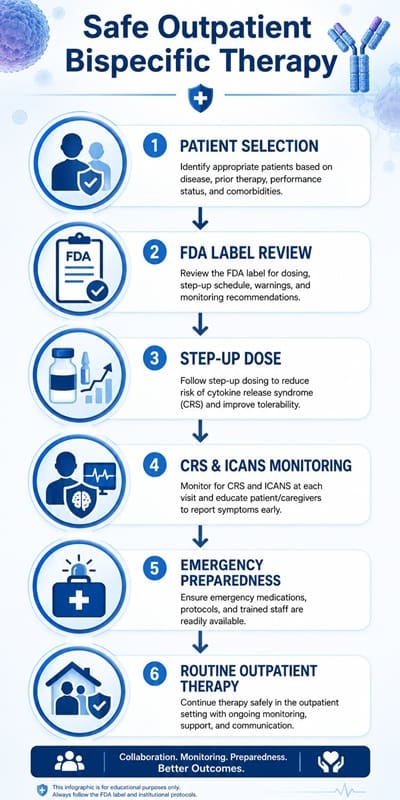
Outpatient administration is appropriate when it is label-concordant, formulation-specific, patient-specific, and supported by a trained multidisciplinary system with immediate rescue and escalation capacity. A practical operational framework distinguishes label-required inpatient or prolonged monitored dosing, outpatient-permitted high-vigilance dosing, and routine outpatient continuation therapy after the agent-specific highest-risk period.
Outpatient care can be too early if it’s mainly about bed pressure, cost, or convenience. It needs proper monitoring, triage, pharmacy checks, emergency coordination, and a strong admission system.
For clinicians, the practical standard is the right patient, the right agent and formulation, the right dose, the right monitoring window, and the right rescue pathway. Anything less converts outpatient innovation into avoidable risk.
References
Ahn, M. J., Cho, B. C., Felip, E., et al. (2023). Tarlatamab for patients with previously treated small-cell lung cancer. The New England Journal of Medicine, 389, 2063-2075. https://doi.org/10.1056/NEJMoa2307980. PMID: 37861218.
Amgen Inc. (2026). IMDELLTRA (tarlatamab-dlle) prescribing information. DailyMed. Retrieved July 23, 2026, from https://dailymed.nlm.nih.gov/dailymed/drugInfo.cfm?setid=1e7b6163-5d83-42ea-82c9-cf7620cdc782.
Budde, L. E., Sehn, L. H., Matasar, M., et al. (2022). Safety and efficacy of mosunetuzumab, a bispecific antibody, in patients with relapsed or refractory follicular lymphoma: A single-arm, multicentre, phase 2 study. The Lancet Oncology, 23(8), 1055-1065. https://doi.org/10.1016/S1470-2045(22)00335-7. PMID: 35803286.
Bumma, N., Richter, J., Jagannath, S., et al. (2024). Linvoseltamab for treatment of relapsed/refractory multiple myeloma. Journal of Clinical Oncology, 42(22), 2702-2712. https://doi.org/10.1200/JCO.24.01008. PMID: 38879802.
Chari, A., Minnema, M. C., Berdeja, J. G., et al. (2022). Talquetamab, a T-cell-redirecting GPRC5D bispecific antibody for multiple myeloma. The New England Journal of Medicine, 387, 2232-2244. https://doi.org/10.1056/NEJMoa2204591. PMID: 36507686.
Dickinson, M. J., Carlo-Stella, C., Morschhauser, F., et al. (2022). Glofitamab for relapsed or refractory diffuse large B-cell lymphoma. The New England Journal of Medicine, 387, 2220-2231. https://doi.org/10.1056/NEJMoa2206913. PMID: 36507690.
Genentech, Inc. (2026). COLUMVI (glofitamab-gxbm) prescribing information. DailyMed. Retrieved July 23, 2026, from https://dailymed.nlm.nih.gov/dailymed/drugInfo.cfm?setid=3516e753-f064-4d30-9bd5-e3f2e143f75d.
Genentech, Inc. (2026). LUNSUMIO (mosunetuzumab-axgb) intravenous prescribing information. DailyMed. Retrieved July 23, 2026, from https://dailymed.nlm.nih.gov/dailymed/drugInfo.cfm?setid=2ef0cf38-101c-4681-98fe-c05dc9ead443.
Genentech, Inc. (2026). LUNSUMIO VELO (mosunetuzumab-axgb) subcutaneous prescribing information. DailyMed. Retrieved July 23, 2026, from https://dailymed.nlm.nih.gov/dailymed/drugInfo.cfm?setid=6a2b6dc2-48bd-4da7-a611-bc6bae2893c8.
Genmab US, Inc., & AbbVie Inc. (2026). EPKINLY (epcoritamab-bysp) prescribing information. DailyMed. Retrieved July 23, 2026, from https://dailymed.nlm.nih.gov/dailymed/drugInfo.cfm?setid=d7836711-b677-412d-bf2d-0f7c8444103a.
Janssen Biotech, Inc. (2025). TALVEY (talquetamab-tgvs) prescribing information. DailyMed. Retrieved July 23, 2026, from https://dailymed.nlm.nih.gov/dailymed/lookup.cfm?setid=9001355e-003d-4d4e-b4ce-337e0fd14952.
Janssen Biotech, Inc. (2026). TECVAYLI (teclistamab-cqyv) prescribing information. DailyMed. Retrieved July 23, 2026, from https://dailymed.nlm.nih.gov/dailymed/lookup.cfm?setid=54e0f974-ccee-44ea-9254-40e9883cee1e.
Lee, D. W., Santomasso, B. D., Locke, F. L., et al. (2019). ASTCT consensus grading for cytokine release syndrome and neurologic toxicity associated with immune effector cells. Biology of Blood and Marrow Transplantation, 25(4), 625-638. https://doi.org/10.1016/j.bbmt.2018.12.758. PMID: 30592986.
Lesokhin, A. M., Tomasson, M. H., Arnulf, B., et al. (2023). Elranatamab in relapsed or refractory multiple myeloma: Phase 2 MagnetisMM-3 trial results. Nature Medicine, 29, 2259-2267. https://doi.org/10.1038/s41591-023-02528-9. PMID: 37582952.
Moreau, P., Garfall, A. L., van de Donk, N. W. C. J., et al. (2022). Teclistamab in relapsed or refractory multiple myeloma. The New England Journal of Medicine, 387, 495-505. https://doi.org/10.1056/NEJMoa2203478. PMID: 35661166.
Mountzios, G., Sun, L., Cho, B. C., et al. (2025). Tarlatamab in small-cell lung cancer after platinum-based chemotherapy. The New England Journal of Medicine, 393(4), 349-361. https://doi.org/10.1056/NEJMoa2502099. PMID: 40454646.
Pfizer Inc. (2026). ELREXFIO (elranatamab-bcmm) prescribing information. DailyMed. Retrieved July 23, 2026, from https://dailymed.nlm.nih.gov/dailymed/lookup.cfm?setid=aa044060-5b4b-4692-bf0f-9a50e140b10e.
Rahbari, K. J., Del Toro Mijares, R., Kennedy, K., et al. (2025). Outpatient administration of bispecific antibody therapy for hematologic malignancies: A practical guide. JCO Oncology Practice. Advance online publication. https://doi.org/10.1200/OP-25-00652. PMID: 41343736.
Raje, N., Anderson, K., Einsele, H., et al. (2023). Monitoring, prophylaxis, and treatment of infections in patients with multiple myeloma receiving bispecific antibody therapy: Consensus recommendations from an expert panel. Blood Cancer Journal, 13, 116. https://doi.org/10.1038/s41408-023-00879-7. PMID: 37528088.
Regeneron Pharmaceuticals, Inc. (2025). LYNOZYFIC (linvoseltamab-gcpt) prescribing information. U.S. Food and Drug Administration. Retrieved July 23, 2026, from https://www.accessdata.fda.gov/drugsatfda_docs/label/
2025/761400s000lbl.pdf. Current DailyMed version:
https://dailymed.nlm.nih.gov/dailymed/drugInfo.cfm?setid=e9fd0739-1b3f-4b8b-824a-1f0a902384d3.
Rodriguez-Otero, P., Usmani, S., Cohen, A. D., et al. (2024). International Myeloma Working Group immunotherapy committee consensus guidelines and recommendations for optimal use of T-cell-engaging bispecific antibodies in multiple myeloma. The Lancet Oncology, 25(5), e205-e216. https://doi.org/10.1016/S1470-2045(24)00043-3. PMID: 38697166.
Sandahl, T. B., Soefje, S. A., Fonseca, R., et al. (2025). Real-world safety and health care resource utilization of teclistamab under an outpatient model for step-up dosing administration. JCO Oncology Practice, 21(5), 702-709. https://doi.org/10.1200/OP-24-00489. PMID: 39705632.
Thieblemont, C., Phillips, T., Ghesquieres, H., et al. (2023). Epcoritamab, a novel, subcutaneous CD3xCD20 bispecific T-cell-engaging antibody, in relapsed or refractory large B-cell lymphoma: Dose expansion in a phase I/II trial. Journal of Clinical Oncology, 41(12), 2238-2247. https://doi.org/10.1200/JCO.22.01725. PMID: 36548927.
U.S. Food and Drug Administration. (2025, November 19). FDA grants traditional approval to tarlatamab-dlle for extensive-stage small cell lung cancer. Retrieved July 23, 2026, from https://www.fda.gov/drugs/resources-information-approved-drugs/fda-grants-traditional-approval-tarlatamab-dlle-extensive-stage-small-cell-lung-cancer.
Recent Articles


Integrative Perspectives on Cognition, Emotion, and Digital Behavior

Sleep-related:
Longevity/Nutrition & Diet:
Philosophical / Happiness / Social:
Other:
Modern Mind Unveiled
Developed under the direction of David McAuley, Pharm.D., this collection explores what it means to think, feel, and connect in the modern world. Drawing upon decades of clinical experience and digital innovation, Dr. McAuley and the GlobalRPh initiative translate complex scientific ideas into clear, usable insights for clinicians, educators, and students.
The series investigates essential themes–cognitive bias, emotional regulation, digital attention, and meaning-making—revealing how the modern mind adapts to information overload, uncertainty, and constant stimulation.
At its core, the project reflects GlobalRPh’s commitment to advancing evidence-based medical education and clinical decision support. Yet it also moves beyond pharmacotherapy, examining the psychological and behavioral dimensions that shape how healthcare professionals think, learn, and lead.
Through a synthesis of empirical research and philosophical reflection, Modern Mind Unveiled deepens our understanding of both the strengths and vulnerabilities of the human mind. It invites readers to see medicine not merely as a science of intervention, but as a discipline of perception, empathy, and awareness–an approach essential for thoughtful practice in the 21st century.
The Six Core Themes
I. Human Behavior and Cognitive Patterns
Examining the often-unconscious mechanisms that guide human choice-how we navigate uncertainty, balance logic with intuition, and adapt through seemingly irrational behavior.
II. Emotion, Relationships, and Social Dynamics
Investigating the structure of empathy, the psychology of belonging, and the influence of abundance and selectivity on modern social connection.
III. Technology, Media, and the Digital Mind
Analyzing how digital environments reshape cognition, attention, and identity- exploring ideas such as gamification, information overload, and cognitive “nutrition” in online spaces.
IV. Cognitive Bias, Memory, and Decision Architecture
Exploring how memory, prediction, and self-awareness interact in decision-making, and how external systems increasingly serve as extensions of thought.
V. Habits, Health, and Psychological Resilience
Understanding how habits sustain or erode well-being-considering anhedonia, creative rest, and the restoration of mental balance in demanding professional and personal contexts.
VI. Philosophy, Meaning, and the Self
Reflecting on continuity of identity, the pursuit of coherence, and the construction of meaning amid existential and informational noise.
Keywords
Cognitive Science • Behavioral Psychology • Digital Media • Emotional Regulation • Attention • Decision-Making • Empathy • Memory • Bias • Mental Health • Technology and Identity • Human Behavior • Meaning-Making • Social Connection • Modern Mind
Video Section