Mesh in Hernia Repair: Evolving Strategies and Contemporary Perspectives
Abstract
Purpose: This review examines the evolving role of surgical mesh in contemporary hernia repair, focusing on guideline recommendations, device safety, patient selection, wound environment, operative technique, and practical clinical decision-making.
Methodology: This narrative review synthesizes current international and regional hernia guidelines, U.S. Food and Drug Administration device-safety information, randomized trials, long-term outcome data, and perioperative antimicrobial-prophylaxis guidance. Particular attention is given to mesh versus non-mesh repair, synthetic versus biologic materials, anatomical placement plane, fascial closure, contaminated fields, and patient-reported outcomes.
Main findings: Mesh remains central to many hernia repairs because it reduces recurrence in appropriately selected settings. Contemporary practice, however, is not a binary choice between mesh and non-mesh repair. For most adults undergoing inguinal hernia repair, guidelines favor a mesh-based technique while preserving a role for selected non-mesh repair when appropriate expertise is available. For midline incisional hernias within the population addressed by current guidance, mesh-based repair with fascial closure and avoidance of bridging is recommended, with retromuscular placement preferred when feasible. In selected clean-contaminated and contaminated ventral hernia repairs performed with fascial closure and retromuscular placement, randomized evidence does not support assuming that biologic mesh is safer or more durable than permanent synthetic mesh. Emergency recommendations remain conditional and are frequently based on low- or very low-certainty evidence. Optimal outcomes depend on patient selection, wound classification, source control, mesh material, anatomical plane, operative technique, surgeon expertise, and informed patient preferences.
Keywords: hernia repair, surgical mesh, inguinal hernia, ventral hernia, incisional hernia, biologic mesh, synthetic mesh, chronic postoperative pain
Introduction
Few surgical devices have moved through as many shifts in public perception as hernia mesh. Mesh reinforcement became an important advance in abdominal wall surgery because it reduced recurrence compared with primary tissue repair in many common hernias. Its widespread adoption was supported by improved repair durability, particularly in inguinal and incisional hernia surgery.
Long-term experience also revealed clinically important limitations. Patients may develop chronic postoperative pain, mesh infection, migration, contraction, adhesions, erosion into adjacent structures, fistula formation, bowel obstruction, recurrence, or a need for complex reoperation. These complications may occur months or years after an otherwise technically successful procedure.
Not all surgical mesh is permanent. Nonabsorbable synthetic mesh is intended to provide long-term reinforcement and remains in the body indefinitely, although some materials may undergo degradation over time. Absorbable synthetic and animal-derived mesh materials lose strength and are absorbed or remodeled. Both permanent and absorbable devices may be associated with early or delayed complications, but they should not be treated as a single interchangeable class.
Current evidence does not support a broad return to routine non-mesh repair. It also does not support indiscriminate mesh implantation. The clinically relevant question is whether a particular patient, hernia type, wound environment, repair technique, mesh material, and anatomical plane favor prosthetic reinforcement over tissue repair alone.
Why the Topic Matters Now
Patient concern about mesh remains common. Some patients request a non-mesh repair without recognizing the differences among abdominal wall hernia mesh, mesh used for stress urinary incontinence, and transvaginal mesh previously marketed for pelvic organ prolapse. FDA actions requiring manufacturers to stop selling mesh products for transvaginal pelvic organ prolapse repair should not be generalized to mesh used for inguinal, umbilical, ventral, or incisional hernia repair.
Patient concerns should nevertheless be addressed directly. The FDA identifies pain, infection, recurrence, adhesions, intestinal obstruction, bleeding, fistula, seroma, perforation, migration, and mesh contraction among adverse events associated with hernia repair or hernia mesh implantation. The risk and relevance of these complications vary by patient, hernia, device, surgical approach, and follow-up duration.
Guidelines have also become more nuanced. The 2023 HerniaSurge update recommends mesh-based repair for most adults undergoing inguinal hernia repair. It also supports selected non-mesh repair after careful patient selection and shared decision-making when the surgeon has appropriate expertise. Among non-mesh operations, Shouldice repair remains the best-supported and most standardized tissue-repair technique.
Ventral and incisional hernia surgery has increasingly adopted abdominal wall reconstruction principles. Defect closure, mesh plane, overlap, fixation strategy, tissue quality, loss of domain, contamination, and surgeon experience may be as important as the material itself. The 2023 European Hernia Society guideline recommends mesh-based repair for the midline incisional hernias addressed by the guideline, closure of the fascial defect, avoidance of bridging when possible, and retromuscular placement for many patients.
The role of biologic mesh has also been reassessed. The biologically plausible assumption that biologic materials would resist infection and perform better in contaminated fields has not consistently translated into superior clinical outcomes. Randomized evidence supports permanent synthetic mesh in selected clean-contaminated or contaminated ventral hernia repairs performed by experienced abdominal wall surgeons using fascial closure and retromuscular placement.
What Mesh Does and Does Not Do
Surgical mesh provides additional support to weakened or disrupted tissue. Synthetic mesh may be nonabsorbable, absorbable, or composed of both permanent and absorbable components. Biologic meshes are processed tissue matrices whose source, processing, cross-linking, degradation, and mechanical characteristics vary by product.
Nonabsorbable synthetic mesh is designed to provide long-term mechanical reinforcement. Absorbable synthetic and biologic materials lose mechanical strength over time and depend on host tissue incorporation or remodeling for longer-term repair durability. These categories are heterogeneous, and the performance of one product should not automatically be attributed to another.
Mesh does not correct every contributor to recurrence. Recurrence may reflect inadequate overlap, failure of fascial closure, mesh displacement, infection, technical failure, poor tissue quality, obesity, smoking, poorly controlled diabetes, immunosuppression, malnutrition, ascites, chronic cough, constipation, or persistently elevated intra-abdominal pressure. Mesh may reduce mechanical failure at the repair site, but it cannot fully overcome adverse biology, an inappropriate operative strategy, or an uncorrected source of abdominal wall stress.
A small primary umbilical hernia in a low-risk patient, a recurrent incisional hernia after prior infection, a primary unilateral inguinal hernia in a young adult, and an emergency strangulated ventral hernia requiring bowel resection are different clinical problems. They should not be managed through a uniform device-centered approach.
Current Evidence by Hernia Type
Inguinal and Femoral Hernias
For most adults undergoing inguinal hernia repair, mesh-based repair remains the standard evidence-supported approach. The HerniaSurge update concludes that mesh-based repair reduces recurrence without increasing chronic pain risk in aggregate evidence and strongly recommends a mesh-based technique for most patients.
Non-mesh repair remains an option for selected patients. It may be considered after careful patient selection and shared decision-making when the patient prefers to avoid mesh and a surgeon with appropriate tissue-repair expertise is available. The Shouldice technique is the recommended non-mesh operation and has lower recurrence rates than other suture repairs. These findings should not be interpreted as support for an improvised or technically incomplete tissue repair.
For patients of either sex with a primary unilateral inguinal hernia, a laparo-endoscopic technique is recommended when a surgeon with specific expertise and sufficient resources is available. Compared with Lichtenstein repair, laparo-endoscopic approaches are associated with less postoperative pain, a lower incidence of chronic pain, and faster recovery. Patient characteristics, hernia anatomy, prior surgery, anesthetic considerations, and local expertise may still make an open Lichtenstein repair appropriate.
Chronic postoperative inguinal pain warrants specific preoperative counseling. Potential contributors include nerve injury, entrapment, scar, inflammatory response, mesh-related factors, recurrence, and unrelated musculoskeletal or neuropathic disorders. Evidence supporting surgery for established chronic postoperative inguinal pain remains limited, and mesh removal, neurectomy, or combined procedures may fail to relieve pain or may worsen symptoms.
Femoral hernias require separate consideration. A missed femoral hernia may be interpreted as an inguinal recurrence, particularly in women. Surgical planning should account for sex, groin anatomy, prior repair, and the need to evaluate the femoral canal.
Umbilical and Epigastric Hernias
European and American guidance recommends mesh repair for most symptomatic umbilical and epigastric hernias to reduce recurrence, commonly through an open approach using a flat preperitoneal mesh. The guideline acknowledges that much of the underlying evidence is limited and that many recommendations are weak.
For very small defects, particularly those smaller than 1 cm, the evidence is less definitive, and suture repair may be considered after shared decision-making. Mesh becomes more compelling as defect size and recurrence risk increase, including in patients with recurrent hernias, obesity, rectus diastasis, or other mechanical risk factors.
The recommendation should not be simplified to mean that every small umbilical defect requires mesh. A 0.8-cm defect in a lean, low-risk patient differs from a 2.5-cm defect in a patient with obesity, diabetes, chronic cough, and rectus diastasis.
Ventral and Incisional Hernias
For adult patients with midline incisional hernias within the population addressed by the 2023 European Hernia Society guideline, mesh-based repair is recommended. The guideline focuses primarily on defects for which fascial closure is anticipated without advanced myofascial-release techniques.
The fascial defect should generally be closed, and bridging with mesh should be avoided when feasible. This recommendation is strong but supported by low-certainty evidence. Closure is intended to restore abdominal wall anatomy and function, although the magnitude of benefit for individual outcomes remains incompletely defined.
Retromuscular placement is recommended for many midline incisional hernias. This is a strong recommendation based on very low-certainty evidence. The term retromuscular includes retrorectus and preperitoneal planes. The optimal plane remains dependent on anatomy, prior operations, contamination, the need for future abdominal access, and surgeon expertise.
Intraperitoneal mesh may remain appropriate in selected circumstances, but mesh exposed to abdominal viscera warrants caution because of potential implications for adhesions and future abdominal surgery.
Preoperative CT is frequently useful in complex incisional hernia planning. Imaging may define defect width, hernia area, loss of domain, rectus retraction, prior mesh position, occult defects, bowel involvement, and features suggesting that myofascial release may be required. Imaging supports, but does not replace, operative judgment.
Emergency and Contaminated Hernias
Emergency hernia repair requires a different hierarchy of priorities. Physiologic stabilization, bowel viability, source control, management of sepsis, and safe closure of the abdominal cavity may take precedence over definitive abdominal wall reconstruction.
The 2026 European Hernia Society emergency guideline conditionally suggests mesh-based repair rather than primary fascial closure in stable patients with primary ventral or incisional hernias, CDC class I wounds, and defects amenable to direct closure. The recommendation is based on low-certainty evidence.
For stable patients with CDC class II or higher wounds, the guideline conditionally suggests mesh-based repair when adequate source control has been achieved and the defect is amenable to direct closure. The certainty of evidence is very low. Contamination is therefore not an absolute prohibition against mesh, but neither is it a general indication for immediate permanent mesh implantation.
For defects that are not amenable to direct closure, the guideline suggests deferring definitive abdominal wall reconstruction rather than forcing an immediate complex repair. Temporary or staged strategies may be used to close the abdominal cavity and permit later referral to a center experienced in abdominal wall reconstruction.
When emergency mesh repair is selected, the 2026 guideline conditionally suggests onlay placement rather than retromuscular or other positions. This recommendation is based on very low-certainty evidence and should not be extrapolated to elective midline incisional hernia repair, for which retromuscular placement is generally preferred.
Clinical decisions in contaminated fields should consider physiologic stability, wound class, extent of contamination, source control, tissue viability, bowel resection or spillage, feasibility of direct fascial closure, mesh type, anatomical plane, and surgeon expertise.
Biologic, Biosynthetic, and Synthetic Mesh
Biologic mesh has historically been used in contaminated fields because of presumed infection tolerance and the absence of a permanent synthetic implant. This rationale is biologically plausible but does not establish superior clinical effectiveness.
In a multicenter randomized trial of 253 adults undergoing single-stage clean-contaminated or contaminated ventral hernia repair with fascial closure and retromuscular mesh placement, 2-year recurrence was 20.5% with biologic mesh and 5.6% with permanent synthetic mesh. Synthetic mesh significantly reduced recurrence risk. There was no statistically significant difference in the overall 2-year rate of surgical-site occurrences requiring procedural intervention.
These results apply to a defined population treated at specialized abdominal wall reconstruction centers. They should not be generalized to every contaminated abdomen, unstable patient, mesh product, or operative plane. The trial does not establish that permanent synthetic mesh is appropriate in uncontrolled infection, gross contamination without source control, or situations in which fascial closure cannot be achieved.
Biologic mesh should not be presumed safer or more durable solely because contamination is present. Its substantially higher cost also warrants a clear indication and documentation of the clinical rationale.
Biosynthetic and long-term absorbable meshes constitute a separate and heterogeneous category. Their degradation profiles, mechanical behavior, durability, comparative effectiveness, and cost vary by product and clinical setting. Device-specific claims require device-specific evidence.
Robotic Repair: A Technique Question
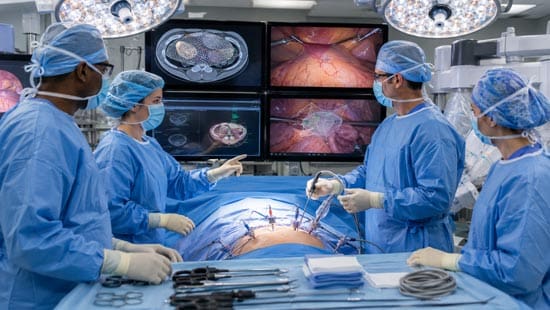
Robotic hernia repair is not inherently a pro-mesh or anti-mesh development. Its potential value lies in facilitating minimally invasive dissection, suturing, fascial closure, and extraperitoneal mesh placement in selected patients.
Randomized evidence has not established broad superiority of robotic ventral hernia repair over conventional laparoscopy. A randomized trial found no significant difference in hospital days within 90 days, while robotic repair was associated with longer operative duration and greater cost.
The relevant clinical question is whether the robotic platform enables a meaningful technical objective, such as fascial closure or extraperitoneal mesh placement, that would otherwise be infeasible or require a more morbid open approach. The availability of a robotic platform alone is not evidence that the robotic operation is superior.
Outcomes remain dependent on the operation performed, patient selection, surgeon experience, mesh plane, and quality of the reconstruction rather than on the platform alone.
Patient Selection and Risk Stratification
Mesh selection should be documented within a structured risk discussion. Relevant hernia variables include type, location, defect size, recurrence history, reducibility, symptoms, prior mesh, contamination, anticipated bowel entry, loss of domain, and feasibility of fascial closure.
Patient factors include obesity, smoking, diabetes, malnutrition, frailty, immunosuppression, ascites, liver disease, chronic cough, constipation, anticoagulant or antiplatelet therapy, prior wound infection, and expectations regarding pain, recovery, and permanent implantation.
High body mass index, smoking, and poorly controlled diabetes are recognized modifiable risk factors in incisional hernia care. Optimization may include smoking cessation, glycemic management, nutritional assessment, weight-management support when feasible, treatment of ascites, cough or constipation management, and review of medications that affect bleeding, immunity, or wound healing.
Optimization should not become an indefinite barrier to care. When symptoms are substantial or a defect is enlarging, the risks of prolonged delay may outweigh the incremental benefit of further optimization. This requires individualized discussion.
Patient preference is important, but it must be informed. A patient may reasonably decline mesh after understanding the potential increase in recurrence risk. Another may select mesh after understanding the potential for chronic pain, infection, device complications, or future reoperation. Shared decision-making should clarify the tradeoffs rather than transfer unresolved clinical uncertainty to the patient.
Practical Approach for Clinicians
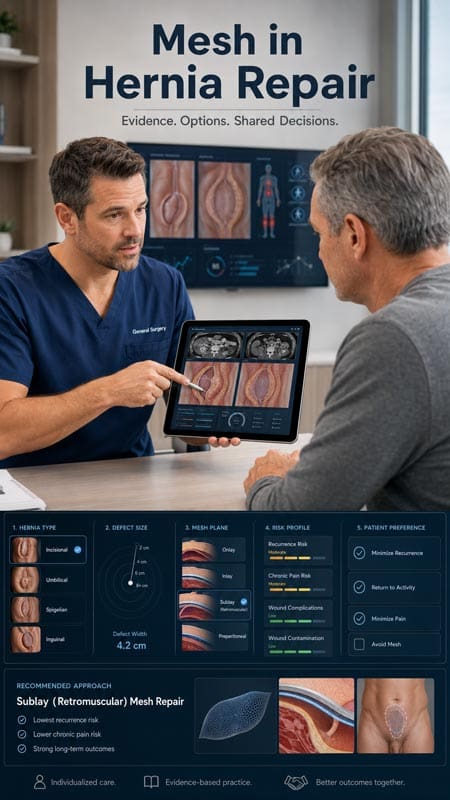
A practical mesh discussion can be organized around five questions.
First, what hernia is being repaired? Groin, femoral, umbilical, epigastric, primary ventral, recurrent ventral, and incisional hernias have different evidence bases and should not be treated as one category.
Second, what is the mechanical problem? Defect width, tissue quality, rectus diastasis, loss of domain, recurrence, prior mesh, and feasibility of fascial closure should guide the repair strategy.
Third, what is the wound environment? A clean elective repair differs from clean-contaminated bowel surgery, gross enteric spillage, infected mesh, uncontrolled infection, or sepsis.
Fourth, what mesh and anatomical plane are planned? Retromuscular or preperitoneal placement is preferred in many elective ventral and incisional repairs. Intraperitoneal mesh may be appropriate in selected situations but warrants caution when future abdominal surgery is likely. Emergency recommendations may differ from elective guidance.
Fifth, what outcomes matter most to the patient? Some patients prioritize minimizing recurrence. Others prioritize avoiding a permanent implant. The clinician should ensure that these preferences are informed by evidence rather than fear, habit, litigation narratives, or device marketing.
Device and Safety Considerations
Surgical mesh is a medical device, not simply a substitute for suture. Operative documentation should include mesh material, manufacturer, product name, size, anatomical plane, fixation strategy, lot number when available, wound class, contamination status, antimicrobial prophylaxis when used, fascial-closure method, and intraoperative complications.
Early complications may include hematoma, seroma, wound infection, urinary retention, ileus, and acute postoperative pain. Delayed complications may include recurrence, chronic pain, mesh infection, migration, contraction, adhesions, bowel obstruction, fistula, erosion into adjacent structures, and reoperation.
Not every postoperative symptom is caused by mesh. Chronic pain may reflect nerve injury, musculoskeletal disease, recurrence, scar, fixation material, or unrelated neuropathic conditions. Similarly, complete mesh explantation is not universally indicated and may cause recurrent herniation, tissue loss, visceral injury, or a need for complex reconstruction.
When a patient presents years after repair with a recurrent bulge, unexplained abdominal wall pain, a draining sinus, chronic infection, or obstructive symptoms, prior mesh should be included in the differential diagnosis. Imaging may be helpful, although not all mesh-related complications are radiographically apparent. Referral to a surgeon experienced in complex hernia repair may be appropriate.

Medication and Perioperative Considerations
Pharmacists and perioperative clinicians can influence outcomes through medication reconciliation, antimicrobial stewardship, allergy assessment, glycemic planning, anticoagulant and antiplatelet management, and multimodal analgesia.
Antimicrobial prophylaxis should be procedure- and risk-specific rather than administered solely because mesh is implanted. The 2023 HerniaSurge guideline does not recommend prophylaxis for average-risk patients undergoing elective open inguinal mesh repair in a low-infection-risk environment. It suggests prophylaxis for higher-risk patients undergoing open repair in such environments and recommends prophylaxis for open inguinal mesh repair when the institutional infection environment is high risk. Prophylaxis is not routinely suggested for elective laparo-endoscopic inguinal repair.
Recommendations for ventral, incisional, emergency, or bowel-associated procedures depend on wound class, anticipated enteric entry, local protocols, and patient risk. When prophylaxis is indicated for a clean procedure, cefazolin is commonly appropriate unless allergy, colonization, local susceptibility patterns, or the operative field requires a different regimen.
Most prophylactic agents should be started within 60 minutes before incision. Vancomycin and fluoroquinolones require an earlier start, generally within 120 minutes before incision, because of their longer infusion times. Weight-based dosing, intraoperative redosing, blood loss, procedure duration, renal function, and allergy history should be considered.
Vancomycin should not be used reflexively. MRSA colonization status and institutional protocols should guide its use. Routine continuation of postoperative antibiotics solely because mesh was placed should be avoided in the absence of a specific infectious indication.
Medication review should also address corticosteroids, immunosuppressants, diabetes therapies, smoking-cessation pharmacotherapy, and postoperative pain management. Opioid-sparing analgesia is desirable, but nonsteroidal anti-inflammatory drug use should be individualized according to renal function, bleeding risk, cardiovascular risk, and the operative plan.
Clinical Table 1. Mesh Use by Scenario
| Clinical scenario | Evidence-supported direction | Key caution |
|---|---|---|
| Most adult inguinal hernias | Mesh-based repair generally recommended | Selected non-mesh repair remains reasonable with shared decision-making and appropriate expertise |
| Primary unilateral inguinal hernia | Laparo-endoscopic repair favored when expertise and resources are available | Patient or hernia factors may favor open Lichtenstein repair |
| Selected inguinal hernia with strong preference to avoid mesh | Consider Shouldice repair | Do not equate Shouldice repair with an improvised tissue repair |
| Symptomatic umbilical or epigastric hernia | Mesh generally recommended to reduce recurrence | Evidence is limited for very small defects, which may be individualized |
| Midline incisional hernia within guideline population | Mesh repair with fascial closure; retromuscular plane generally preferred | Recommendations for plane are based on very low-certainty evidence |
| Stable emergency hernia with a closable defect | Mesh may be considered, including after source control in some contaminated cases | Recommendations are conditional and supported by low- or very low-certainty evidence |
| Emergency defect not amenable to direct closure | Defer definitive reconstruction and consider a staged strategy | Avoid forcing immediate complex reconstruction |
| Selected clean-contaminated or contaminated ventral hernia | Permanent synthetic mesh may be appropriate with fascial closure and retromuscular placement | Trial findings should not be generalized to unstable patients or uncontrolled infection |
Clinical Table 2. Mesh-Related Complications to Discuss or Monitor
| Complication | Typical timing | Clinical clue | Practical response |
|---|---|---|---|
| Seroma or hematoma | Early | Swelling, discomfort, bruising | Examine; obtain imaging when diagnosis or extent is uncertain |
| Surgical-site or mesh infection | Early or delayed | Erythema, fever, drainage, sinus formation | Culture when appropriate; assess need for drainage, antibiotics, source control, and surgical consultation |
| Chronic postoperative pain | Months to years | Burning, pulling, neuropathic or activity-related pain | Evaluate for recurrence, nerve injury, fixation-related pain, and nonhernia causes |
| Recurrence | Months to years | Bulge, pressure, pain, functional limitation | Clinical examination, imaging when needed, and surgical reassessment |
| Adhesion or bowel obstruction | Delayed | Vomiting, distention, obstipation, abdominal pain | Urgent evaluation |
| Migration, contraction, erosion, or fistula | Delayed | Pain, drainage, infection, bowel or bladder symptoms | Specialist evaluation and individualized operative planning |
Clinical Table 3. Documentation Elements After Mesh Repair
| Element | Why it matters | Practical note |
|---|---|---|
| Mesh product and material | Device identification and future safety review | Record manufacturer and product name |
| Mesh size and anatomical plane | Helps interpret imaging, recurrence, and reoperation | Specify retrorectus, preperitoneal, onlay, intraperitoneal, or other plane |
| Fascial-closure method | Distinguishes reinforced closure from bridging | Document whether native fascia was closed |
| Fixation strategy | Relevant to pain, migration, and reoperation | Record sutures, tacks, adhesive, self-fixation, or no fixation |
| Wound class and contamination | Provides context for infection risk and mesh selection | Document bowel entry, spillage, infection, and source control |
| Lot number | Supports device tracking and adverse-event investigation | Include when available |
| Antimicrobial prophylaxis | Supports stewardship and quality review | Record agent, dose, timing, redosing, and allergy rationale |
| Intraoperative complications | Supports later evaluation and operative planning | Document enterotomy, tissue injury, contamination, or conversion |
Limitations of the Evidence
Hernia studies differ in their definitions of recurrence, chronic pain, surgical-site occurrence, mesh infection, quality of life, and follow-up duration. Many trials are insufficiently powered to detect uncommon but serious long-term complications.
Mesh products are heterogeneous. Findings from one synthetic, biologic, or biosynthetic device cannot automatically be applied to all products in the same category. Outcomes may also depend on mesh plane, fixation, fascial closure, surgeon experience, and center volume.
Randomized trials provide stronger internal validity but frequently originate from specialized centers and may not reflect community practice. Registry and administrative studies offer larger populations and longer follow-up but remain vulnerable to confounding, coding limitations, and selection bias.
Several guideline recommendations, particularly those involving emergency surgery, mesh position, and complex reconstruction, are based on low- or very low-certainty evidence. Recommendation strength should therefore not be confused with certainty that the same strategy is optimal for every patient.
Future Directions
Future research should emphasize standardized definitions of recurrence and chronic pain, device-specific surveillance, patient-reported outcomes, and long-term comparative studies of mesh material, anatomical plane, fascial closure, fixation strategy, and minimally invasive techniques.
Pragmatic trials are needed to determine whether robotic and endoscopic approaches provide clinically meaningful advantages beyond facilitating particular reconstructive techniques. Research is also needed in patients who prioritize avoiding permanent implants, women with groin hernias, patients with chronic pain syndromes, immunosuppressed patients, and those undergoing contaminated abdominal wall reconstruction.
Improved registries and complete device documentation may strengthen postmarket surveillance and help distinguish complications related to material, technique, patient selection, and operative environment.
The evolution of hernia surgery does not represent a simple return toward more mesh or a broad retreat toward non-mesh repair. It reflects a more selective and technically precise approach.
Mesh frequently reduces recurrence and remains an established component of many inguinal, umbilical, ventral, and incisional hernia repairs. It is not a benign intervention, and its use requires consideration of chronic pain, infection, device complications, future abdominal surgery, and patient preferences.
Non-mesh repair may be appropriate in selected patients, particularly when a standardized Shouldice repair can be performed by an experienced surgeon. It should not be presented as universally safer or as equivalent to any tissue-repair technique.
Biologic mesh should not be presumed superior in contaminated fields. Permanent synthetic mesh has produced lower recurrence than biologic mesh in a defined randomized-trial population undergoing single-stage contaminated ventral hernia repair with fascial closure and retromuscular placement. These results should be applied within their clinical and technical boundaries.
The quality of hernia repair depends on more than the implanted material. Durable outcomes require an appropriate indication, patient optimization, careful anatomical planning, source control when contamination is present, selection of the proper mesh and plane, sound operative technique, balanced counseling, complete documentation, and clinically appropriate follow-up.
The central question is therefore not whether mesh is inherently good or bad. It is whether a particular repair strategy offers the best balance of recurrence, pain, infection, function, and future reoperation risk for a specific patient and hernia.
References
Bratzler, D. W., Dellinger, E. P., Olsen, K. M., Perl, T. M., Auwaerter, P. G., Bolon, M. K., Fish, D. N., Napolitano, L. M., Sawyer, R. G., Slain, D., Steinberg, J. P., & Weinstein, R. A. (2013). Clinical practice guidelines for antimicrobial prophylaxis in surgery. American Journal of Health-System Pharmacy, 70(3), 195-283. doi:10.2146/ajhp120568
Henriksen, N. A., Montgomery, A., Kaufmann, R., Berrevoet, F., East, B., Fischer, J., Hope, W., Klassen, D., Lorenz, R., Renard, Y., Garcia Urena, M. A., & Simons, M. P. (2020). Guidelines for treatment of umbilical and epigastric hernias from the European Hernia Society and Americas Hernia Society. British Journal of Surgery, 107(3), 171-190. doi:10.1002/bjs.11489
Olavarria, O. A., Bernardi, K., Shah, S. K., Wilson, T. D., Wei, S., Pedroza, C., et al. (2020). Robotic versus laparoscopic ventral hernia repair: Multicenter, blinded randomized controlled trial. BMJ, 370, m2457. doi:10.1136/bmj.m2457
Rosen, M. J., Krpata, D. M., Petro, C. C., Carbonell, A. M., Warren, J. A., Poulose, B. K., Prabhu, A. S., Holihan, J. L., Haskins, I. N., Tastaldi, L., Alkhatib, H., Fafaj, A., Tu, C., & Rosenblatt, S. (2022). Biologic versus synthetic mesh for single-stage repair of contaminated ventral hernias: A randomized clinical trial. JAMA Surgery, 157(4), 293-301. doi:10.1001/jamasurg.2021.6902
Sanders, D. L., Pawlak, M. M., Simons, M. P., Aufenacker, T., Balla, A., Berger, C., et al. (2023). Midline incisional hernia guidelines: The European Hernia Society. British Journal of Surgery, 110(12), 1732-1768. doi:10.1093/bjs/znad284
Stabilini, C., Theodorou, A., Pawlak, M., Antoniou, S., Berrevoet, F., Bougard, H., Bracale, U., et al. (2026). EHS guidelines on the management of primary ventral and incisional hernias under emergency conditions. Journal of Abdominal Wall Surgery, 5, 16228. doi:10.3389/jaws.2026.16228
Stabilini, C., van Veenendaal, N., Aasvang, E., Agresta, F., Aufenacker, T., Berrevoet, F., et al. (2023). Update of the international HerniaSurge guidelines for groin hernia management. BJS Open, 7(5), zrad080. doi:10.1093/bjsopen/zrad080
U.S. Food and Drug Administration. (2023). Surgical mesh used for hernia repair. Retrieved July 13, 2026.
U.S. Food and Drug Administration. (2024). FDA’s activities: Urogynecologic surgical mesh. Retrieved July 13, 2026.
Recent Articles


Integrative Perspectives on Cognition, Emotion, and Digital Behavior

Sleep-related:
Longevity/Nutrition & Diet:
Philosophical / Happiness / Social:
Other:
Modern Mind Unveiled
Developed under the direction of David McAuley, Pharm.D., this collection explores what it means to think, feel, and connect in the modern world. Drawing upon decades of clinical experience and digital innovation, Dr. McAuley and the GlobalRPh initiative translate complex scientific ideas into clear, usable insights for clinicians, educators, and students.
The series investigates essential themes–cognitive bias, emotional regulation, digital attention, and meaning-making—revealing how the modern mind adapts to information overload, uncertainty, and constant stimulation.
At its core, the project reflects GlobalRPh’s commitment to advancing evidence-based medical education and clinical decision support. Yet it also moves beyond pharmacotherapy, examining the psychological and behavioral dimensions that shape how healthcare professionals think, learn, and lead.
Through a synthesis of empirical research and philosophical reflection, Modern Mind Unveiled deepens our understanding of both the strengths and vulnerabilities of the human mind. It invites readers to see medicine not merely as a science of intervention, but as a discipline of perception, empathy, and awareness–an approach essential for thoughtful practice in the 21st century.
The Six Core Themes
I. Human Behavior and Cognitive Patterns
Examining the often-unconscious mechanisms that guide human choice-how we navigate uncertainty, balance logic with intuition, and adapt through seemingly irrational behavior.
II. Emotion, Relationships, and Social Dynamics
Investigating the structure of empathy, the psychology of belonging, and the influence of abundance and selectivity on modern social connection.
III. Technology, Media, and the Digital Mind
Analyzing how digital environments reshape cognition, attention, and identity- exploring ideas such as gamification, information overload, and cognitive “nutrition” in online spaces.
IV. Cognitive Bias, Memory, and Decision Architecture
Exploring how memory, prediction, and self-awareness interact in decision-making, and how external systems increasingly serve as extensions of thought.
V. Habits, Health, and Psychological Resilience
Understanding how habits sustain or erode well-being-considering anhedonia, creative rest, and the restoration of mental balance in demanding professional and personal contexts.
VI. Philosophy, Meaning, and the Self
Reflecting on continuity of identity, the pursuit of coherence, and the construction of meaning amid existential and informational noise.
Keywords
Cognitive Science • Behavioral Psychology • Digital Media • Emotional Regulation • Attention • Decision-Making • Empathy • Memory • Bias • Mental Health • Technology and Identity • Human Behavior • Meaning-Making • Social Connection • Modern Mind
Video Section