The Great Appendicitis Debate Revisited: Who Still Needs the OR in 2026?

Abstract
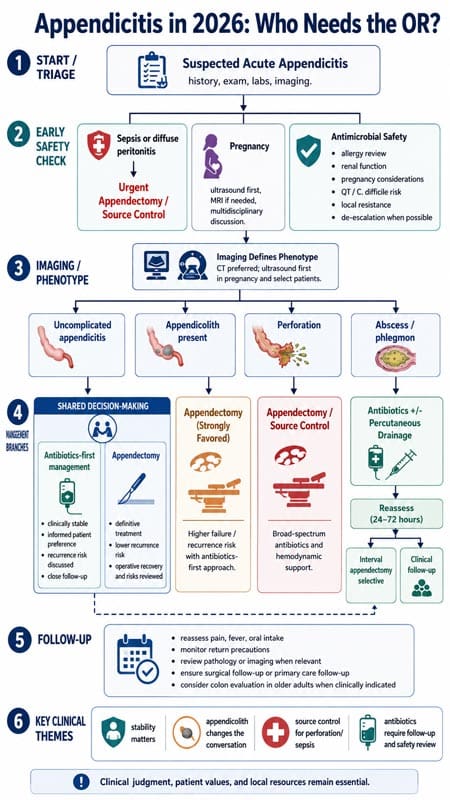
The management of acute appendicitis has shifted from routine appendectomy for nearly all patients to a more selective strategy based on disease severity, imaging findings, patient factors, antimicrobial feasibility, and shared decision-making. Appendectomy remains definitive therapy and is still preferred or required for many patients, including those with generalized peritonitis, free perforation, gangrene, sepsis, diagnostic uncertainty requiring exploration, failed antibiotic therapy, pregnancy with confirmed appendicitis, appendicolith-associated high-risk disease, and complicated appendicitis requiring source control. Antibiotics-first management is a reasonable option for carefully selected patients with imaging-confirmed uncomplicated appendicitis, no appendicolith, stable physiology, reliable follow-up, and timely access to surgical rescue.
The evidence base includes APPAC, CODA, pediatric studies, systematic reviews, and contemporary guideline updates. Antibiotics can initially avoid appendectomy in many patients with uncomplicated appendicitis, but recurrence and delayed appendectomy are common enough that clinicians should describe this strategy as appendectomy deferral rather than guaranteed appendectomy avoidance. Appendicolith is a major predictor of failure. Older age, pregnancy, immunocompromise, severe systemic features, unreliable follow-up, and complicated imaging findings require a more cautious approach.
For pharmacists and prescribers, antibiotic selection must account for gram-negative and anaerobic coverage, local resistance, allergy history, renal and hepatic function, pregnancy status, C. difficile risk, drug interactions, and drug-specific warnings. The practical question for 2026 is not whether antibiotics can work. They can. The question is whether a specific patient has an uncomplicated disease, an acceptable risk of failure, safe antimicrobial options, reliable monitoring, and surgical backup.
Introduction
Acute appendicitis remains one of the most common abdominal surgical emergencies. For more than a century, appendectomy was the default treatment because it provides source control, confirms the diagnosis, prevents recurrence, and removes the risk of missed appendiceal pathology. That logic remains valid. What has changed is the recognition that appendicitis is not a single uniform disease state.
Imaging-confirmed uncomplicated appendicitis without an appendicolith differs from perforated appendicitis, appendiceal abscess, gangrenous appendicitis, appendicitis in pregnancy, and appendicitis in older or immunocompromised adults. The modern decision is therefore not simply “antibiotics versus surgery.” It is a source-control decision supported by imaging, clinical trajectory, antimicrobial safety, patient preference, and the availability of timely operative intervention if needed.
Evidence Summary
The APPAC trial helped establish that antibiotics could treat CT-confirmed uncomplicated appendicitis in many adults. At 1 year, approximately 73% of patients treated with antibiotics avoided appendectomy. At 5 years, recurrence occurred in 39.1% of patients initially treated with antibiotics, meaning that about 6 in 10 remained surgery-free. Most recurrent cases were uncomplicated, and delayed appendectomy did not produce a high rate of severe complications in that trial.
CODA broadened the evidence base in a pragmatic U.S. population. Antibiotics were noninferior to appendectomy for 30-day health status, but nearly 3 in 10 antibiotic-assigned patients underwent appendectomy by 90 days. Appendicolith substantially changed the risk profile. Patients with appendicolith had higher early appendectomy and complication rates than those without appendicolith.
Pediatric evidence supports discussing nonoperative management in selected children with uncomplicated appendicitis, especially when there is no appendicolith. However, the evidence is heterogeneous and includes patient-choice designs as well as randomized data. Pediatric appendicolith should be treated as a strong reason to favor appendectomy.
The evidence supports antibiotics-first management as a selective strategy. It does not support indiscriminate nonoperative care, and it does not make appendectomy obsolete.
Diagnosis and Classification
The initial task is to distinguish suspected appendicitis from confirmed appendicitis, then uncomplicated disease from complicated disease. Clinical scores such as the AIR score, Adult Appendicitis Score, Alvarado score, and Pediatric Appendicitis Score may help stratify probability, but they should not replace imaging when treatment selection depends on excluding complicated appendicitis.
In adults, CT is usually the most practical test for confirming appendicitis and identifying appendicolith, abscess, perforation, mass, or alternative diagnoses. Ultrasound is often preferred first in children and may be used initially in pregnancy. MRI is useful in pregnancy when ultrasound is nondiagnostic, and resources are available. In older adults, imaging is particularly important because appendiceal or cecal neoplasms become more clinically relevant.
Who Can Reasonably Be Offered Antibiotics First?
Antibiotics-first management is most defensible when the patient has imaging-confirmed uncomplicated appendicitis, no appendicolith, no abscess, no free perforation, no generalized peritonitis, no hemodynamic instability, no severe sepsis, safe antibiotic options, reliable follow-up, and timely access to surgery if the clinical course worsens.
The discussion should be explicit. Antibiotics may avoid surgery initially, but they do not remove the appendix. Recurrence, early failure, delayed appendectomy, repeat imaging, adverse drug effects, and additional healthcare encounters remain possible. Patients should be instructed to return urgently for worsening pain, fever, vomiting, inability to tolerate oral intake, syncope, progressive tenderness, or systemic symptoms.
Who Still Needs the OR?
Appendectomy remains preferred or required for many patients. Patients with generalized peritonitis, free perforation, gangrene, hemodynamic instability, sepsis requiring source control, or clinical deterioration on antibiotics should undergo urgent surgical evaluation. Patients with appendicolith should generally be steered toward appendectomy because appendicolith is associated with higher failure and complication rates during nonoperative management.
Pregnancy requires special caution. Nonoperative treatment should not be presented as routine. When appendicitis is confirmed in pregnancy, contemporary guidance generally favors operative management, with laparoscopy preferred over open surgery when technically appropriate and expertise is available. Diagnostic accuracy is essential because both delayed treatment of true appendicitis and unnecessary surgery carry maternal-fetal implications.
Older adults also require a lower threshold for operative and oncologic evaluation. Appendicitis in older patients is more likely to be complicated at presentation, and appendiceal or cecal neoplasm becomes a more important concern. Adults older than 35 to 40 years who undergo nonoperative treatment for abscess or phlegmon should not be lost to follow-up. Follow-up imaging, colon evaluation, interval appendectomy, or a combination of these may be appropriate depending on imaging findings, symptoms, age, and local practice.
Complicated Appendicitis Is Not One Entity
The term complicated appendicitis should be used precisely. Free perforation with generalized peritonitis is different from a contained periappendiceal abscess. Gangrenous appendicitis is different from phlegmon. These distinctions determine whether immediate surgery, antibiotics, percutaneous drainage, interval appendectomy, or evaluation for malignancy is most appropriate.
For localized abscess or phlegmon, initial nonoperative management with antibiotics, with or without percutaneous drainage, may be reasonable in selected stable patients. Early laparoscopic appendectomy may also be appropriate in centers with adequate expertise. In adults, especially those older than 40 years, follow-up after nonoperative management is important because interval appendectomy specimens and follow-up evaluations can reveal appendiceal neoplasm.
Antimicrobial Strategy and Safety
Antibiotic regimens for appendicitis must cover enteric gram-negative organisms and anaerobes. Selection should reflect local susceptibility patterns, illness severity, allergy history, renal and hepatic function, pregnancy status, and whether the patient is being treated nonoperatively or perioperatively.
Common approaches include a beta-lactam/beta-lactamase inhibitor, a third-generation cephalosporin plus metronidazole, or broader therapy for high-risk patients. Fluoroquinolone plus metronidazole may be used in selected beta-lactam-allergic patients, but fluoroquinolone toxicity makes it less attractive when safer alternatives are available. Ertapenem may be reasonable when the risk of extended-spectrum beta-lactamase is high, but carbapenem use should be stewardship-sensitive.
Antibiotics should not be treated as benign. Amoxicillin-clavulanate requires attention to serious beta-lactam hypersensitivity, prior cholestatic jaundice or hepatic dysfunction, renal dosing, hepatic monitoring in hepatic impairment, and C. difficile-associated diarrhea. Ceftriaxone requires attention to beta-lactam allergy, neonatal calcium-related contraindications, biliary complications, hemolytic anemia, neurologic adverse reactions, and C. difficile. Metronidazole adds concerns about nausea, metallic taste, neuropathy with prolonged exposure, CNS toxicity, warfarin potentiation, and disulfiram-like reactions with alcohol, depending on product labeling. Fluoroquinolones carry boxed warnings for disabling and potentially irreversible tendon, peripheral nerve, CNS, and myasthenia gravis-related adverse effects.
Most nonoperative protocols use initial intravenous therapy followed by oral therapy for a total course of around 7 to 10 days, although shorter and oral-only regimens continue to be studied. After an appendectomy for uncomplicated appendicitis with adequate source control, postoperative antibiotics are generally not needed. For complicated appendicitis after adequate source control, short postoperative courses are preferred over prolonged therapy.
Table 1. Treatment Direction by Clinical Scenario
| Clinical scenario | Preferred direction in 2026 | Practical rationale |
| CT-confirmed uncomplicated appendicitis, no appendicolith, stable patient, reliable follow-up | Discuss antibiotics-first management or appendectomy | Antibiotics may avoid surgery initially, but recurrence and delayed appendectomy remain possible |
| Appendicolith present | Favor appendectomy | Higher antibiotic failure and complication risk |
| Generalized peritonitis, free perforation, gangrene, sepsis, or hemodynamic instability | Urgent surgical source control | Antibiotics alone are inadequate when source control is required |
| Localized abscess or phlegmon | Individualize: antibiotics, drainage, early laparoscopy, or interval appendectomy | Depends on stability, abscess features, age, malignancy risk, and local expertise |
| Pregnancy with confirmed appendicitis | Favor operative management after appropriate imaging | Nonoperative management should not be routine in pregnancy |
| Child with uncomplicated appendicitis, no appendicolith | Shared decision-making | Nonoperative management may be reasonable, but recurrence and failure risk must be discussed |
| Immunocompromised patient | Early surgical consultation; lower threshold for operative management | Atypical presentation and faster progression may reduce the safety margin |
| Older adult, especially aged 35 to 40, with an abscess or suspicious imaging | Ensure follow-up for malignancy; consider colon evaluation, repeat imaging, or interval appendectomy | Appendiceal and cecal neoplasm risk becomes more relevant |
| Failed antibiotics after 24 to 72 hours or earlier clinical deterioration | Convert promptly to surgery | Delay after recognized failure increases risk |
Table 2. Antibiotic Safety Considerations for Clinicians and Pharmacists
| Drug or regimen component | Key safety issues | Practical monitoring or prescribing notes |
| Amoxicillin-clavulanate | Beta-lactam hypersensitivity, prior cholestatic jaundice or hepatic dysfunction, C. difficile-associated diarrhea | Review allergy history, hepatic history, renal function, and diarrhea risk |
| Ceftriaxone | Beta-lactam hypersensitivity, neonatal calcium precipitation risk, biliary sludge, hemolytic anemia, C. difficile-associated diarrhea | Avoid in contraindicated neonates; review calcium-containing IV fluids in neonates; monitor for hypersensitivity and severe diarrhea |
| Metronidazole | GI intolerance, metallic taste, peripheral neuropathy with prolonged exposure, CNS toxicity, warfarin interaction, alcohol or propylene glycol warning, depending on the product | Review warfarin use, neurologic symptoms, alcohol exposure, and duration |
| Ciprofloxacin or levofloxacin | Boxed warnings for tendon rupture, peripheral neuropathy, CNS effects, and myasthenia gravis exacerbation; QT prolongation and dysglycemia concerns | Avoid when safer alternatives exist, especially in older adults, steroid users, transplant recipients, those with myasthenia gravis, and those with prior fluoroquinolone toxicity |
| Ertapenem | Carbapenem allergy, seizure risk, renal dosing, C. difficile-associated diarrhea, valproate interaction | Reserve for ESBL risk or resistant organisms when appropriate; adjust for renal function; review anticonvulsants |
Shared Decision-Making
Shared decision-making should occur only after the clinician determines that both pathways are medically reasonable. The conversation should include the probability of initial treatment success, the risk of early failure, the risk of recurrence, the possibility of a delayed appendectomy, the adverse effects of antibiotics, the expected recovery after appendectomy, and the need for urgent reassessment if symptoms worsen.
Patients who cannot reliably return for reassessment, who live far from emergency surgical care, who have high-risk imaging features, or who prefer definitive therapy are often better served by appendectomy.

Practical Bottom Line
The patient most likely to succeed with antibiotics-first management has imaging-confirmed uncomplicated appendicitis, no appendicolith, stable physiology, no pregnancy or major immunocompromising condition, safe antibiotic options, reliable follow-up, and prompt access to surgery.
The patient who still needs the OR has generalized peritonitis, free perforation, gangrene, sepsis, hemodynamic instability, appendicolith-associated high-risk disease, pregnancy with confirmed appendicitis, diagnostic uncertainty requiring exploration, failed antibiotic therapy, or complicated disease requiring source control.
The appendicitis debate has matured. Antibiotics-first treatment is no longer experimental for selected uncomplicated appendicitis, but appendectomy remains definitive therapy and is still the best option for many patients. The key clinical task is accurate classification.
In 2026, clinicians should avoid both extremes. Universal appendectomy ignores evidence that some patients can safely avoid or defer surgery. Universal antibiotics-first management ignores the importance of source control, appendicolith-associated failure, pregnancy-specific concerns, neoplasm risk in older adults, antimicrobial toxicity, and the consequences of poor follow-up.
The modern standard is individualized management of appendicitis: diagnose accurately, classify severity, assess failure risk, choose antibiotics carefully, document shared decision-making, and maintain a low threshold for surgical source control when the clinical picture warrants it.
References
CODA Collaborative; Flum DR, Davidson GH, Monsell SE, Shapiro NI, Odom SR, Sanchez SE, Drake FT, Fischkoff K, Johnson J, Patton JH, Evans H, Cuschieri J, Sabbatini AK, Faine BA, Skeete DA, Liang MK, Sohn V, McGrane K, Kutcher ME, Chung B, Carter DW, Ayoung-Chee P, Chiang W, Rushing A, Steinberg S, Foster CS, Schaetzel SM, Price TP, Mandell KA, Ferrigno L, Salzberg M, DeUgarte DA, Kaji AH, Moran GJ, Saltzman D, Alam HB, Park PK, Kao LS, Thompson CM, Self WH, Yu JT, Wiebusch A, Winchell RJ, Clark S, Krishnadasan A, Fannon E, Lavallee DC, Comstock BA, Bizzell B, Heagerty PJ, Kessler LG, Talan DA. A Randomized Trial Comparing Antibiotics with Appendectomy for Appendicitis. N Engl J Med. 2020 Nov 12;383(20):1907-1919. doi: 10.1056/NEJMoa2014320. Epub 2020 Oct 5. PMID: 33017106.
Di Saverio, S., Podda, M., De Simone, B., Ceresoli, M., Augustin, G., Gori, A., et al. (2020). Diagnosis and treatment of acute appendicitis: 2020 update of the WSES Jerusalem guidelines. World Journal of Emergency Surgery, 15, 27.
Georgiou R, Eaton S, Stanton MP, Pierro A, Hall NJ. Efficacy and Safety of Nonoperative Treatment for Acute Appendicitis: A Meta-analysis. Pediatrics. 2017 Mar;139(3):e20163003. doi: 10.1542/peds.2016-3003. Epub 2017 Feb 17. PMID: 28213607.
Kumar SS, Collings AT, Lamm R, Haskins IN, Scholz S, Nepal P, Train AT, Athanasiadis DI, Pucher PH, Bradley JF 3rd, Hanna NM, Quinteros F, Narula N, Slater BJ. SAGES guideline for the diagnosis and treatment of appendicitis. Surg Endosc. 2024 Jun;38(6):2974-2994. doi: 10.1007/s00464-024-10813-y. Epub 2024 May 13. PMID: 38740595.
Minneci, P. C., Mahida, J. B., Lodwick, D. L., Sulkowski, J. P., Nacion, K. M., Cooper, J. N., et al. (2016). Effectiveness of patient choice in nonoperative vs surgical management of pediatric uncomplicated acute appendicitis. JAMA Surgery, 151(5), 408-415.
Podda M, Ceresoli M, De Simone B, Fugazzola P, Pata F, Balla A, Gerardi C, Allocati E, Salminen P, Coimbra R, Kelly M, Boermeester M, Segovia Lohse H, Tan E, Pisanu A, Abu-Zidan F, Flum D, Sakakushev B, Ansaloni L, Gomes CA, Talan D, Tebala GD, Shelat V, Bendinelli C, Balogh Z, Mentula P, Di Carlo I, Kluger Y, Tolonen M, Sammalkorpi H, Damaskos D, Biffl W, Yang B, Sallinen V, Davies J, Vallicelli C, Amico F, Augustin G, Cucinotta E, Litvin A, Kirkpatrick A, de’Angelis N, Weber D, Leppaniemi A, Lee M, Cabrera Vargas LF, Sartelli M, Coccolini F, Di Saverio S, Catena F. Diagnosis and Treatment of Acute Appendicitis: 2025 Edition of the World Society of Emergency Surgery Jerusalem Guidelines. JAMA Surg. 2026 Mar 1;161(3):283-295. doi: 10.1001/jamasurg.2025.6218. PMID: 41604201.
Podda, M., Gerardi, C., Cillara, N., Fearnhead, N., Gomes, C. A., Birindelli, A., et al. (2019). Antibiotic treatment and appendectomy for uncomplicated acute appendicitis in adults and children: A systematic review and meta-analysis. Annals of Surgery, 270(6), 1028-1040.
Salminen, P., Paajanen, H., Rautio, T., Nordström, P., Aarnio, M., Rantanen, T., et al. (2015). Antibiotic therapy vs appendectomy for treatment of uncomplicated acute appendicitis: The APPAC randomized clinical trial. JAMA, 313(23), 2340-2348.
Salminen, P., Tuominen, R., Paajanen, H., Rautio, T., Nordström, P., Aarnio, M., et al. (2018). Five-year follow-up of antibiotic therapy for uncomplicated acute appendicitis in the APPAC randomized clinical trial. JAMA, 320(12), 1259-1265.
Talan, D. A., Saltzman, D. J., Mower, W. R., Krishnadasan, A., Jude, C. M., Amii, R., et al. (2017). Antibiotics-first versus surgery for appendicitis: A U.S. pilot randomized controlled trial allowing outpatient antibiotic management. Annals of Emergency Medicine, 70(1), 1-11.
U.S. National Library of Medicine. DailyMed prescribing information for amoxicillin-clavulanate, ceftriaxone, ciprofloxacin, levofloxacin, metronidazole, and ertapenem. Accessed: June 2026.
Writing Group for the CODA Collaborative. (2022). Patient factors associated with appendectomy within 30 days of initiating antibiotic treatment for appendicitis. JAMA Surgery, 157(3), e216900.
Recent Articles


Integrative Perspectives on Cognition, Emotion, and Digital Behavior

Sleep-related:
Longevity/Nutrition & Diet:
Philosophical / Happiness / Social:
Other:
Modern Mind Unveiled
Developed under the direction of David McAuley, Pharm.D., this collection explores what it means to think, feel, and connect in the modern world. Drawing upon decades of clinical experience and digital innovation, Dr. McAuley and the GlobalRPh initiative translate complex scientific ideas into clear, usable insights for clinicians, educators, and students.
The series investigates essential themes–cognitive bias, emotional regulation, digital attention, and meaning-making—revealing how the modern mind adapts to information overload, uncertainty, and constant stimulation.
At its core, the project reflects GlobalRPh’s commitment to advancing evidence-based medical education and clinical decision support. Yet it also moves beyond pharmacotherapy, examining the psychological and behavioral dimensions that shape how healthcare professionals think, learn, and lead.
Through a synthesis of empirical research and philosophical reflection, Modern Mind Unveiled deepens our understanding of both the strengths and vulnerabilities of the human mind. It invites readers to see medicine not merely as a science of intervention, but as a discipline of perception, empathy, and awareness–an approach essential for thoughtful practice in the 21st century.
The Six Core Themes
I. Human Behavior and Cognitive Patterns
Examining the often-unconscious mechanisms that guide human choice-how we navigate uncertainty, balance logic with intuition, and adapt through seemingly irrational behavior.
II. Emotion, Relationships, and Social Dynamics
Investigating the structure of empathy, the psychology of belonging, and the influence of abundance and selectivity on modern social connection.
III. Technology, Media, and the Digital Mind
Analyzing how digital environments reshape cognition, attention, and identity- exploring ideas such as gamification, information overload, and cognitive “nutrition” in online spaces.
IV. Cognitive Bias, Memory, and Decision Architecture
Exploring how memory, prediction, and self-awareness interact in decision-making, and how external systems increasingly serve as extensions of thought.
V. Habits, Health, and Psychological Resilience
Understanding how habits sustain or erode well-being-considering anhedonia, creative rest, and the restoration of mental balance in demanding professional and personal contexts.
VI. Philosophy, Meaning, and the Self
Reflecting on continuity of identity, the pursuit of coherence, and the construction of meaning amid existential and informational noise.
Keywords
Cognitive Science • Behavioral Psychology • Digital Media • Emotional Regulation • Attention • Decision-Making • Empathy • Memory • Bias • Mental Health • Technology and Identity • Human Behavior • Meaning-Making • Social Connection • Modern Mind
Video Section