Evidence-based clinical review
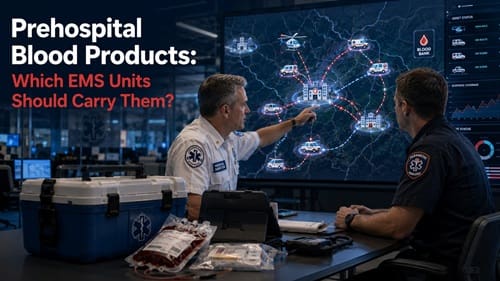
Prehospital Blood Products Determining Which EMS Units Should Carry Them
Clinical Notes
No, not every EMS unit should carry blood. The most defensible goal is reliable regional access to early transfusion. This is best achieved through selected assets that can maintain strict transfusion-service oversight, validated storage, clinician competency, product traceability, supply stewardship, and continuous quality improvement.
Abstract
Background: Prehospital transfusion moves blood closer to patients with life-threatening hemorrhage. However, the policy question is often framed too broadly. Universal patient access and universal ambulance inventory are simply not the same objective.
Evidence Review: Randomized evidence is highly context-dependent. The PAMPer trial found lower 30-day mortality with prehospital plasma during air transport, whereas the COMBAT and RePHILL trials did not demonstrate benefit for their studied plasma or component strategies. More recently, the 2026 SWiFT and TOWAR trials found that prehospital whole blood was not superior to component therapy. A comprehensive 2026 AHRQ review concluded that no single transfusion or infusion intervention was consistently superior across all settings.
Practical Answer: Every EMS system must determine whether eligible patients can receive blood rapidly. However, most systems should place inventory only on carefully selected assets. Candidate assets are those with sufficient hemorrhage volume, a meaningful response-time or transport-time advantage, dependable dispatch, trained clinicians, validated storage, blood-bank integration, product rotation, traceability, adverse-event response, and reliable data review.
Conclusion: The appropriate performance target is the time to blood for eligible patients, not the percentage of vehicles carrying blood. Whole blood may simplify logistics and is favored in current professional guidance for trauma, but recent randomized trials do not establish its clinical superiority over components.
The Core Decision Is Patient Access, Not Blanket Inventory
Prehospital blood programs address a very real clinical problem. A patient may lose vital circulating volume, oxygen-carrying capacity, and hemostatic function long before reaching definitive hemorrhage control. Blood can replace oxygen-carrying capacity and, depending on the specific product, provide coagulation factors and platelets much more directly than crystalloid fluids.
That physiological rationale does not mean every ambulance should function as an independent blood depot. A system can provide rapid access through air medical teams, critical-care transport units, strategically placed advanced life support units, supervisors or fly cars, specialty response teams, dedicated blood-delivery vehicles, or rendezvous models. The most defensible policy goal is to minimize the interval from patient contact to indicated transfusion while maintaining rigorous transfusion-level quality.
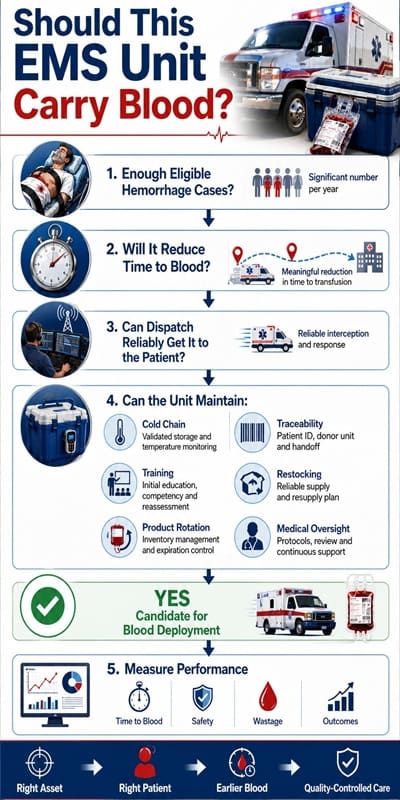
To justify carrying blood, a specific unit should pass three fundamental tests:
- Clinical demand: The unit should encounter, or reliably intercept, enough eligible hemorrhage cases to preserve readiness and justify the use of scarce inventory.
- Time advantage: Carrying blood should produce a meaningful reduction in time to transfusion compared with hospital administration or response by another blood-capable asset.
- Operational reliability: The agency and its transfusion-service partners must be able to maintain storage, traceability, training, medical oversight, adverse-event response, supply rotation, and continuous quality improvement without interruption.
What the Randomized Clinical Trials Actually Demonstrate
The randomized evidence does not produce one universal answer for every EMS system.
The PAMPer trial found lower 30-day mortality with prehospital plasma in an air medical network. However, the COMBAT trial did not reproduce that result during short urban ground transport. A pooled post hoc analysis later suggested that patients with transport times longer than 20 minutes might be more likely to benefit from plasma. That result is exploratory and should not be converted into a rigid stocking threshold.
The RePHILL trial found no improvement in its composite primary outcome when red blood cells plus lyophilized plasma were compared with saline in a United Kingdom prehospital critical-care model. The apparently discordant findings across PAMPer, COMBAT, and RePHILL likely reflect differences in geography, transport time, patient selection, comparator, product strategy, cointerventions, and outcome definition.
More recently, the SWiFT and TOWAR trials addressed a different question entirely. They sought to determine whether whole blood is superior to component therapy when both groups receive prehospital blood. Neither trial demonstrated superiority.
It is important to note that these neutral superiority trials do not prove that the strategies are exactly equivalent. They also do not establish that prehospital blood is ineffective or that components are inherently superior. They do, however, weaken any claim that whole blood should be selected solely because randomized evidence has demonstrated a better clinical outcome.
A 2026 AHRQ systematic review reached an appropriately cautious synthesis. The reviewers concluded that no transfusion or infusion intervention was consistently superior, noting that many comparisons had low or insufficient strength of evidence. They also highlighted that implementation research remains a major ongoing need. Insufficient evidence is not evidence that early blood has no value. It simply means deployment should be clinically plausible, locally measurable, and quality controlled rather than justified by a universal mortality claim.
Why Universal Blood Stocking Is Usually the Wrong Target
Managing Blood as a Scarce Regional Resource
Placing blood on low-use vehicles can increase the rotation burden and threaten availability elsewhere unless a reliable return-and-reissue pathway prevents waste. A unit of blood that is rarely transfused should not remain isolated on a vehicle until it reaches its expiration date.
Maintaining the Cold Chain as a Strict Clinical Control
A cooler alone does not create a safe transfusion program. Storage and transport conditions must be validated, continuously monitored, and thoroughly documented. The system must also have a defined response for temperature excursions, equipment failure, product quarantine, and restocking.
Preventing Competency Decay in Low-Frequency Procedures
Prehospital transfusion may be uncommon even in mature programs, making initial education insufficient on its own. Programs need recurrent simulation, observed competency assessment, documentation, and remediation for clinicians, supervisors, dispatch personnel, and support staff.
Understanding How Every Additional Unit Expands the Risk Surface
Each vehicle carrying blood adds another opportunity for identification errors, temperature excursions, traceability failures, undocumented transfusions, delayed recognition of adverse events, incomplete hospital handoffs, or restocking gaps.
Ensuring Dispatch Protocols Actually Deliver Inventory to the Patient
Blood stored on an uninvolved unit cannot help the patient. A smaller number of reliably dispatched blood-capable assets may provide better coverage than diffuse stocking, especially when supported by hemorrhage-aware call triage, automatic dispatch rules, and rendezvous procedures.
Coordinating Product Strategy Across the Entire System
Group O selection, RhD strategy, antibody-titer limits, recipient restrictions, product rotation, recall procedures, and shortage contingencies should be coordinated centrally with the blood supplier, transfusion service, receiving hospitals, and EMS medical director rather than improvised vehicle by vehicle.

Identifying the Strongest Candidate Assets for Blood Deployment
No national evidence-based formula identifies the exact vehicle classes that should carry blood. The following categories are program-design priorities rather than strict mandates. Each should be tested against local hemorrhage incidence, geography, transport intervals, dispatch performance, and transfusion-service capacity.
Strong Candidates for Deployment
Air medical or critical-care transport units are excellent candidates because longer transport intervals, high-acuity trauma, advanced staffing, and concentrated case volume often create a meaningful time advantage. Similarly, remote or rural advanced life support hubs can make early transfusion operationally valuable when distance to definitive care is significant, provided dispatch and supply continuity are reliable. Strategically placed supervisors, fly cars, or specialty response units also represent strong candidates, as a rendezvous model can extend geographic coverage without duplicating inventory on every single transport unit.
Conditional Candidates for Deployment
High-volume urban advanced life support units may be reasonable candidates when hemorrhage volume is high and modeling shows that selected transport units can deliver blood faster than a specialty asset or nearby trauma center. Interfacility critical-care teams might also carry blood if it is appropriate for unstable hemorrhage transfers under a distinct transfusion-service and medical-control protocol.
Units That Are Usually Not a First Priority
Low-volume basic life support or routine transport units are usually not a first priority. Universal inventory is difficult to justify on these vehicles without sufficient clinical demand, transfusion authority, dependable training, and a measurable time benefit.
A Practical Screening Tool for Prehospital Deployment
Before launching a program, the system should answer several critical questions across multiple domains.
Regarding clinical demand, leadership must determine how many patients met the proposed transfusion indication during the previous 12 to 24 months, and how many received early hospital transfusion or massive transfusion. Regarding **time advantage**, the system must calculate current median and 90th-percentile times to blood, and estimate how much each proposed asset would reduce them.
Dispatch reliability is equally crucial. The communications center must be able to identify probable hemorrhage and send or rendezvous the blood asset without delaying transport. Operational reliability requires confirming that storage, temperature monitoring, handoff, documentation, traceability, restocking, and product rotation can be maintained on every single shift.
Clinical readiness demands that authorized clinicians are trained, assessed, and supported by medical direction and a clear adverse-reaction pathway. Finally, the system must evaluate overall system impact to ensure the design preserves regional supply, equitable coverage, mutual aid, and resilience during shortages, cooler failure, or vehicle downtime.
A program should define success before launch. Useful measures include dispatch-to-blood-asset arrival time, patient-contact-to-transfusion time, protocol eligibility and compliance, product utilization and wastage, temperature excursions, identification and traceability completion, suspected adverse events, scene time, receiving-hospital communication, and risk-adjusted clinical outcomes. The Standardized EMS Metrics for Survival in Transfusion and Advanced Resuscitation, known as the SEMSTAR project, provides an excellent consensus framework for standardized reporting and benchmarking.
Selecting the Most Appropriate Blood Product for the Field
Low-titer group O whole blood is operationally attractive because one bag provides red blood cells, plasma, and platelets. This can significantly simplify packaging, field administration, and inventory management. The 2025 National Association of EMS Physicians position statement identifies low-titer group O whole blood as the first-choice product for traumatic life-threatening bleeding in systems capable of supporting a high-quality transfusion program.
However, that professional recommendation must now be interpreted alongside the SWiFT and TOWAR trials. Both trials found that whole blood was not superior to component therapy. Product choice should therefore reflect local availability, blood-supplier capacity, storage and rotation logistics, recipient policy, training burden, and receiving-hospital integration rather than an assertion of proven mortality superiority.
Red blood cells plus plasma offer a flexible component strategy with substantial prehospital trial experience, though this requires additional inventory and sequencing. Red blood cells alone replace oxygen-carrying capacity and may be simpler where plasma logistics are limiting, but they do not provide balanced hemostatic replacement. Plasma alone provides coagulation factors, and the PAMPer trial found lower 30-day mortality in its specific air medical setting, though the COMBAT trial was neutral. Platelets or additional products may complete hemostatic resuscitation in specialized programs, but their storage, supply, and operational requirements are more complex, making them an uncommon starting point for general EMS deployment.
Minimum Operational Requirements Before a Unit Carries Blood
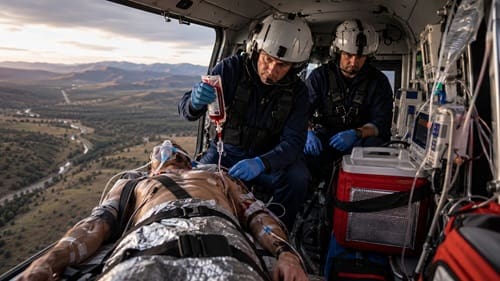
Before any unit carries blood, the system must establish robust governance. This includes named EMS physician leadership, a formal transfusion-medicine and blood-supplier partnership, receiving-hospital agreements, and strict compliance with state and local scope-of-practice requirements.
The system must also develop a comprehensive written clinical protocol. This document must define indications, exclusions, product selection, reassessment requirements, stopping rules, communication procedures, and the management of suspected transfusion reactions.
Validated logistics are non-negotiable. The program requires qualified storage and transport containers, continuous temperature monitoring, excursion management, a secure chain of custody, and documented restocking procedures. Identification and traceability must be ensured through positive patient identification when possible, donation-unit documentation, durable labeling, complete receiving-facility handoff, and hemovigilance reporting.
A rigorous competency program must be established, featuring initial education, simulation, observed skills, recurrent assessment, and remediation for all authorized clinicians and supervisors. Supply stewardship is equally important, requiring rotation into hospital use before expiration, shortage contingencies, mutual-aid procedures, and clear processes for recalled, quarantined, or temperature-exposed products. Finally, the system must commit to continuous quality improvement through case review, adverse-event review, protocol compliance monitoring, time metrics, inventory and wastage monitoring, and standardized outcome reporting.
Integrating Safety and Stewardship With Patient Access
Prehospital transfusion carries the same core hazards as transfusion in any other medical setting. These include acute hemolytic incompatibility, febrile and allergic reactions, anaphylaxis, transfusion-associated circulatory overload, transfusion-related acute lung injury, residual infectious risk, hypothermia, citrate-associated hypocalcemia, clerical error, and alloimmunization. Field conditions can make recognition, documentation, and escalation significantly more difficult.
Group O emergency-release products reduce but do not eliminate compatibility concerns. Whole blood contains donor plasma antibodies and red-cell antigens. Low-titer definitions, RhD strategy, recipient restrictions, and contingency use all belong in a formal local transfusion-service policy. For that reason, no universal product-selection rule can safely cover females of childbearing potential, pregnant patients, children, or patients likely to require repeated transfusion. Those populations require distinct product, RhD, dosing, documentation, and follow-up policies.
If a transfusion reaction is suspected, the clinician should immediately cease the transfusion, initiate protocolized reassessment, provide supportive care, contact medical control, preserve the product and tubing when required, notify the receiving hospital, and ensure hemovigilance follow-up. Any decision about restarting or modifying the transfusion must follow current labeling, transfusion standards, and local protocol.
Acknowledging Evidence Boundaries and Unresolved Clinical Questions
Several important boundaries and unresolved questions remain in the current literature. Most randomized evidence concerns adult traumatic hemorrhage. While nontraumatic bleeding is included in some implementation guidance, direct comparative evidence for medical bleeding is much thinner.
Furthermore, pediatric and obstetric transfusions require entirely separate policies. Adult trauma findings should never be generalized automatically to children, pregnancy, or postpartum hemorrhage. The optimal clinical trigger also remains uncertain. Current professional guidance favors a composite of physiology, mechanism, suspected bleeding, response to initial care, transport context, and clinical judgment rather than relying on one single vital-sign threshold.
The optimal product remains unsettled as well. Whole blood may offer distinct operational advantages, but randomized superiority over component therapy has not been demonstrated. Finally, the best deployment architecture is still unsettled. Regional models should be compared using time to blood, safety, supply stewardship, equitable coverage, and patient-centered outcomes rather than simply counting the number of blood-carrying vehicles.
The Bottom Line for EMS Medical Directors and System Leaders
Not every EMS unit should be expected to carry blood. Every EMS region should, however, determine whether patients with life-threatening hemorrhage can receive blood soon enough, and whether selected prehospital assets can safely close that gap.
The strongest current strategy is targeted deployment. Blood should be placed on assets that encounter or reliably intercept eligible patients, materially reduce time to transfusion, and can sustain a formal transfusion-quality system. Whole blood may be selected when it best fits the regional program, but it should not be justified by a claim of randomized-trial superiority over components. Systems should measure time to blood, protocol performance, safety, product stewardship, and clinical outcomes, then expand, reposition, or contract their programs according to those data.
Clinical Update Disclaimer
This review reflects literature, professional guidance, FDA-recognized labeling information, and transfusion standards available through August 12, 2026. Evidence, standards, regulatory labeling, and safety guidance may change. Clinicians and EMS systems should confirm current authoritative information, local scope-of-practice requirements, blood-supplier policies, and medical-direction protocols before applying these recommendations.
References
-
Carney N, Blackie K, Dana T, Kenzie E, Jungbauer R, Pappas M, Seater M, Goueth R, Yu Y, Daya M, Neth M, Overton-Harris P, Fu R, Totten AM. Prehospital Emergency Medical Services Blood Transfusion and Fluid Interventions for Hemorrhagic Shock: Systematic Review. AHRQ Publication No. 26-EHC006. Rockville, MD: Agency for Healthcare Research and Quality; February 2026.DOI. PMID: 42018698.NCBI Bookshelf.
-
Brown JB, Yazer MH, Kelly J, Spinella PC, DeMaio V, Fisher AD, Cap AP, Winckler CJ, Beltran G, Martin-Gill C, Guyette FX. Prehospital Trauma Compendium: Transfusion of Blood Products in Trauma – A Position Statement and Resource Document of NAEMSP. Prehosp Emerg Care. 2025;1-10. DOI. PubMed.
-
Levy MJ, Schaefer RM, Obyrne H, Krohmer JR, Bank EA, Holcomb JB. Prehospital blood transfusion coalition clinical practice guideline for civilian emergency medical services. Trauma Surg Acute Care Open. 2025;10(3). DOI. PubMed. Full text.
-
Association for the Advancement of Blood & Biotherapies. Standards for Emergency Prehospital and Scheduled Out-of-Hospital Transfusions. 1st ed. Effective July 1, 2025. Official source. Accessed August 12, 2026.
-
AABB, American Red Cross, America’s Blood Centers, and Armed Services Blood Program. Circular of Information for the Use of Human Blood and Blood Components. June 2024. Official source. Accessed August 12, 2026.
-
US Food and Drug Administration. An Acceptable Circular of Information for the Use of Human Blood and Blood Components: Guidance for Industry. September 2024. FDA guidance. Accessed August 12, 2026.
-
Sperry JL, Guyette FX, Brown JB, Yazer MH, Triulzi DJ, Early-Young BJ, et al.; PAMPer Study Group. Prehospital Plasma during Air Medical Transport in Trauma Patients at Risk for Hemorrhagic Shock. N Engl J Med. 2018;379(4):315-326. DOI. PubMed.
-
Moore HB, Moore EE, Chapman MP, McVaney K, Bryskiewicz G, Blechar R, et al. Plasma-first resuscitation to treat haemorrhagic shock during emergency ground transportation in an urban area: a randomised trial. Lancet. 2018;392(10144):283-291. DOI. PubMed. Full text.
-
Pusateri AE, Moore EE, Moore HB, Le TD, Guyette FX, Chapman MP, et al. Association of Prehospital Plasma Transfusion With Survival in Trauma Patients With Hemorrhagic Shock When Transport Times Are Longer Than 20 Minutes: A Post Hoc Analysis of the PAMPer and COMBAT Clinical Trials. JAMA Surg. 2020;155(2). DOI. PubMed. Full text.
-
Crombie N, Doughty HA, Bishop JRB, Desai A, Dixon EF, Hancox JM, et al.; RePHILL Collaborative Group. Resuscitation with blood products in patients with trauma-related haemorrhagic shock receiving prehospital care: a multicentre, open-label, randomised, controlled, phase 3 trial. Lancet Haematol. 2022;9(4). DOI. PubMed. Full text.
-
Smith JE, Cardigan R, Sanderson E, Silsby L, Rourke C, Barnard EBG, et al.; SWiFT Trial Group. Prehospital Whole Blood in Traumatic Hemorrhage – A Randomized Controlled Trial. N Engl J Med. 2026;394(23):2305-2316. DOI. PubMed.
-
Sperry JL, Guyette FX, Cotton BA, Luther JF, Utarnachitt RB, Kutcher ME, et al.; TOWAR Study Group. Prehospital Resuscitation with Type O Whole Blood for Trauma and Hemorrhage. N Engl J Med. 2026;394(23):2317-2328. DOI. PubMed. Full text.
-
Krohmer J, Obyrne H, Schaefer R, Bank EA, Holcomb JB, Bullock WJ, Hill RL, Levy M. Prehospital blood transfusion coalition core competencies for emergency medical services personnel. Trauma Surg Acute Care Open. 2026;11(1). DOI. PubMed. Full text.
-
Levy MJ, Obyrne H, Hack K, Staudt A, Crowe R, Bank EA, et al. Establishing the Standardized EMS Metrics for Survival in Transfusion and Advanced Resuscitation: the SEMSTAR project. Trauma Surg Acute Care Open. 2026;11(1). DOI. Journal page.
-
National Highway Traffic Safety Administration, Office of Emergency Medical Services. Prehospital Blood Transfusion. Last updated June 24, 2026. Official source. Accessed August 12, 2026.
Recent Articles


Integrative Perspectives on Cognition, Emotion, and Digital Behavior

Sleep-related:
Longevity/Nutrition & Diet:
Philosophical / Happiness / Social:
Other:
Modern Mind Unveiled
Developed under the direction of David McAuley, Pharm.D., this collection explores what it means to think, feel, and connect in the modern world. Drawing upon decades of clinical experience and digital innovation, Dr. McAuley and the GlobalRPh initiative translate complex scientific ideas into clear, usable insights for clinicians, educators, and students.
The series investigates essential themes–cognitive bias, emotional regulation, digital attention, and meaning-making—revealing how the modern mind adapts to information overload, uncertainty, and constant stimulation.
At its core, the project reflects GlobalRPh’s commitment to advancing evidence-based medical education and clinical decision support. Yet it also moves beyond pharmacotherapy, examining the psychological and behavioral dimensions that shape how healthcare professionals think, learn, and lead.
Through a synthesis of empirical research and philosophical reflection, Modern Mind Unveiled deepens our understanding of both the strengths and vulnerabilities of the human mind. It invites readers to see medicine not merely as a science of intervention, but as a discipline of perception, empathy, and awareness–an approach essential for thoughtful practice in the 21st century.
The Six Core Themes
I. Human Behavior and Cognitive Patterns
Examining the often-unconscious mechanisms that guide human choice-how we navigate uncertainty, balance logic with intuition, and adapt through seemingly irrational behavior.
II. Emotion, Relationships, and Social Dynamics
Investigating the structure of empathy, the psychology of belonging, and the influence of abundance and selectivity on modern social connection.
III. Technology, Media, and the Digital Mind
Analyzing how digital environments reshape cognition, attention, and identity- exploring ideas such as gamification, information overload, and cognitive “nutrition” in online spaces.
IV. Cognitive Bias, Memory, and Decision Architecture
Exploring how memory, prediction, and self-awareness interact in decision-making, and how external systems increasingly serve as extensions of thought.
V. Habits, Health, and Psychological Resilience
Understanding how habits sustain or erode well-being-considering anhedonia, creative rest, and the restoration of mental balance in demanding professional and personal contexts.
VI. Philosophy, Meaning, and the Self
Reflecting on continuity of identity, the pursuit of coherence, and the construction of meaning amid existential and informational noise.
Keywords
Cognitive Science • Behavioral Psychology • Digital Media • Emotional Regulation • Attention • Decision-Making • Empathy • Memory • Bias • Mental Health • Technology and Identity • Human Behavior • Meaning-Making • Social Connection • Modern Mind
Video Section