The One-Piece Takeaway: How Trail-Hip Lift and Lead-Shoulder Descent Build a Reliable Golf Swing

Abstract
A sound golf swing begins with a connected, one-piece takeaway in which the club, hands, arms, chest, and torso start back as a coordinated unit. The feel is not merely “turn the shoulders.” A more useful image is that the trail hip begins to work upward and around while the lead shoulder moves down toward the ball. This creates depth, tilt, width, and early structure without forcing the hands to manipulate the club. Combine this with the trail arm secret.
Introduction
Golf instruction often gets buried under slogans: “keep your head down,” “swing easy,” “turn through it,” “let the club do the work.” The problem is that the club rarely volunteers. It usually requires coordinated body motion, a stable setup, and a takeaway that does not unravel the swing before it begins.
A useful central principle is this: the takeaway should feel like one connected motion, with the trail hip moving up and around as the lead shoulder moves down toward the ball. This is not just a stylistic preference. It fits well with modern golf biomechanics, especially the importance of the torso-pelvis relationship, rotational sequencing, and maintaining swing radius. Research on golf swing mechanics has repeatedly emphasized the role of upper-torso and pelvic rotation, segment separation, and the kinematic sequence in producing efficient clubhead speed and ball velocity.
The goal is not to create a robotic backswing. It is to create a backswing that gives the downswing a fighting chance.

The Takeaway Is the Swing’s Opening Argument
The first two feet of club movement set the tone for the rest of the swing. A poor takeaway can send the club too far inside, too far outside, too steep, too flat, or disconnected from the body. Once that happens, the golfer spends the rest of the swing making compensations. Sometimes these compensations work. Sometimes they produce a majestic 40-yard slice into a fairway that belongs to another hole.
The one-piece takeaway reduces this chaos. In a connected takeaway, the hands do not snatch the club away independently. The wrists do not roll the clubface open. The arms do not detach from the chest. Instead, the chest, arms, hands, and club move together while the lower body begins to respond in sequence. The motion feels wide, quiet, and organized.
This does not mean the hips should spin immediately or aggressively. A good takeaway is not a dance contest between the hips and shoulders. The trail hip begins to work upward and around, while the lead shoulder moves down and toward the ball. That combination helps the golfer turn on an inclined plane rather than simply swaying laterally or standing up out of posture.
Why the Trail Hip Should Feel Like It Moves Up
For a right-handed golfer, the trail hip is the right hip. During a proper backswing, it should not merely slide away from the target. It should rotate back and slightly upward as the pelvis turns on an incline. This sensation can help the player maintain posture, create depth, and avoid a flat, around-the-body takeaway.
The “trail hip up” feeling is especially helpful because many amateurs misunderstand rotation. They hear “turn” and immediately spin the hips level, like a lazy Susan at a diner. That creates a flat shoulder turn, loss of spine angle, and often a club that gets dragged too far inside. The better image is more three-dimensional. The pelvis turns, but it also responds to the golfer’s address posture and side bend.
A useful checkpoint: at the top of the backswing, the trail hip should feel deeper and slightly higher than it was at address, while pressure has moved into the inside of the trail foot. The golfer should feel coiled, not collapsed.
Why the Lead Shoulder Should Move Down Toward the Ball
The lead shoulder moving down toward the ball is the matching piece. It helps the torso rotate around the spine angle established at address. Without this downward lead-shoulder motion, golfers often lift the chest, flatten the shoulder turn, or stand up during the takeaway.
The phrase “lead shoulder to the ball” is a directional cue. It tells the player that the lead side should work down and across, not level and around.
This matters because the golf swing is performed from an inclined posture. A baseball swing occurs more horizontally. A golf swing has to deliver the club downward and forward into a ball on the ground. The lead shoulder moving down helps preserve that geometry.
Table 1
| Swing element | Desired feel | Common fault | Likely result | Corrective cue |
|---|---|---|---|---|
| Takeaway | Chest, arms, hands, and club move as one unit | Hands snatch club inside | Flat backswing, open face, blocks or hooks | “Move the triangle together.” |
| Trail hip | Moves up, back, and around | Hip slides laterally | Sway, poor pressure shift, inconsistent low point | “Trail pocket turns behind you.” |
| Lead shoulder | Moves down toward the ball | Shoulder turns level | Loss of posture, lifted backswing, thin shots | “Lead shoulder points toward the ball.” |
| Clubface | Stays relatively square to arc | Early forearm roll | Open face, compensations at the top | “Keep the logo/knuckles quiet.” |
| Pressure | Moves into inside of trail foot | Weight rolls outside trail foot | Reverse move or poor transition | “Load inside the trail heel.” |
| Width | Arms stay extended but relaxed | Trail arm folds too early | Narrow backswing, timing-dependent release | “Keep the handle away from your chest.” |
The Biomechanics Behind the Feel
The golf swing is a sequence of linked movements. Energy is generated from the ground, transferred through the lower body and trunk, and then delivered through the arms, hands, club, and ball. Studies of golf swing mechanics have associated greater ball velocity with variables such as upper torso-pelvis separation, weight shift, trunk tilt, and delayed release patterns.
This is where the one-piece takeaway becomes more than an aesthetic preference. When the takeaway is connected, the golfer has a better chance of creating useful separation between the torso and pelvis later in the backswing. Myers and colleagues found that torso-pelvic separation and upper torso rotational velocity were related to ball velocity in recreational golfers.
However, separation should not be forced. Many golfers hear “X-factor” and try to freeze the hips while violently turning the shoulders. That can create tension, restricted motion, and stress on the lower back. A better approach is to let the backswing organize naturally: connected takeaway first, trail hip working up and around, lead shoulder working down, then the torso completing its turn.
In plain English: coil like an athlete, not like someone trying to open a stuck pickle jar with their spine.
Setup: The Forgotten Foundation
The takeaway cannot fix a poor setup. A golfer who begins with poor posture, weak balance, or incorrect ball position is already negotiating with physics, and physics is a notoriously stubborn negotiator.
A good setup includes athletic posture, slight knee flex, a neutral pelvis, and a spine tilted forward from the hips. The arms should hang naturally. Grip pressure should be firm enough to control the club but not so tight that the forearms become rigid. The ball position should match the club. The driver is played more forward. Short irons are more centered. Fairway woods and hybrids live between those extremes.
Once posture is established, the lead shoulder can move down naturally. If the golfer stands too upright, the shoulder has nowhere useful to go. If the golfer bends excessively from the waist, the swing becomes cramped. Balance matters.
The Role of the Arms and Hands
A one-piece takeaway does not mean the arms are passive ropes. The arms maintain structure. The hands hold the club securely. The wrists remain quiet early, then hinge naturally as the backswing develops.
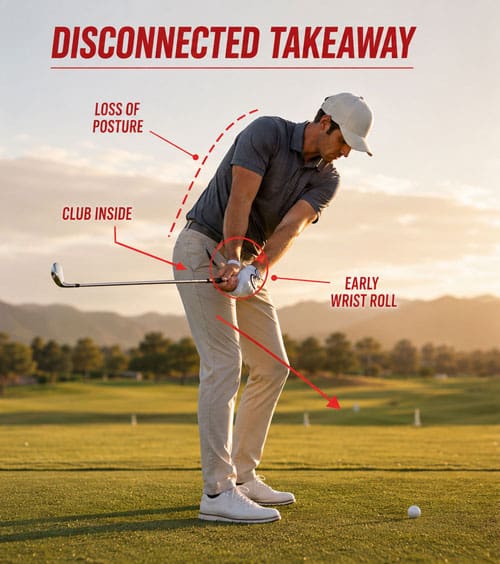
The common mistake is overusing the hands. When the hands dominate the takeaway, the clubhead often moves behind the hands too early. The face opens. The trail elbow folds prematurely. The player then has to reroute the club on the downswing. Occasionally, this produces a playable shot, but it is not a reliable business model.
The better pattern is simple: the body moves the arms, and the arms move the club. The hands provide control, not panic.
The Trail Hip and Pressure Shift
The phrase “weight shift” can be misleading. Many golfers translate it as “move your body sideways.” A better term is pressure shift. During the backswing, pressure moves into the trail side, especially the inside of the trail foot and heel. The body turns over that pressure.
The trail hip moving up and around helps prevent a sway. It also creates space for the arms. A golfer who sways laterally often gets trapped. The arms lift. The club loses structure. The downswing becomes a rescue mission.
When done correctly, the golfer feels loaded but centered. The head may move slightly, but it should not drift dramatically. The lower body supports the coil rather than replacing it.
Transition: The Payoff for a Good Takeaway
The best reason to improve the takeaway is that it improves transition. Transition is the moment when the backswing becomes the downswing. It is also where many otherwise respectable people become amateur meteorologists, tracking the wind while pretending the shot they just hit was not their fault.
A connected backswing allows the lower body to begin the downswing while the upper body completes its coil. This creates a smooth change of direction. The club shallows more naturally. The golfer can rotate through impact rather than throwing the hands from the top.
In contrast, a disconnected takeaway often forces a rushed transition. The player senses the club is out of position and instinctively tries to fix it. That usually means early hand action, early shoulder spin, or a steep over-the-top move.

Practical Training Approach
The best drill is a slow rehearsal. Take the club back until the shaft is parallel to the ground. Stop. Check that the clubhead is outside or in line with the hands, the clubface is not dramatically rolled open, the trail hip has begun to move back and slightly up, and the lead shoulder has moved down toward the ball.
Then rehearse to the top. The trail hip should feel deep. The lead shoulder should feel under the chin. The arms should feel wide. Nothing should feel violently stretched.
A second useful drill is to place an alignment stick just outside the ball-target line behind the clubhead. During the takeaway, the club should not whip dramatically inside the stick. This provides immediate feedback. The golfer learns to move the club back with the body rather than yanking it inward with the hands.
Individual Differences Matter
Not every golfer will look the same. Age, mobility, injury history, hip structure, thoracic rotation, strength, and skill level all affect swing shape. A college golfer, a 60-year-old recreational player, and a tour professional may all use the same principles but display them differently.
This is important. The cue “trail hip up, lead shoulder down” should be adapted to the player. For some golfers, it will create an ideal backswing. For others, it may need moderation. A golfer with limited hip mobility may need a slightly flared trail foot. A golfer with back pain may need a shorter backswing. A highly flexible golfer may need more structure, not more turn.
Good instruction is not about copying a model. It is about matching principles to the body in front of you.
Common Errors
The most common error is confusing “one-piece” with “stiff.” The takeaway should be connected, but not rigid. Another mistake is turning the shoulders level. That often causes the club to move too far inside and the body to rise. A third mistake is overemphasizing the hip turn. If the hips outrun the torso early, the swing loses coil.
The final mistake is treating the takeaway as a position rather than a motion. Positions matter, but golf is movement. A technically perfect checkpoint achieved through tension and manipulation is not very useful. The goal is a repeatable motion that can survive pressure, uneven lies, and the terrifying sight of water on the right.
The one-piece takeaway is one of the most important fundamentals in the golf swing because it organizes the body, club, and sequence from the start. The specific feel of the trail hip moving up and around while the lead shoulder moves down toward the ball gives the golfer a practical way to preserve posture, create depth, maintain width, and prepare for a powerful transition.
This concept is not a magic trick. Golf does not hand out miracles. But it is a reliable foundation. When the takeaway is connected, the backswing becomes simpler. When the backswing is simpler, the downswing becomes less desperate. And when the downswing is less desperate, the golfer has a much better chance of striking the center of the clubface rather than conducting another field study in nearby trees.

At an age when I should probably be easing into the senior division, I still generate club speeds that would place me near the upper tier of professional players. I do this while using traditional player’s irons, including Mizuno blades and similar compact irons that offer very little forgiveness. Hitting an 8-iron more than 200 yards is not especially useful on the course. In fact, it can be wildly inconvenient when the goal is precision, not shock value. But it does demonstrate something important: power is not only a product of size, youth, or effort. It is the result of sequencing, leverage, timing, and the efficient transfer of energy.
My approach to the swing comes from breaking it down into its core mechanical elements. Centripetal force, torque, angular momentum, ground reaction forces, and the double-pendulum effect are not abstract textbook concepts. They are present in every powerful, repeatable golf swing. When the body, arms, hands, and club work together in the correct sequence, the swing becomes less about “trying to hit hard” and more about creating speed through structure.
This paper is built around that idea. A reliable golf swing begins with a connected, one-piece takeaway, supported by the sensation of the trail hip moving up and around while the lead shoulder moves down toward the ball. That movement pattern helps establish depth, tilt, width, and stored energy early in the swing. From there, the golfer has a much better chance of converting rotation into speed, speed into compression, and compression into controlled ball flight.
References
Bourgain, M., Rouch, P., Rouillon, O., Thoreux, P., & Sauret, C. (2022). Golf swing biomechanics: A systematic review and methodological recommendations for kinematics. Sports, 10(6), 91. https://doi.org/10.3390/sports10060091
Chu, Y., Sell, T. C., & Lephart, S. M. (2010). The relationship between biomechanical variables and driving performance during the golf swing. Journal of Sports Sciences, 28(11), 1251–1259. https://doi.org/10.1080/02640414.2010.507249
Hume, P. A., Keogh, J., & Reid, D. (2005). The role of biomechanics in maximising distance and accuracy of golf shots. Sports Medicine, 35(5), 429–449. https://doi.org/10.2165/00007256-200535050-00005
McLean, J., & Andrisani, J. (1997). The X-factor swing. HarperCollins.
Myers, J., Lephart, S., Tsai, Y. S., Sell, T., Smoliga, J., & Jolly, J. (2008). The role of upper torso and pelvis rotation in driving performance during the golf swing. Journal of Sports Sciences, 26(2), 181–188. https://doi.org/10.1080/02640410701373543
Recent Articles


Integrative Perspectives on Cognition, Emotion, and Digital Behavior

Sleep-related:
Longevity/Nutrition & Diet:
Philosophical / Happiness / Social:
Other:
Modern Mind Unveiled
Developed under the direction of David McAuley, Pharm.D., this collection explores what it means to think, feel, and connect in the modern world. Drawing upon decades of clinical experience and digital innovation, Dr. McAuley and the GlobalRPh initiative translate complex scientific ideas into clear, usable insights for clinicians, educators, and students.
The series investigates essential themes–cognitive bias, emotional regulation, digital attention, and meaning-making—revealing how the modern mind adapts to information overload, uncertainty, and constant stimulation.
At its core, the project reflects GlobalRPh’s commitment to advancing evidence-based medical education and clinical decision support. Yet it also moves beyond pharmacotherapy, examining the psychological and behavioral dimensions that shape how healthcare professionals think, learn, and lead.
Through a synthesis of empirical research and philosophical reflection, Modern Mind Unveiled deepens our understanding of both the strengths and vulnerabilities of the human mind. It invites readers to see medicine not merely as a science of intervention, but as a discipline of perception, empathy, and awareness–an approach essential for thoughtful practice in the 21st century.
The Six Core Themes
I. Human Behavior and Cognitive Patterns
Examining the often-unconscious mechanisms that guide human choice-how we navigate uncertainty, balance logic with intuition, and adapt through seemingly irrational behavior.
II. Emotion, Relationships, and Social Dynamics
Investigating the structure of empathy, the psychology of belonging, and the influence of abundance and selectivity on modern social connection.
III. Technology, Media, and the Digital Mind
Analyzing how digital environments reshape cognition, attention, and identity- exploring ideas such as gamification, information overload, and cognitive “nutrition” in online spaces.
IV. Cognitive Bias, Memory, and Decision Architecture
Exploring how memory, prediction, and self-awareness interact in decision-making, and how external systems increasingly serve as extensions of thought.
V. Habits, Health, and Psychological Resilience
Understanding how habits sustain or erode well-being-considering anhedonia, creative rest, and the restoration of mental balance in demanding professional and personal contexts.
VI. Philosophy, Meaning, and the Self
Reflecting on continuity of identity, the pursuit of coherence, and the construction of meaning amid existential and informational noise.
Keywords
Cognitive Science • Behavioral Psychology • Digital Media • Emotional Regulation • Attention • Decision-Making • Empathy • Memory • Bias • Mental Health • Technology and Identity • Human Behavior • Meaning-Making • Social Connection • Modern Mind
Video Section