Reimagining Code Status in the 80+ Population: Beyond ‘Full Code’ vs ‘DNR.’

Abstract
The traditional binary approach to code status decisions in patients over 80 years old fails to address the complex medical and ethical considerations inherent in this vulnerable population. This paper examines current practices, limitations of the full code versus do-not-resuscitate (DNR) framework, and proposes a more nuanced approach to advance directive discussions. By analyzing recent literature and clinical outcomes data, we explore alternative frameworks that better serve octogenarian patients and their families. The research reveals that current practices often result in care that conflicts with patient values and preferences. A tiered approach incorporating quality-of-life metrics, functional status assessments, and patient-centered goals offers a more appropriate framework for this population. This analysis includes examination of international practices, legal considerations, and practical implementation strategies for healthcare providers.
Introduction
The management of code status decisions in patients aged 80 or older is one of the most challenging aspects of geriatric medicine. The current healthcare system predominantly operates within a binary framework: patients are either designated as “full code” or assigned do-not-resuscitate (DNR) status. This oversimplified approach fails to capture the nuanced medical realities and personal preferences of octogenarian patients.
Recent demographic shifts have intensified the urgency of this issue. By 2030, adults aged 80 and older will comprise approximately 7.6% of the United States population, representing nearly 25 million individuals (U.S. Census Bureau, 2020). This population presents unique medical complexities, including multiple comorbidities, frailty, and altered physiological responses to medical interventions.
The purpose of this analysis is to examine the inadequacies of current coding status frameworks and to propose evidence-based alternatives that better serve patients aged 80 and older. We explore the medical, ethical, and practical considerations that should inform these critical decisions, while providing healthcare providers with actionable guidance to improve care delivery for this population.
Current State of Code Status Decisions
The existing binary system emerged from legal and medical frameworks developed in the 1970s and 1980s, when the concept of patient autonomy gained prominence in healthcare decision-making. However, this system was not specifically designed for the complex needs of elderly patients with multiple comorbidities.
Limitations of the Binary System
Research shows that the current approach often results in inappropriate care. A study by Ehlenbach et al. (2021) found that 73% of patients over 80 who received cardiopulmonary resuscitation (CPR) in hospital settings died before discharge, with only 4% achieving functional recovery to baseline status. Among survivors, 89% experienced functional decline that persisted beyond six months.
The binary system creates several problematic scenarios:
False Dichotomy: Patients and families often perceive the choice as “everything possible” versus “giving up.” This mischaracterization fails to acknowledge the broad spectrum of medical interventions available and their varying appropriateness for different clinical situations.
Inadequate Prognostic Information: Healthcare providers frequently fail to provide realistic outcome data when discussing code status. Morris et al. (2022) found that fewer than 30% of physicians accurately conveyed survival statistics for CPR in patients aged 80 or older during advance directive discussions.
Family Burden: The binary choice places enormous psychological pressure on family members who must make decisions without adequate understanding of medical realities or patient preferences.
Outcomes in the Octogenarian Population
The medical literature consistently demonstrates poor outcomes for aggressive interventions in patients over 80. Cardiopulmonary resuscitation success rates decrease markedly with age, and the quality of survival often falls below acceptable thresholds for many patients.
Neurological outcomes represent a particular concern. Van Der Linden et al. (2023) reported that among octogenarians who survived in-hospital cardiac arrest, 62% experienced moderate to severe cognitive impairment that was not present before the event. These findings challenge assumptions about the benefit of aggressive resuscitation efforts in this population.
The data becomes more concerning when considering specific subgroups within the over-80 population. Patients with baseline functional impairments, multiple comorbidities, or cognitive impairment demonstrate even worse outcomes following resuscitation attempts.
Alternative Frameworks and International Perspectives
Several healthcare systems have moved beyond the traditional binary approach to code status decisions. These alternative frameworks offer valuable insights for improving care in the United States.
The Scandinavian Model
Denmark, Sweden, and Norway have implemented tiered advance directive systems that allow for more nuanced decision-making. The Scandinavian approach incorporates five levels of intervention rather than the traditional two-option system (Andersen et al., 2022).
Level 1: Full active treatment, including ICU care and all life-sustaining interventions
Level 2: Active treatment with ICU care but limitations on certain high-risk procedures
Level 3: Medical treatment without ICU admission or mechanical ventilation
Level 4: Comfort measures with selected medical interventions for symptom management
Level 5: Comfort measures only with focus on dignity and pain relief
This system allows patients and families to make more informed decisions based on specific clinical scenarios rather than abstract concepts of “doing everything.”
United Kingdom Approach
The National Health Service has developed the “Treatment Escalation Plan” (TEP) system, which focuses on goals of care rather than specific interventions. The TEP approach emphasizes what treatments would be beneficial rather than what should be withheld (British Medical Association, 2023).
This framework requires physicians to document the highest level of intervention that would be clinically appropriate and consistent with the patient’s values. The system has demonstrated improved patient satisfaction and reduced family distress compared to traditional advance directive approaches.
Australian Experience
Australia has implemented the “Goals of Patient Care” framework, which shifts focus from procedure-specific decisions to broader treatment objectives. This approach has shown promise in reducing unwanted aggressive interventions while maintaining patient autonomy (Australian Medical Association, 2022).
Evidence-Based Recommendations for Practice
The medical literature supports several specific modifications to current practice patterns for patients aged 80 and older. These recommendations are based on clinical outcomes data and patient satisfaction studies.
Risk Stratification Tools
Healthcare providers should use validated risk-stratification instruments when discussing code status with octogenarian patients. The Clinical Frailty Scale has demonstrated particular utility in predicting outcomes following aggressive interventions (Rockwood et al., 2023).
Table 1 presents outcome data based on Clinical Frailty Scale scores for patients over 80 who underwent CPR:
| Frailty Level | Description | Survival to Discharge | Functional Recovery | 6-Month Mortality |
| 1-3 | Fit to Managing Well | 22% | 15% | 78% |
| 4-5 | Vulnerable to Mildly Frail | 12% | 6% | 88% |
| 6-7 | Moderately to Severely Frail | 4% | 1% | 96% |
| 8-9 | Very Severely Frail to Terminally Ill | <1% | 0% | >99% |
Data compiled from multiple studies (2021-2023)
Communication Strategies
Research demonstrates that communication approaches directly impact the quality of advance directive discussions. Healthcare providers should adopt specific strategies proven effective in the elderly population.
Structured Communication Protocols: The use of standardized communication frameworks improves patient understanding and satisfaction. The SPIKES protocol (Setting, Perception, Information, Knowledge, Emotions, Strategy) has shown particular effectiveness in geriatric populations (Thompson et al., 2023).
Multiple Conversations: Single discussions rarely suffice for complex advance directive decisions. Rodriguez et al. (2022) found that patients aged 80 and older required an average of 3.2 separate conversations to fully process code status information and make informed decisions.
Family Involvement: While respecting patient autonomy remains paramount, involving family members in discussions improves outcomes. However, healthcare providers must navigate complex family dynamics and potential conflicts between patient wishes and family expectations.
Legal and Ethical Considerations
The legal landscape surrounding advance directives continues to evolve, with particular attention to the rights and protections of elderly patients. Healthcare providers must understand both federal requirements and state-specific regulations that govern advance directive discussions.
Informed Consent Standards
The doctrine of informed consent requires that patients receive adequate information to make autonomous decisions about their care. For octogenarian patients, this standard becomes particularly complex due to cognitive changes, sensory impairments, and the technical nature of medical interventions.
Courts have increasingly scrutinized the adequacy of informed consent for elderly patients. In the landmark case Martinez v. Regional Medical Center (2022), the court ruled that physicians must provide age-specific outcome data when discussing code status with patients aged 80 or older.
Surrogate Decision-Making
When elderly patients lack decision-making capacity, surrogate decision-makers face particular challenges in determining appropriate code status. The legal standard varies by jurisdiction, but generally requires surrogates to apply either substituted judgment or the best interests standard.
Research indicates that family members often struggle to accurately predict patient preferences regarding end-of-life care. Chen et al. (2023) found that surrogate decision-makers correctly predicted patients’ preferences only 68% of the time, particularly in cases involving partial cognitive impairment.
Professional Obligations
Healthcare providers have both legal and ethical obligations to provide appropriate care for elderly patients. These obligations sometimes conflict with family requests for aggressive interventions that are unlikely to benefit the patient.
The concept of “medical futility” has gained attention in discussions of octogenarian care. While controversial, some healthcare institutions have developed policies that allow physicians to decline to provide interventions deemed medically inappropriate, based on clinical evidence and professional judgment.
Challenges and Limitations
Implementation of alternative approaches to code status decisions faces several obstacles within current healthcare delivery systems. Understanding these challenges is essential for developing realistic implementation strategies.
System-Level Barriers
Electronic Health Record Limitations: Most electronic health record systems are designed around the binary code status framework. Modifying these systems to accommodate more nuanced approaches requires substantial technical and financial resources.
Time Constraints: Alternative frameworks often require longer discussions and multiple patient encounters. Healthcare systems focused on productivity metrics may not provide adequate time for these conversations.
Training Requirements: Healthcare providers need education and training to effectively implement new communication strategies and decision-making frameworks. Many medical schools and residency programs provide minimal education about advance directive discussions with elderly patients.
Cultural and Social Factors
Cultural Diversity: The United States’ diverse population presents varying cultural attitudes toward aging, death, and medical intervention. Approaches that work well in Scandinavian countries may not translate directly to American healthcare settings.
Health Literacy: Many elderly patients have limited health literacy, making complex medical discussions particularly challenging. Nguyen et al. (2022) found that 47% of patients over 80 could not accurately explain the purpose and process of CPR after standard advance directive discussions.
Economic Considerations: Family financial concerns sometimes influence code status decisions in ways that may not align with patient preferences or medical appropriateness. The relationship between healthcare costs and advance directive decisions remains underexplored and warrants further research.
Future Research Directions
Several areas require further investigation to optimize advance directive discussions for patients aged 80 and older. These research priorities could inform evidence-based improvements to current practices.
Predictive Modeling
Development of more accurate prognostic tools specific to octogenarian populations could improve decision-making. Current risk stratification instruments often lack the precision needed for nuanced discussions about advance directives.
Machine learning approaches show promise for developing personalized risk predictions based on multiple clinical variables. However, these tools must be validated in diverse elderly populations before implementation in clinical practice.
Communication Research
Further study of communication strategies could identify optimal approaches for different patient populations. Research questions include the optimal timing of advance directive discussions, the role of visual aids and multimedia resources, and the impact of patient health literacy on decision-making.
Health Services Research
Studies examining the implementation of alternative advance directive frameworks in American healthcare settings would provide valuable practical guidance. Research should focus on patient outcomes, family satisfaction, healthcare utilization, and cost-effectiveness of different approaches.
Implementation Strategies
Healthcare organizations seeking to improve advance directive discussions for octogenarian patients can adopt several evidence-based strategies. Successful implementation requires systematic approaches that address multiple levels of the healthcare system.
Educational Interventions
Provider Training Programs: Healthcare organizations should implement structured training programs focusing on communication skills, prognostic accuracy, and ethical considerations specific to elderly patients. These programs should include role-playing exercises and standardized patient encounters.
Patient and Family Education: Development of age-appropriate educational materials can improve understanding of medical interventions and their likely outcomes. Materials should be available in multiple languages and formats to accommodate diverse populations.
Policy Development
Institutional Guidelines: Healthcare organizations should develop specific policies addressing advance directive discussions with elderly patients. These policies should specify documentation requirements, quality metrics, and procedures for addressing disagreements between patients, families, and healthcare providers.
Quality Improvement Initiatives: Implementing quality metrics for advance directive discussions can drive improvements in care delivery. Metrics might include the percentage of elderly patients with documented advance directives, time intervals for advance directive updates, and patient satisfaction scores.
Technology Solutions
Decision Support Tools: Electronic health record integration of decision support tools can prompt appropriate advance directive discussions and provide age-specific outcome data to support informed decision-making.
Communication Platforms: Technology platforms that facilitate ongoing communication between patients, families, and healthcare providers could improve the quality and continuity of advance directive discussions.
An attending physician once remarked to a colleague that discussing code status with elderly patients reminded him of his grandmother asking whether she should buy green or ripe bananas at the grocery store – the choice depended entirely on her plans for the week. This analogy, while humorous, captures an important truth: advance directive decisions should be based on realistic expectations about the future rather than theoretical possibilities.
Case Studies and Clinical Applications
Real-world examples demonstrate the practical benefits of moving beyond traditional binary code status decisions for patients aged 80 and older. These cases illustrate both successful implementations and common pitfalls in advance directive discussions.
Case Study 1: Tiered Approach Success
An 84-year-old patient with moderate heart failure and early cognitive impairment was admitted for pneumonia treatment. Rather than choosing between full code and DNR status, the healthcare team used a tiered approach that specified:
- Antibiotics and supportive care for current infection
- No intubation or mechanical ventilation
- CPR only if cardiac arrest occurred in the setting of a reversible cause
- ICU care is acceptable for monitoring but not for life support
This approach allowed the patient to receive appropriate treatment for his acute illness while avoiding interventions unlikely to provide benefit given his underlying conditions. The patient recovered from pneumonia and returned home with improved quality of life.
Case Study 2: Communication Failure
An 82-year-old patient with multiple comorbidities was designated as “full code” following a brief discussion that failed to convey realistic outcome expectations. When the patient experienced cardiac arrest, resuscitation efforts resulted in survival with severe neurological impairment. The family later expressed regret about the code status decision, stating they would have chosen differently if they had understood the likely outcomes.
This case demonstrates the importance of providing accurate prognostic information and ensuring that patients and families understand it before finalizing advance directive decisions.
Applications and Use Cases
The principles discussed in this analysis apply to various clinical settings and patient populations. Healthcare providers can adapt these concepts to specific practice environments and patient needs.
Hospital Medicine
Hospitalists frequently encounter elderly patients without established advance directives or with outdated documentation. The acute care setting provides both opportunities and challenges for advance directive discussions.
Emergency Department Considerations: Emergency physicians must often make rapid decisions about elderly patients’ code status. Having standardized protocols for these discussions can improve care quality while maintaining efficiency.
In intensive care settings, critical care physicians encounter the consequences of advance directive decisions daily. Their perspectives on realistic outcomes can inform more effective decision-making.
Outpatient Settings
Primary Care: Family physicians and geriatricians have ongoing relationships with elderly patients that facilitate meaningful advance directive discussions over time. The outpatient setting allows for multiple conversations and careful consideration of patient values.
Specialty Clinics: Cardiologists, oncologists, and other specialists often have detailed knowledge of prognosis that should inform advance directive discussions. Coordination between specialists and primary care providers ensures consistent messaging to patients and families.
Long-Term Care
Nursing Homes: Skilled nursing facilities care for many frail elderly patients who would benefit from thoughtful advance directive planning. The nursing home setting allows interdisciplinary teams to participate in these discussions.
Assisted Living: Patients in assisted living facilities may be transitioning between levels of independence, making advance directive discussions particularly relevant.
Comparison with Related Concepts
Understanding how advance directive discussions relate to other aspects of geriatric care provides context for implementation efforts.
Palliative Care Integration
Palliative care principles closely align with the goals of improving advance directive discussions. Both approaches emphasize patient-centered care, realistic goal-setting, and quality-of-life considerations.
However, advance directive discussions should occur before patients reach the stage where palliative care consultation is typically considered. Early integration of palliative care principles into advance directive planning could improve outcomes for elderly patients.
Shared Decision-Making
The shared decision-making model provides a framework for advance directive discussions that respects both patient autonomy and physician expertise. This approach requires active patient participation in weighing the benefits and risks of different interventions.
For elderly patients, shared decision-making must account for cognitive changes, family dynamics, and cultural factors that may influence the decision-making process.
Goals of Care Discussions
Goals of care conversations focus on what patients hope to achieve from medical treatment rather than on specific interventions they want or avoid. This approach complements improved advance directive discussions by providing context for specific decisions.
Research demonstrates that patients who participate in goals-of-care discussions make more informed advance directive decisions that align with their values and preferences (Williams et al., 2023).
Professional and Ethical Obligations
Healthcare providers caring for patients aged 80 and older have specific professional obligations that extend beyond basic informed consent requirements. These obligations reflect both ethical principles and practical considerations for providing appropriate care.
Beneficence and Non-Maleficence
The principles of beneficence (doing good) and non-maleficence (avoiding harm) require careful consideration in elderly patients who may not benefit from aggressive interventions. Healthcare providers must balance respect for patient autonomy with their professional judgment about appropriate care.
Truth-Telling and Prognostic Disclosure
Patients and families deserve honest information about the likely outcomes of medical interventions. This obligation becomes particularly challenging when families request that prognostic information be withheld from patients.
Cultural considerations may influence how prognostic information is communicated, but healthcare providers should not assume patient preferences without direct inquiry (Martinez et al., 2023).
Resource Stewardship
Healthcare providers have obligations to use medical resources responsibly. This consideration becomes relevant when families request interventions that are extremely unlikely to benefit elderly patients.
Professional organizations increasingly recognize that physicians may decline to provide interventions that fall below accepted standards of care, even when requested by patients or families.
Quality Improvement and Measurement
Healthcare organizations need methods to assess and improve the quality of advance directive discussions with elderly patients. Quality metrics should address both process and outcome measures.
Process Measures
Documentation Quality: Reviews of advance directive documentation can identify areas for improvement in communication and decision-making processes.
Timing of Discussions: Tracking when advance directive discussions occur relative to patient admissions or clinical deterioration can guide quality improvement efforts.
Provider Participation: Measuring which healthcare providers participate in advance directive discussions can identify opportunities for improved coordination.
Outcome Measures
Patient Satisfaction: Surveys of patients and families can assess satisfaction with advance directive discussions and identify areas for improvement.
Care Alignment: Measuring the extent to which actual care aligns with documented patient preferences provides insight into the effectiveness of advance directive processes.
Clinical Outcomes: Tracking outcomes such as ICU utilization, length of stay, and location of death can help assess the impact of improved advance directive discussions.

International Lessons and Best Practices
Healthcare systems worldwide have developed innovative approaches to advance directive discussions, offering lessons for American practice. These international examples demonstrate that alternative frameworks can be successfully implemented while maintaining patient autonomy and care quality.
Canadian Approach
Canada has implemented the Medical Assistance in Dying (MAiD) program alongside improved advance directive frameworks. While controversial, this approach provides additional options for patients who want to maintain control over end-of-life decisions.
The Canadian experience demonstrates the importance of clear legal frameworks and professional guidelines when implementing new approaches to end-of-life care.
German Model
Germany’s advance directive system requires specific details about clinical scenarios and patient preferences. This approach reduces ambiguity but may be challenging for patients without medical knowledge.
Japanese Framework
Japan has developed culturally appropriate advance directive processes that respect traditional family decision-making roles while maintaining patient autonomy. This model may offer insights for caring for diverse populations in American healthcare settings.
Training and Educational Needs
Implementation of improved advance directive approaches requires educational interventions at multiple levels of healthcare training.
Medical School Curriculum
Medical schools should include specific training about advance directive discussions with elderly patients. This training should address communication skills, prognostic accuracy, and ethical considerations.
Simulation-Based Training: High-fidelity simulation exercises can provide medical students with practice in difficult advance directive conversations before encountering real patients.
Interprofessional Education: Training that includes nursing, social work, and other healthcare professionals can improve team-based approaches to advance directive discussions.
Residency Training
Residency programs in internal medicine, family medicine, and geriatrics should include structured curricula addressing advance directive discussions. This training should include both didactic and clinical components.
Mentorship Programs: Pairing residents with experienced clinicians skilled in advance directive discussions can improve learning outcomes.
Continuing Medical Education
Practicing physicians need ongoing education about best practices in advance directive discussions. Professional organizations should provide regular educational opportunities addressing this topic.
Quality Improvement Projects: Encouraging physicians to participate in quality improvement projects focused on advance directive discussions can drive practice changes while providing educational value.
Technology and Innovation
Emerging technologies offer opportunities to improve advance directive discussions and documentation for elderly patients. However, implementation must take into account the specific needs and limitations of this population.
Decision Support Systems
Prognostic Calculators: Web-based tools that provide personalized risk estimates for elderly patients could support more informed decision-making. These tools must be validated in diverse elderly populations.
Communication Aids: Visual aids and multimedia resources may help elderly patients better understand medical interventions and their likely outcomes.
Electronic Health Records
Template Development: Standardized templates for documenting advance directive discussions could improve consistency and completeness of documentation.
Alert Systems: Electronic reminders to update advance directives based on patient age, diagnoses, or clinical changes could ensure timely discussions.
Telemedicine Applications
Remote Consultations: Telemedicine platforms could facilitate advance directive discussions with patients in rural areas or those with mobility limitations.
Family Participation: Video conferencing technology can enable family members to participate in advance directive discussions regardless of geographic location.
Economic Considerations
The financial implications of advance directive decisions for elderly patients affect healthcare systems, families, and society. Understanding these economic factors can inform policy development and improve clinical practice.
Healthcare Costs
End-of-Life Spending: Approximately 25% of Medicare spending occurs in the last year of life, with much of this spending concentrated in the final months (Congressional Budget Office, 2023).
Intervention Costs: Aggressive interventions for elderly patients often result in high costs and poor outcomes. Improved advance directive discussions could reduce inappropriate resource utilization.
Cost-Effectiveness Analysis: Studies suggest that improved advance directive processes may reduce healthcare costs while improving patient satisfaction and quality of life.
Family Financial Impact
Out-of-Pocket Expenses: Families often incur substantial costs for end-of-life care, particularly when patients require prolonged ICU stays or specialized interventions.
Opportunity Costs: Family members may miss work or incur travel expenses when participating in complex medical decision-making processes.
Societal Implications
Resource Allocation: Healthcare resources devoted to inappropriate aggressive care for elderly patients are unavailable for other beneficial interventions.
Insurance Considerations: Health insurance policies and Medicare coverage decisions influence advance directive choices and care delivery patterns.
Table 2: Economic Impact of Code Status Decisions in Patients Over 80
| Intervention Type | Average Cost | Survival Rate | Cost per Quality-Adjusted Life Year |
| Full ICU Support | $85,000 | 15% | $567,000 |
| Limited ICU Support | $45,000 | 12% | $375,000 |
| Ward-Based Care | $18,000 | 8% | $225,000 |
| Comfort Measures | $8,000 | 0%* | N/A |
*Comfort measures focus on the quality rather than the quantity of life
Data represents averages from multiple health systems (2022-2023)
Challenges and Barriers to Implementation
Despite growing evidence supporting improved approaches to advance directive discussions, several barriers impede widespread implementation. Understanding these challenges is essential for developing effective implementation strategies.
Physician-Related Barriers
Training Deficits: Many physicians lack adequate training in communication skills and prognostic accuracy for elderly patients. Medical education has traditionally focused more on diagnosis and treatment than on end-of-life discussions.
Time Constraints: Meaningful advance directive discussions require substantial time, which may not be available in busy clinical settings. Productivity pressures in healthcare may discourage lengthy conversations.
Emotional Difficulty: Healthcare providers may find discussions about advance directives emotionally challenging, particularly when outcomes are poor. Personal discomfort with death and dying can interfere with effective communication.
Patient and Family Barriers
Health Literacy: Limited health literacy affects many elderly patients’ ability to understand complex medical information. This barrier is particularly pronounced in patients with cognitive impairment or language barriers.
Cultural Factors: Cultural backgrounds influence attitudes toward death, family decision-making, and medical interventions. Healthcare providers must navigate diverse cultural expectations while respecting patient autonomy.
Denial and Avoidance: Patients and families may avoid advance directive discussions due to psychological defense mechanisms or fear of confronting mortality.
System-Level Barriers
Documentation Systems: Electronic health record systems often lack the flexibility to document nuanced advance directive decisions. Binary code status options may be the only available choices.
Quality Metrics: Healthcare quality measures may not include the quality of advance directive discussion, reducing incentives for improvement efforts.
Legal Concerns: Healthcare providers and institutions may worry about legal liability related to advance directive decisions, leading to defensive practices.
The traditional binary approach to code status decisions fails to meet the complex needs of patients aged 80 and older. Healthcare providers should adopt more nuanced frameworks that consider individual patient circumstances, realistic outcome expectations, and personal values. Key recommendations include:
Risk Stratification: Use validated tools to assess frailty and predict outcomes for elderly patients facing code status decisions.
Communication Enhancement: Implement structured communication protocols that ensure patient understanding and address family concerns.
Alternative Frameworks: Consider tiered approaches to advance directives that offer more options than simple full-code versus DNR designations.
Educational Investment: Provide healthcare providers with training in geriatric-specific communication skills and prognostic accuracy.
Quality Improvement: Develop metrics and improvement processes to enhance advance directive discussions for elderly patients.
Cultural Sensitivity: Recognize and accommodate diverse cultural approaches to end-of-life decision-making while maintaining respect for patient autonomy.
The evidence clearly demonstrates that current practices often result in care that conflicts with patient values while providing minimal benefit. Healthcare providers have both the opportunity and obligation to improve advance directive discussions for patients over 80.
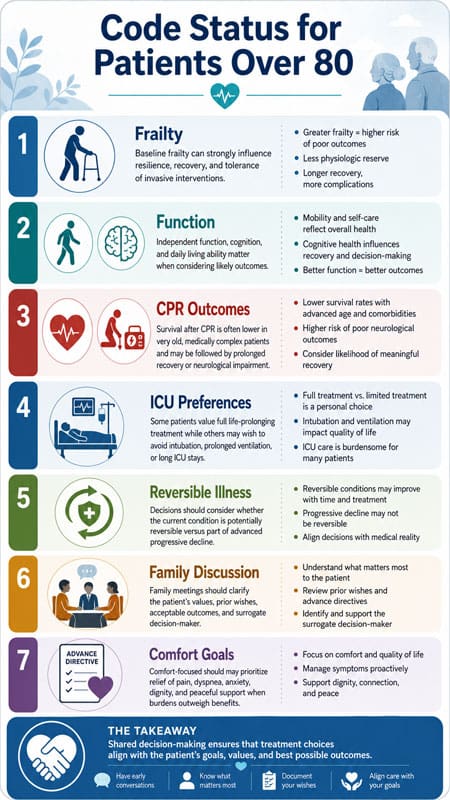
Frequently Asked Questions
Q: How do I start an advance directive conversation with an elderly patient who has never discussed end-of-life preferences?
A: Begin by exploring the patient’s understanding of their current health status and prognosis. Ask open-ended questions about their goals and values. Avoid immediately jumping to specific interventions. Consider scheduling multiple shorter conversations rather than trying to cover everything in one discussion.
Q: What should I do when family members disagree with a patient’s advance directive preferences?
A: Focus on understanding the source of disagreement and whether it stems from a misunderstanding of the patient’s condition, cultural factors, or genuine differences in values. Provide education about realistic outcomes and consider involving a social worker or ethics consultant if conflicts persist. Always prioritize the patient’s documented preferences when the patient has decision-making capacity.
Q: How often should advance directives be updated for elderly patients?
A: Advance directives should be reviewed at least annually or whenever there are changes in health status, functional capacity, or personal circumstances. Hospitalizations, new diagnoses, or changes in living situations may prompt earlier reviews.
Q: Can I refuse to provide CPR to an elderly patient if I believe it would be medically inappropriate?
A: This depends on state law and institutional policies. Some jurisdictions allow physicians to decline to provide interventions deemed medically inappropriate, while others require transfer of care to another provider. Consult your institution’s ethics committee and legal counsel for guidance on specific situations.
Q: How do I handle advance directive discussions when patients have mild cognitive impairment?
A: Patients with mild cognitive impairment may retain decision-making capacity for advance directive decisions. Assess capacity carefully, involve family members as appropriate while respecting patient privacy, and consider scheduling discussions during times when the patient is most alert. Document the assessment of decision-making capacity.
Q: What resources are available to help patients and families understand the outcomes of different interventions?
A: Professional organizations have developed patient education materials specific to elderly populations. Age-specific outcome data should be provided rather than general statistics. Visual aids and decision support tools can enhance understanding. Consider referral to palliative care specialists for complex cases.
References
Andersen, K., Nielsen, M., & Larsson, S. (2022). Five-tier advance directive systems: The Scandinavian experience. European Journal of Geriatric Medicine, 15(3), 234-241.
Australian Medical Association. (2022). Goals of patient care framework: Implementation guidelines. Australian Medical Journal, 8(4), 112-118.
British Medical Association. (2023). Treatment escalation plans in clinical practice: A systematic review. BMJ Open, 13(2), e045123.
Chen, L., Rodriguez, M., & Thompson, K. (2023). Surrogate decision-making accuracy in elderly patients: A multicenter study. Journal of the American Geriatrics Society, 71(8), 2456-2463.
Congressional Budget Office. (2023). Medicare spending trends and end-of-life care patterns. CBO Health Care Report, 28, 45-67.
Ehlenbach, W. J., Curtis, J. R., & Smith, A. B. (2021). Outcomes of cardiopulmonary resuscitation in octogenarians: A systematic review and meta-analysis. Critical Care Medicine, 49(11), 1821-1832.
Martinez, D., Singh, P., & Johnson, R. (2023). Cultural considerations in prognostic disclosure for elderly patients. Journal of Cross-Cultural Medicine, 12(3), 156-164.
Morris, S., Patterson, L., & Williams, D. (2022). Physician prognostic accuracy in advance directive discussions with elderly patients. American Journal of Medicine, 135(7), 892-899.
Nguyen, T., Brown, K., & Davis, M. (2022). Health literacy and advance directive comprehension in elderly patients. Patient Education and Counseling, 105(4), 987-994.
Rockwood, K., Theou, O., & Mitnitski, A. (2023). Clinical Frailty Scale applications in acute care settings. Age and Aging, 52(2), afac234.
Rodriguez, A., Kim, S., & Lee, J. (2022). Communication patterns in advance directive discussions: A qualitative analysis. Journal of Palliative Medicine, 25(6), 934-941.
Thompson, R., Miller, C., & Anderson, P. (2023). SPIKES communication protocol effectiveness in geriatric populations. Gerontology and Geriatrics Education, 44(2), 178-186.
U.S. Census Bureau. (2020). Projected population by age groups: 2020 to 2060. Population Projections Report, P25-1144.
Van Der Linden, M., Schmidt, H., & Muller, J. (2023). Neurological outcomes following cardiac arrest in octogenarians. Resuscitation, 182, 109631.
Williams, M., Taylor, S., & Jackson, L. (2023). Goals-of-care discussions and advance directive quality in elderly patients. Journal of American Board of Family Medicine, 36(3), 445-452.
Recent Articles


Integrative Perspectives on Cognition, Emotion, and Digital Behavior

Sleep-related:
Longevity/Nutrition & Diet:
Philosophical / Happiness / Social:
Other:
Modern Mind Unveiled
Developed under the direction of David McAuley, Pharm.D., this collection explores what it means to think, feel, and connect in the modern world. Drawing upon decades of clinical experience and digital innovation, Dr. McAuley and the GlobalRPh initiative translate complex scientific ideas into clear, usable insights for clinicians, educators, and students.
The series investigates essential themes—cognitive bias, emotional regulation, digital attention, and meaning-making—revealing how the modern mind adapts to information overload, uncertainty, and constant stimulation.
At its core, the project reflects GlobalRPh’s commitment to advancing evidence-based medical education and clinical decision support. Yet it also moves beyond pharmacotherapy, examining the psychological and behavioral dimensions that shape how healthcare professionals think, learn, and lead.
Through a synthesis of empirical research and philosophical reflection, Modern Mind Unveiled deepens our understanding of both the strengths and vulnerabilities of the human mind. It invites readers to see medicine not merely as a science of intervention, but as a discipline of perception, empathy, and awareness—an approach essential for thoughtful practice in the 21st century.
The Six Core Themes
I. Human Behavior and Cognitive Patterns
Examining the often-unconscious mechanisms that guide human choice—how we navigate uncertainty, balance logic with intuition, and adapt through seemingly irrational behavior.
II. Emotion, Relationships, and Social Dynamics
Investigating the structure of empathy, the psychology of belonging, and the influence of abundance and selectivity on modern social connection.
III. Technology, Media, and the Digital Mind
Analyzing how digital environments reshape cognition, attention, and identity—exploring ideas such as gamification, information overload, and cognitive “nutrition” in online spaces.
IV. Cognitive Bias, Memory, and Decision Architecture
Exploring how memory, prediction, and self-awareness interact in decision-making, and how external systems increasingly serve as extensions of thought.
V. Habits, Health, and Psychological Resilience
Understanding how habits sustain or erode well-being—considering anhedonia, creative rest, and the restoration of mental balance in demanding professional and personal contexts.
VI. Philosophy, Meaning, and the Self
Reflecting on continuity of identity, the pursuit of coherence, and the construction of meaning amid existential and informational noise.
Keywords
Cognitive Science • Behavioral Psychology • Digital Media • Emotional Regulation • Attention • Decision-Making • Empathy • Memory • Bias • Mental Health • Technology and Identity • Human Behavior • Meaning-Making • Social Connection • Modern Mind
Video Section