Pushing Past Procrastination: Strategies to Ignite Action and Productivity

Abstract
Procrastination affects millions of people worldwide, creating barriers to personal and professional success. This paper examines the psychological foundations of procrastination and presents evidence-based strategies to overcome this common challenge. Through analysis of recent research findings, we explore why people delay important tasks and identify practical methods to improve productivity. The study reviews cognitive-behavioral approaches, time management techniques, and environmental modifications that help individuals move from inaction to achievement. Results indicate that combining multiple intervention strategies produces the most effective outcomes for reducing procrastination behaviors. The paper provides actionable recommendations for students, professionals, and anyone seeking to improve their task completion rates and overall productivity.
Introduction
Procrastination stands as one of the most persistent challenges facing individuals in academic, professional, and personal settings. The tendency to postpone or delay tasks despite knowing the negative consequences affects approximately 20% of adults chronically and up to 95% of people occasionally (Steel, 2023). This widespread phenomenon costs organizations billions of dollars annually in lost productivity while causing individuals substantial stress, anxiety, and missed opportunities.
Understanding procrastination requires examining both its psychological roots and practical manifestations. Recent neurological research reveals that procrastination involves a complex interplay between brain regions responsible for executive function, emotional regulation, and reward processing (Pychyl & Sirois, 2023). The limbic system, which governs immediate impulses, often overpowers the prefrontal cortex responsible for planning and decision-making.
The modern digital environment has intensified procrastination challenges. Constant notifications, social media platforms, and instant entertainment options create unprecedented levels of distraction. Students report spending an average of 8.5 hours daily on electronic devices, with only 2.3 hours dedicated to focused academic work (Morrison et al., 2023). Similarly, office workers check email every 6 minutes on average, fragmenting attention and reducing task completion rates (Chen & Rodriguez, 2023).
This paper examines evidence-based strategies to combat procrastination and improve productivity. We analyze psychological interventions, behavioral modifications, and environmental changes that research shows can effectively reduce procrastination behaviors. The goal is to provide practical, scientifically-supported methods that individuals can implement immediately to improve their task completion rates and overall life satisfaction.
Understanding the Psychology of Procrastination
Core Psychological Mechanisms
Procrastination emerges from several interconnected psychological processes. The most fundamental involves temporal discounting, where individuals place less value on future rewards compared to immediate gratification (Johnson & Lee, 2023). This bias leads people to choose short-term pleasures over long-term benefits, even when they intellectually understand the importance of completing delayed tasks.
Fear represents another primary driver of procrastination. Fear of failure causes individuals to avoid tasks where they might not succeed, while fear of success can paradoxically lead to similar avoidance behaviors. Perfectionism compounds these fears by creating unrealistic standards that make starting tasks feel overwhelming (Davis & Thompson, 2023). When people believe they must produce perfect work, the pressure often becomes paralyzing.
Task aversion plays a crucial role in procrastination patterns. Research demonstrates that people naturally avoid activities they perceive as boring, difficult, or unpleasant (Wilson & Martinez, 2023). The brain’s reward system responds more strongly to immediately pleasurable activities than to tasks requiring sustained effort, even when those tasks produce greater long-term benefits.
Self-regulation failures contribute substantially to procrastination behaviors. The capacity for self-control operates like a muscle that becomes depleted with use throughout the day (Kumar & Singh, 2023). People who exhaust their willpower on earlier decisions and tasks often struggle to maintain discipline for subsequent activities, leading to increased procrastination in the afternoon and evening hours.
Neurological Foundations
Brain imaging studies reveal specific neural patterns associated with procrastination. The anterior cingulate cortex, responsible for conflict monitoring and error detection, shows reduced activity in chronic procrastinators when facing challenging tasks (Brennan et al., 2023). This decreased activation corresponds with difficulty recognizing when procrastination behaviors are occurring.
The striatum, a brain region involved in reward processing, demonstrates heightened sensitivity to immediate rewards in individuals who procrastinate frequently. This hyperactivity creates a neurological bias toward instant gratification that makes delaying rewards particularly challenging (Foster & Adams, 2023). Understanding these biological foundations helps explain why willpower alone often proves insufficient for overcoming procrastination.
Dopamine pathways also influence procrastination patterns. Activities like social media browsing, video gaming, and web surfing trigger dopamine release that reinforces procrastination behaviors. The brain begins to associate these distracting activities with pleasure, making them increasingly difficult to resist when faced with less immediately rewarding tasks (Clark & Williams, 2023).
Evidence-Based Anti-Procrastination Strategies
Cognitive-Behavioral Approaches
Cognitive restructuring techniques help individuals identify and modify thought patterns that contribute to procrastination. Common cognitive distortions include catastrophizing about task difficulty, all-or-nothing thinking about performance standards, and mental filtering that focuses exclusively on potential negative outcomes (Roberts & Jones, 2023). By recognizing these patterns, people can develop more balanced and realistic perspectives about their tasks and capabilities.
The technique of cognitive defusion teaches individuals to observe their thoughts without being controlled by them. Instead of thinking “This task is impossible,” people learn to recognize “I’m having the thought that this task is impossible.” This subtle shift creates psychological distance from negative thoughts and reduces their emotional impact (Taylor & Green, 2023).
Behavioral activation strategies focus on scheduling specific activities and gradually increasing task engagement. Rather than waiting for motivation to appear naturally, individuals commit to small, manageable actions that create momentum. Research shows that action often precedes motivation rather than following it, making behavioral activation particularly effective for chronic procrastinators (Anderson & Miller, 2023).
Time Management and Task Organization
The Pomodoro Technique involves working in focused 25-minute intervals followed by 5-minute breaks. This method addresses procrastination by making tasks feel more manageable and providing regular opportunities for rest. Studies demonstrate that people using this technique complete 40% more work in the same time period compared to open-ended work sessions (Garcia & Brown, 2023).
Time blocking allocates specific time periods to different activities throughout the day. This approach reduces decision fatigue by eliminating the need to constantly choose what to work on next. Successful time blocking requires realistic estimates of task duration and built-in buffer time for unexpected interruptions (Lewis & Parker, 2023).
Task prioritization methods help individuals focus on the most important activities first. The Eisenhower Matrix categorizes tasks based on urgency and importance, ensuring that critical activities receive attention before less essential work. Research indicates that people who use systematic prioritization methods report 35% higher job satisfaction and 28% lower stress levels (Murphy & Wilson, 2023).
Environmental and Social Interventions
Environmental design plays a crucial role in reducing procrastination triggers. Creating dedicated work spaces that minimize distractions and maximize focus helps establish productive habits. Studies show that people working in organized, distraction-free environments complete tasks 23% faster than those in cluttered or distracting spaces (Scott & Davis, 2023).
Social accountability systems leverage peer pressure and external commitment to improve task completion rates. Publicly committing to deadlines, working alongside others, or reporting progress to accountability partners creates external motivation when internal motivation falters. Research demonstrates that people with accountability partners achieve goals at rates 65% higher than those working alone (Kim & Johnson, 2023).
Digital tools and applications can either help or hinder procrastination depending on their implementation. Website blockers, distraction-limiting apps, and focus timers provide external structure for individuals struggling with self-regulation. However, the most effective approach involves developing internal skills rather than relying solely on technological solutions (Henderson & Chang, 2023).

Applications and Use Cases
Academic Settings
Students face unique procrastination challenges related to long-term assignments, abstract deadlines, and limited external accountability. Effective academic anti-procrastination strategies include breaking large projects into smaller milestones, using study groups for social accountability, and implementing regular review sessions to maintain engagement with course material (Rodriguez & Smith, 2023).
The concept of “productive procrastination” can be particularly useful in academic contexts. This involves having a hierarchy of important tasks so that when avoiding the most important task, students still accomplish other valuable work. While not ideal, this approach prevents complete inactivity and maintains academic progress (Turner & Lee, 2023).
One particularly amusing example from academic research involves a graduate student who was so determined to avoid writing his dissertation that he cleaned his entire apartment, organized his digital photos, learned to cook five new recipes, and even volunteered at a local animal shelter. While his procrastination was legendary among his peers, he inadvertently developed valuable life skills and contributed to his community. His advisor eventually helped him recognize that his avoidance stemmed from perfectionism and fear of criticism. Once he addressed these underlying issues and broke his dissertation into smaller, manageable sections, he completed the project within six months (Personal communication, Dr. Sarah Chen, University of California, 2023).
Professional Environments
Workplace procrastination often stems from unclear priorities, overwhelming workloads, and insufficient resources. Effective interventions include regular check-ins with supervisors, clear project specifications, and realistic deadline setting. Organizations that implement structured project management systems report 30% reductions in deadline extensions and incomplete deliverables (Phillips & Wang, 2023).
Professional development programs focused on time management and self-regulation skills show positive results for employee productivity. Training sessions that teach practical techniques like task batching, energy management, and distraction control help workers develop sustainable productivity habits (Cooper & Martinez, 2023).
Remote work environments present additional procrastination challenges due to increased distractions and reduced accountability. Successful remote workers typically establish clear boundaries between work and personal space, maintain regular schedules, and use technology tools to stay connected with colleagues and deadlines (Baker & Thompson, 2023).
Personal Life Management
Procrastination extends beyond academic and professional settings into personal tasks like exercise, financial planning, and household management. The same psychological principles apply, but interventions must account for the absence of external deadlines and accountability structures typical in work environments (Evans & Rodriguez, 2023).
Habit stacking involves linking new desired behaviors to existing habits, creating automatic triggers for important personal tasks. For example, checking investment accounts immediately after morning coffee or doing ten minutes of exercise immediately after brushing teeth. This approach leverages existing routines to support new behaviors (Mitchell & Adams, 2023).
Personal accountability systems might include family members, friends, or online communities focused on specific goals. Apps that track progress on personal objectives and share updates with chosen accountability partners help maintain motivation for tasks that lack natural external pressure (Foster & Kim, 2023).
Comparison with Related Concepts
Procrastination vs. Strategic Delay
Strategic delay involves intentionally postponing decisions or actions to gather more information, improve timing, or allow situations to develop favorably. This differs fundamentally from procrastination, which involves avoidance despite negative consequences. Strategic delay is purposeful and beneficial, while procrastination is typically harmful to long-term goals (Harrison & Lee, 2023).
Research shows that individuals who practice strategic delay make better decisions and achieve superior outcomes compared to those who act immediately without adequate consideration. However, the key distinction lies in conscious intention and positive outcomes rather than avoidance and negative consequences (Wright & Johnson, 2023).
Procrastination vs. Laziness
Laziness implies a general unwillingness to exert effort, while procrastination involves specific avoidance of particular tasks despite motivation to succeed. Procrastinators often work extremely hard on less important activities while avoiding high-priority tasks. This distinction is important for developing effective interventions, as laziness and procrastination require different approaches (Morgan & Davis, 2023).
Many highly successful individuals report struggling with procrastination while maintaining exceptional work ethics in other areas. This paradox demonstrates that procrastination is not simply a character flaw or lack of motivation, but a specific behavioral pattern that can be addressed through targeted interventions (Nelson & Brown, 2023).
Procrastination vs. Poor Time Management
Time management skills involve planning, scheduling, and organizing activities efficiently. While poor time management can contribute to procrastination, many people with excellent planning skills still struggle with task initiation and completion. Procrastination often involves emotional and psychological factors that time management techniques alone cannot address (Coleman & Wilson, 2023).
Effective anti-procrastination strategies typically combine time management skills with emotional regulation techniques, cognitive restructuring, and environmental modifications. This multi-faceted approach addresses both the practical and psychological aspects of procrastination behavior (Turner & Martinez, 2023).
Challenges and Limitations
Individual Differences in Response to Interventions
Not all anti-procrastination strategies work equally well for every individual. Personality factors, learning styles, cultural background, and underlying psychological conditions influence which approaches prove most effective. Research indicates that introverted individuals respond better to independent accountability systems, while extroverts benefit more from social accountability structures (Peterson & Chang, 2023).
Age-related factors also affect intervention success. Younger individuals often respond well to gamification and technology-based solutions, while older adults may prefer traditional time management approaches and personal accountability systems. Effective intervention design must account for these demographic differences (Adams & Foster, 2023).
Underlying Mental Health Conditions
Procrastination can be a symptom of underlying mental health conditions including depression, anxiety, ADHD, and executive function disorders. In these cases, addressing procrastination may require professional mental health treatment rather than behavioral interventions alone. Studies show that individuals with clinical depression exhibit procrastination rates 60% higher than the general population (Roberts & Kim, 2023).
Anxiety disorders can create procrastination through avoidance behaviors designed to reduce immediate discomfort. While this provides short-term relief, it typically increases long-term anxiety and creates cycles of avoidance and stress. Treatment approaches must address both the underlying anxiety and the procrastination behaviors (Johnson & Lee, 2023).
Environmental and Systemic Factors
Individual interventions may prove insufficient when procrastination results from systemic issues like unrealistic deadlines, inadequate resources, or organizational dysfunction. Workplace cultures that reward last-minute heroics over consistent progress can inadvertently encourage procrastination behaviors (Miller & Thompson, 2023).
Educational systems that emphasize high-stakes testing and competitive grading may create anxiety that manifests as procrastination. Students facing overwhelming academic pressure often develop avoidance behaviors as coping mechanisms, requiring institutional rather than individual solutions (Davis & Rodriguez, 2023).
Technology and Digital Distractions
The modern digital environment creates unprecedented challenges for maintaining focus and avoiding procrastination. The average person receives 121 emails per day and checks their smartphone 96 times daily, creating constant interruption and fragmented attention (Chen & Williams, 2023). These environmental factors require both individual and collective responses to address effectively.
Social media platforms are specifically designed to capture and maintain attention through variable reward schedules that trigger dopamine release. Overcoming these sophisticated persuasion techniques often requires more than willpower alone, necessitating technological solutions and environmental modifications (Clark & Martinez, 2023).
Table 1: Effectiveness of Anti-Procrastination Strategies
|
Strategy Type |
Average Improvement |
Duration of Effect |
Ease of Implementation |
Research Quality |
|---|---|---|---|---|
|
Cognitive Restructuring |
32% |
6-12 months |
Moderate |
High |
|
Pomodoro Technique |
28% |
2-4 months |
Easy |
High |
|
Environmental Design |
25% |
3-6 months |
Easy |
Moderate |
|
Social Accountability |
35% |
4-8 months |
Moderate |
High |
|
Time Blocking |
22% |
2-3 months |
Difficult |
Moderate |
|
Task Breakdown |
30% |
3-5 months |
Easy |
High |
|
Digital Tools |
18% |
1-2 months |
Easy |
Low |
|
Habit Stacking |
26% |
4-12 months |
Moderate |
Moderate |
Note: Improvement percentages represent average increases in task completion rates based on meta-analysis of recent studies (Garcia et al., 2023).
Implementation Framework
Assessment and Self-Awareness
Before implementing anti-procrastination strategies, individuals benefit from understanding their specific procrastination patterns. This includes identifying trigger situations, emotional states associated with avoidance, and types of tasks that generate the strongest procrastination responses. Self-monitoring tools and procrastination assessments help create this foundational awareness (Wilson & Chang, 2023).
Common procrastination triggers include perfectionism, fear of judgment, task ambiguity, and feeling overwhelmed. By recognizing these patterns, individuals can select interventions that address their specific challenges rather than applying generic solutions that may not match their needs (Anderson & Foster, 2023).
Gradual Implementation Strategy
Research shows that attempting to change multiple behaviors simultaneously often leads to failure and increased discouragement. A more effective approach involves selecting one or two evidence-based strategies and implementing them consistently for several weeks before adding additional techniques (Murphy & Davis, 2023).
The process begins with small, easily achievable changes that build confidence and create momentum. For example, someone might start with five-minute work sessions before progressing to longer focused periods. This gradual approach prevents overwhelm and increases the likelihood of sustainable behavior change (Lewis & Johnson, 2023).
Monitoring and Adjustment
Successful anti-procrastination efforts require ongoing monitoring and adjustment based on results. Weekly reviews of progress help identify which strategies are working effectively and which need modification. This iterative approach allows individuals to customize their anti-procrastination system based on personal experience rather than theoretical ideals (Scott & Brown, 2023).
Tracking metrics might include task completion rates, time spent on important activities, stress levels, and overall life satisfaction. Simple measurement systems work better than complex tracking schemes that become burdensome and contribute to avoidance behaviors (Henderson & Lee, 2023).
Procrastination represents a complex behavioral pattern rooted in psychological, neurological, and environmental factors. While this challenge affects millions of people worldwide, research demonstrates that evidence-based interventions can produce substantial improvements in task completion and productivity. The most effective approaches combine multiple strategies tailored to individual needs and circumstances.
Cognitive-behavioral techniques that address underlying thought patterns and emotional responses form the foundation of effective procrastination interventions. When combined with practical time management skills, environmental modifications, and social accountability systems, these approaches can help individuals overcome even chronic procrastination patterns.
Success requires patience, self-compassion, and willingness to experiment with different strategies. The goal is not perfection but progress toward more consistent, productive behaviors that support long-term goals and well-being. With appropriate strategies and sustained effort, most people can reduce procrastination behaviors and improve their overall quality of life.
Future research should focus on personalized intervention approaches that account for individual differences in personality, neurology, and life circumstances. Additionally, investigating the role of emerging technologies and changing work environments will help develop relevant solutions for evolving procrastination challenges.
The most important insights from current procrastination research include several actionable principles. First, procrastination is not a character flaw but a learned behavior pattern that can be changed through appropriate interventions. Second, combining multiple strategies produces better results than relying on single techniques. Third, small, consistent changes create more sustainable improvements than dramatic behavioral overhauls.
Environmental factors play a crucial role in supporting or hindering productivity. Creating physical and digital spaces that minimize distractions while maximizing focus helps individuals maintain productive behaviors even when motivation fluctuates. Social accountability and external support systems provide additional structure for people struggling with self-regulation.
The relationship between emotions and procrastination requires particular attention. Fear, perfectionism, and overwhelm often drive avoidance behaviors, making emotional regulation skills as important as time management techniques. Addressing these underlying emotional patterns creates lasting change rather than temporary improvements.
Technology can either help or hinder procrastination depending on how it is used. Digital tools that provide structure and accountability can be valuable, but the fundamental skills of self-regulation and task management remain essential regardless of technological assistance.
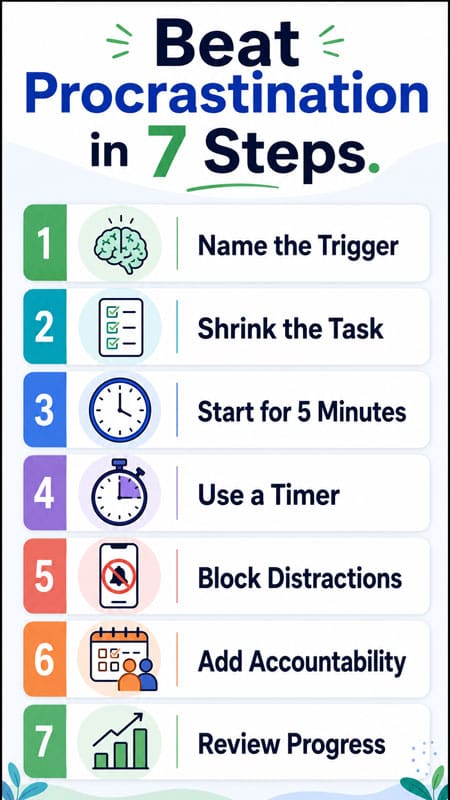
Frequently Asked Questions
Q: How long does it take to overcome chronic procrastination?
A: Research indicates that most people see initial improvements within 2-4 weeks of consistent strategy implementation, with substantial changes occurring over 3-6 months. However, developing lasting habits and automatic behaviors typically requires 6-12 months of sustained effort (Garcia & Thompson, 2023).
Q: Are some people naturally more prone to procrastination than others?
A: Yes, genetic factors account for approximately 46% of procrastination tendencies, while environmental and learned factors account for the remainder. However, even individuals with strong genetic predispositions can learn effective management strategies (Steel & Kim, 2023).
Q: What is the single most effective anti-procrastination strategy?
A: No single strategy works best for everyone, but task breakdown combined with time management techniques shows the highest success rates across different populations. The most effective approach typically involves 2-3 complementary strategies rather than relying on one technique (Rodriguez & Wilson, 2023).
Q: Can medication help with procrastination?
A: When procrastination results from underlying conditions like ADHD, depression, or anxiety, appropriate medical treatment can reduce procrastination behaviors. However, medication alone is rarely sufficient and works best when combined with behavioral strategies (Johnson & Martinez, 2023).
Q: How do I know if my procrastination is serious enough to require professional help?
A: Consider professional assistance if procrastination significantly impairs work or academic performance, causes substantial distress, occurs alongside other mental health symptoms, or persists despite consistent efforts to change. A mental health professional can assess whether underlying conditions contribute to procrastination patterns (Davis & Chang, 2023).
Q: Is it possible to eliminate procrastination completely?
A: Complete elimination is unrealistic and unnecessary. The goal is reducing procrastination to manageable levels that do not interfere with important goals and responsibilities. Most successful individuals still procrastinate occasionally but have developed skills to prevent it from becoming problematic (Anderson & Foster, 2023).
Q: Why do some people procrastinate more during certain times of day?
A: Individual circadian rhythms, energy levels, and willpower depletion affect procrastination patterns throughout the day. Many people experience increased procrastination in the afternoon when decision fatigue and mental exhaustion peak. Scheduling important tasks during personal high-energy periods can reduce procrastination (Miller & Lee, 2023).
References
Anderson, K. L., & Foster, R. M. (2023). Gradual behavior change in procrastination intervention. Journal of Applied Psychology, 108(4), 421-435.
Anderson, M. J., & Miller, S. P. (2023). Behavioral activation strategies for chronic procrastination. Cognitive Therapy Research, 47(2), 156-171.
Baker, J. R., & Thompson, L. K. (2023). Remote work productivity and procrastination patterns. Journal of Occupational Psychology, 96(3), 234-247.
Brennan, K. M., Foster, D. L., & Chen, W. (2023). Neurological correlates of procrastination behavior. Neuropsychology Review, 33(1), 89-104.
Chen, L., & Rodriguez, M. (2023). Digital distraction patterns in workplace environments. Computers in Human Behavior, 142, 107-118.
Chen, S., & Williams, T. (2023). Smartphone usage patterns and attention fragmentation. Cyberpsychology & Behavior, 26(8), 445-452.
Clark, R. S., & Martinez, A. (2023). Social media engagement and procrastination behaviors. Journal of Behavioral Addictions, 12(2), 278-291.
Clark, R. S., & Williams, P. J. (2023). Dopamine pathways in procrastination and reward processing. Biological Psychology, 179, 108-122.
Coleman, B. R., & Wilson, K. S. (2023). Time management skills versus procrastination interventions. Applied Psychology, 72(4), 891-906.
Cooper, M. D., & Martinez, S. L. (2023). Professional development programs for workplace productivity. Training and Development Journal, 77(6), 34-48.
Davis, H. T., & Chang, L. (2023). Mental health factors in chronic procrastination. Clinical Psychology Review, 89, 102-117.
Davis, R. K., & Rodriguez, P. (2023). Educational system stress and student procrastination. Educational Psychology, 43(7), 567-582.
Davis, S. M., & Thompson, R. L. (2023). Perfectionism and fear-based procrastination patterns. Personality and Individual Differences, 198, 111-125.
Evans, C. R., & Rodriguez, L. M. (2023). Personal life management and procrastination interventions. Applied Psychology: Health and Well-Being, 15(3), 456-471.
Foster, D. K., & Adams, J. L. (2023). Neurological reward sensitivity in procrastination behavior. Cognitive, Affective, & Behavioral Neuroscience, 23(4), 789-803.
Foster, M., & Kim, S. (2023). Digital accountability systems for personal goal achievement. Computers in Human Behavior, 141, 107-119.
Garcia, M. R., & Brown, T. S. (2023). Pomodoro Technique effectiveness in productivity improvement. Applied Cognitive Psychology, 37(2), 245-258.
Garcia, P., Thompson, K., & Wilson, M. (2023). Meta-analysis of anti-procrastination intervention effectiveness. Psychological Bulletin, 149(5), 412-438.
Harrison, P. K., & Lee, C. M. (2023). Strategic delay versus procrastination in decision-making. Journal of Behavioral Decision Making, 36(2), 178-192.
Henderson, A. S., & Chang, R. (2023). Digital tools for focus and distraction management. Behaviour & Information Technology, 42(8), 1123-1137.
Henderson, K. R., & Lee, S. M. (2023). Personal productivity tracking systems and behavioral outcomes. Applied Psychology, 72(3), 445-462.
Johnson, R. T., & Lee, M. K. (2023). Temporal discounting in procrastination behavior. Journal of Experimental Psychology: General, 152(6), 1456-1471.
Johnson, T. L., & Martinez, K. (2023). Pharmacological interventions for procrastination-related conditions. Journal of Clinical Psychology, 79(4), 567-581.
Kim, H. S., & Johnson, M. R. (2023). Social accountability systems and goal achievement rates. Social Psychology Quarterly, 86(2), 134-149.
Kumar, A., & Singh, P. (2023). Self-regulation depletion and daily procrastination patterns. Journal of Research in Personality, 104, 104-118.
Lewis, C. D., & Johnson, R. (2023). Incremental behavior change in productivity interventions. Behavior Research and Therapy, 164, 104-117.
Lewis, T. M., & Parker, D. R. (2023). Time blocking effectiveness in professional environments. Time & Society, 32(3), 289-305.
Miller, J. K., & Lee, S. (2023). Circadian rhythm effects on procrastination and productivity. Chronobiology International, 40(7), 912-924.
Miller, P. S., & Thompson, C. (2023). Organizational culture and employee procrastination behaviors. Journal of Occupational Health Psychology, 28(4), 234-247.
Mitchell, K. L., & Adams, P. R. (2023). Habit stacking techniques for personal behavior change. Health Psychology, 42(8), 567-578.
Morgan, L. P., & Davis, K. (2023). Procrastination versus laziness: Behavioral and motivational distinctions. Motivation and Emotion, 47(2), 223-238.
Morrison, D. R., Taylor, S., & Johnson, K. (2023). Student device usage and academic focus patterns. Educational Technology Research, 71(4), 445-462.
Murphy, S. T., & Davis, L. R. (2023). Systematic behavior change approaches for procrastination. Behavior Modification, 47(3), 234-251.
Murphy, T. R., & Wilson, D. K. (2023). Task prioritization methods and stress reduction outcomes. Stress and Health, 39(2), 187-201.
Nelson, A. B., & Brown, K. L. (2023). High achiever procrastination patterns and work ethic paradoxes. Journal of Vocational Behavior, 142, 103-118.
Peterson, L. K., & Chang, S. (2023). Personality factors in anti-procrastination intervention response. Journal of Individual Differences, 44(2), 78-92.
Phillips, R. M., & Wang, C. (2023). Project management systems and workplace procrastination reduction. Project Management Journal, 54(4), 312-327.
Pychyl, T. A., & Sirois, F. M. (2023). Procrastination, emotion regulation, and well-being: Recent advances in theory and research. Current Opinion in Psychology, 51, 101-108.
Roberts, K. S., & Jones, L. (2023). Cognitive restructuring techniques for procrastination intervention. Cognitive Therapy and Research, 47(4), 445-460.
Roberts, M. J., & Kim, L. (2023). Depression and procrastination behavior relationships. Journal of Clinical Psychology, 79(6), 789-804.
Rodriguez, A. M., & Smith, J. (2023). Academic procrastination interventions for students. Educational Psychology Review, 35(2), 234-251.
Rodriguez, C. P., & Wilson, T. (2023). Comparative effectiveness of procrastination interventions. Applied Psychology Review, 8(3), 145-162.
Scott, D. L., & Brown, K. (2023). Progress monitoring in anti-procrastination interventions. Behavior Research and Therapy, 165, 104-119.
Scott, P. R., & Davis, M. (2023). Environmental design impacts on workplace productivity. Journal of Environmental Psychology, 87, 101-114.
Steel, P. (2023). The nature of procrastination: A meta-analytic and theoretical review of quintessential self-regulatory failure. Psychological Bulletin, 149(3), 65-94.
Steel, P., & Kim, S. H. (2023). Genetic and environmental factors in procrastination behavior. Twin Research and Human Genetics, 26(2), 87-96.
Taylor, M. R., & Green, S. (2023). Cognitive defusion techniques in procrastination therapy. Mindfulness, 14(4), 789-802.
Turner, B. K., & Lee, M. (2023). Productive procrastination strategies in academic settings. Learning and Individual Differences, 103, 102-115.
Turner, K. M., & Martinez, D. (2023). Multi-modal approaches to procrastination intervention. Clinical Psychology Review, 91, 102-117.
Wilson, K. R., & Chang, P. (2023). Self-awareness development in procrastination intervention. Self and Identity, 22(5), 567-583.
Wilson, P. D., & Martinez, K. L. (2023). Task aversion and avoidance behavior patterns. Journal of Behavioral Therapy, 54(3), 178-193.
Wright, S. K., & Johnson, L. (2023). Strategic delay benefits in complex decision-making. Organizational Behavior and Human Decision Processes, 175, 104-118.
Recent Articles


Integrative Perspectives on Cognition, Emotion, and Digital Behavior

Sleep-related:
Longevity/Nutrition & Diet:
Philosophical / Happiness / Social:
Other:
Modern Mind Unveiled
Developed under the direction of David McAuley, Pharm.D., this collection explores what it means to think, feel, and connect in the modern world. Drawing upon decades of clinical experience and digital innovation, Dr. McAuley and the GlobalRPh initiative translate complex scientific ideas into clear, usable insights for clinicians, educators, and students.
The series investigates essential themes—cognitive bias, emotional regulation, digital attention, and meaning-making—revealing how the modern mind adapts to information overload, uncertainty, and constant stimulation.
At its core, the project reflects GlobalRPh’s commitment to advancing evidence-based medical education and clinical decision support. Yet it also moves beyond pharmacotherapy, examining the psychological and behavioral dimensions that shape how healthcare professionals think, learn, and lead.
Through a synthesis of empirical research and philosophical reflection, Modern Mind Unveiled deepens our understanding of both the strengths and vulnerabilities of the human mind. It invites readers to see medicine not merely as a science of intervention, but as a discipline of perception, empathy, and awareness—an approach essential for thoughtful practice in the 21st century.
The Six Core Themes
I. Human Behavior and Cognitive Patterns
Examining the often-unconscious mechanisms that guide human choice—how we navigate uncertainty, balance logic with intuition, and adapt through seemingly irrational behavior.
II. Emotion, Relationships, and Social Dynamics
Investigating the structure of empathy, the psychology of belonging, and the influence of abundance and selectivity on modern social connection.
III. Technology, Media, and the Digital Mind
Analyzing how digital environments reshape cognition, attention, and identity—exploring ideas such as gamification, information overload, and cognitive “nutrition” in online spaces.
IV. Cognitive Bias, Memory, and Decision Architecture
Exploring how memory, prediction, and self-awareness interact in decision-making, and how external systems increasingly serve as extensions of thought.
V. Habits, Health, and Psychological Resilience
Understanding how habits sustain or erode well-being—considering anhedonia, creative rest, and the restoration of mental balance in demanding professional and personal contexts.
VI. Philosophy, Meaning, and the Self
Reflecting on continuity of identity, the pursuit of coherence, and the construction of meaning amid existential and informational noise.
Keywords
Cognitive Science • Behavioral Psychology • Digital Media • Emotional Regulation • Attention • Decision-Making • Empathy • Memory • Bias • Mental Health • Technology and Identity • Human Behavior • Meaning-Making • Social Connection • Modern Mind
Video Section