
HIPAA for the Clinician Part 7: Building a Compliance Program That Survives an Audit

Introduction
Anyone who’s survived a chart audit knows the rule: if it isn’t documented, it didn’t happen. You can run a flawless sepsis workup, catch the subtle ST change everyone else missed, and talk a frightened family through an impossible decision, and none of it counts if the note doesn’t say so. The auditor reads the chart, and the chart is the only witness she trusts. OCR reads your compliance program exactly the same way. Over the last six installments of this series, we’ve taken HIPAA apart one piece at a time. This final installment puts the pieces back together into a program you can build, run, and hand to an investigator without sweating through your scrubs. It’s also the one worth bookmarking, because the framework holds up from year to year even when the regulations around it shift.
Think of It as a Care Plan
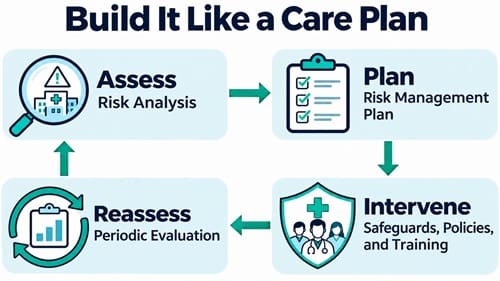
If you’ve ever written a care plan, you already know the shape of a HIPAA compliance program. You assess, you plan, you intervene, and then you reassess. The Security Rule runs on the same loop. Your risk analysis under 45 CFR § 164.308(a)(1)(ii)(A) is the assessment, and your risk management plan under 45 CFR § 164.308(a)(1)(ii)(B) is the plan. Your safeguards, policies, and training are the interventions, and the periodic evaluation required by 45 CFR § 164.308(a)(8) is the reassessment. The practices that end up in enforcement actions usually stall somewhere in the middle of that loop, most often right after the assessment. They paid for a risk analysis, filed it, and treated the filing as the finish line. (Imagine charting a beautiful assessment of a patient’s hypoxia and then never ordering the oxygen.)
Start With Names and a Map
Every program needs someone in charge, and HIPAA requires you to name them. You need a designated security official under 45 CFR § 164.308(a)(2) and a privacy official under 45 CFR § 164.530(a). In a small practice, one person can hold both roles, and it’s usually the practice administrator or an operations lead. Whoever it is needs real authority, protected time to do the job, and enough standing to chase a physician owner who’s three months behind on training. As we covered in the piece on IT providers, your MSP can support this person, but it can’t be this person. The second thing you need is a map of every place ePHI lives. Your EHR is the obvious starting point, but it’s nowhere near the end. Patient information also lives in email, the fax server, the billing portal, the answering service, the telehealth platform, the backup your IT company configured years ago, and the personal laptop your nurse practitioner uses at her kitchen table. Paper counts too. Everything else in your program depends on this inventory, because you can’t protect, train on, or contract around systems you don’t know you have.
Assess, Then Do Something About It
With the map in hand, your risk analysis evaluates the threats and vulnerabilities facing each of those places and rates the resulting risks by likelihood and impact. Part 2 of this series walks through what an accurate and thorough analysis requires. The short version is that a vulnerability scan, a vendor questionnaire, or a template downloaded from another practice won’t qualify. OCR’s attention has moved to the risk management plan. Its Risk Analysis Initiative has produced more than a dozen enforcement actions, and the corrective action plans in those cases consistently require both a new analysis and a plan to address what it finds. Keep a risk register that assigns every significant finding an owner, a target date, and a status. You’re allowed to accept a risk instead of fixing it, as long as you document why that decision is reasonable for your organization. An unaddressed high risk with no explanation is the most dangerous document you can hand an investigator, since it proves you knew.
Write Down How You Operate
Your policies and procedures under 45 CFR § 164.316 should describe how your practice operates today. A policy copied from another organization describes how that organization operates, and an investigator who interviews your front desk will figure out the difference in about four minutes. At a minimum, your policies need to cover access management, including how accounts are granted and how quickly they’re shut off when someone leaves under 45 CFR § 164.308(a)(3)(ii)(C). They also need a sanctions policy, device and media controls, remote work and telehealth rules, and the Privacy Rule procedures for patient access requests, minimum necessary disclosures, and complaints. Retain every version for six years from the date it was created or last in effect, and review the whole set whenever your environment changes.
Put Your Vendors on Paper
Every vendor that creates, receives, maintains, or transmits ePHI on your behalf needs a Business Associate Agreement that meets 45 CFR §§ 164.308(b) and 164.504(e), signed before the access begins. Keep a business associate inventory listing each vendor, what data it touches, when its agreement was signed, and when you last reviewed it. Part 3 covers what the agreement has to contain, and the Change Healthcare attack showed what happens when a practice can’t trace its own vendor chain. Pay special attention to breach notification windows and subcontractor obligations, since those are the clauses you’ll care about most on the worst day of the year.
Train People for the Jobs They Do
Your training program under 45 CFR §§ 164.308(a)(5) and 164.530(b) has to reach every workforce member, including the physicians. Part 6 laid out what the research says about the annual slideshow (spoiler: very little that’s encouraging). Build your program around each role’s real exposure, train new hires before their login works, send short security reminders throughout the year, and make reporting a mistake fast and safe. Keep records of who completed what and when, because “everybody did it” won’t satisfy anyone holding a document request.
Plan for the Bad Month
Your security incident procedures under 45 CFR § 164.308(a)(6) should spell out who gets called, who makes decisions, and who talks to outsiders when something goes wrong. When an incident involves PHI, someone has to work through the risk assessment under 45 CFR § 164.402 and decide whether it’s a reportable breach. If it is, affected individuals must be notified without unreasonable delay and no later than 60 days after discovery under 45 CFR § 164.404, and HHS gets notified under 45 CFR § 164.408. Keep a log of every incident you evaluate, including the ones you decide aren’t breaches, along with your reasoning. Your contingency plan under 45 CFR § 164.308(a)(7) needs to assume the outage lasts a month, since that’s roughly what the data from recent attacks suggests. Test it with a tabletop exercise at least once a year, and include the scenario where a critical vendor goes dark instead of your own systems.
Run It on a Calendar
A compliance program that only moves when something breaks will eventually break in front of OCR. Put the recurring work on a calendar so it happens whether or not anyone remembers. Review user access and system activity logs quarterly under 45 CFR § 164.308(a)(1)(ii)(D), and send a security reminder at least monthly. Once a year, update your risk analysis, review your business associate inventory and agreements, refresh your policies, complete annual training, and run your tabletop. Any major change, such as a new EHR, a new location, a merger, or a serious incident, should trigger an off-cycle review of the risk analysis.
Part 4 of this series described what OCR asks for first: your risk analysis, your risk management plan, your policies and procedures, your training records, your Business Associate Agreements, and your incident and breach documentation. Pick a workforce member and a vendor at random, then try to produce that person’s training history and that vendor’s signed agreement within 15 minutes. After that, pull your current risk register and see whether every high risk has an owner and a date. If you can do all of it without a frantic call to anyone, you’ve built a program that will hold up when the letter arrives. If you can’t, you now know exactly where to start, and you’ve got a six-part reading list to help you finish.

Recent Articles – Will Evertsen 


GlobalRPh Articles
Integrative Perspectives on Cognition, Emotion, and Digital Behavior

