
HIPAA for the Clinician Part 6: Training That Survives Contact With Your Front Desk

Introduction
Between January and October of 2023, UC San Diego Health did something most organizations never bother to do with their security training: it checked whether the training worked. Researchers sent 10 simulated phishing campaigns to roughly 19,500 employees over 8 months, then compared who clicked against who had recently completed the mandatory annual awareness module. The annual training made no measurable difference. Employees who’d finished it recently failed the phishing tests at about the same rate as employees who’d finished it many months earlier. Your practice almost certainly runs some version of that same module. (So does nearly everyone else, which is sort of the problem.) The research also points toward the kind of training that moves the needle, and the regulation gives you far more room to build it than most practices realize.
Somebody Finally Measured It
The study, published in 2025 by researchers from UC San Diego and the University of Chicago, tested two of the most common approaches. One was the yearly awareness course that every workforce member completes, and the other was embedded training, where anyone who clicks a simulated phishing link gets an immediate lesson on what they missed. The annual course showed no relationship with phishing failure at all. Embedded training did a little better, producing a statistically significant improvement of roughly 2%, which looks great in a vendor’s sales deck and considerably less great in your inbox. Over the eight months, 56% of employees clicked at least one simulated phishing link. Most people spent very little time with the training material when it popped up, and for certain types of static content, employees who completed more of it became more likely to fail later tests. That last finding is certainly ironic. Some of the training made people worse.
HIPAA Asks for a Program, and Annual Is Only the Floor
The Security Rule requires a security awareness and training program for all members of your workforce, including management, under 45 CFR § 164.308(a)(5). Its implementation specifications cover security reminders, protection from malicious software, log-in monitoring, and password management. The Privacy Rule adds its own requirement at 45 CFR § 164.530(b): you have to train workforce members on your policies and procedures as necessary for their jobs, train new hires within a reasonable period after they start, retrain people when a material change affects their role, and document all of it. You’ll notice the word “annual” doesn’t appear in either section. In practice, though, OCR’s corrective action plans routinely order annual training, and the proposed Security Rule overhaul would put specific timing requirements into the regulation itself. Treat once a year as the minimum OCR expects to see, and treat everything that makes the training stick as your own business decision. The phrase “security reminders” is the most underused tool in that list. It’s an addressable implementation specification at 45 CFR § 164.308(a)(5)(ii)(A), and it gives you explicit permission to teach in small, frequent doses throughout the year instead of loading everything into 1 forgettable sitting in December.
The New Hire Has Access Before They Have Training
Turnover is where most training programs tend to fall apart. A new front desk coordinator starts on a Monday, gets her EHR login that morning so she can check patients in, and lands on the training roster for whenever the office manager gets around to it (usually 6 weeks later, sometimes never). For that whole stretch, someone with access to every chart in the practice has never heard your policy on looking up a neighbor’s chart, or what to do when the “IT guy” calls. The Privacy Rule only says new hires must be trained within a reasonable period, and the proposed Security Rule overhaul would tighten that considerably. You don’t need to wait for it. Build a short orientation covering the rules most likely to matter in her first month, have her complete it before the login works, and save the full program for her first few weeks on the job. The same goes for people who change roles, since a medical assistant promoted into billing just picked up an entirely new set of ways to get scammed.
“Including Management” Means the Doctors
The regulation’s parenthetical about management is doing more work than it seems. In plenty of practices, the physician owners have the broadest access to ePHI and the thinnest training records, because nobody on staff feels comfortable telling the person who signs their paychecks that the module is overdue. (Some physicians also delegate it to a medical assistant, which is a creative interpretation of “workforce member” that OCR will not share.) If your providers aren’t completing training, your program has a gap that sits right at the top of your access list. Put their completion status in front of whoever owns compliance every quarter, and make sure that person has the standing to chase it. Sorry, doc. The OCR insists that you do the same security awareness training as everyone else.
Train for the Attack Your Staff Will Get
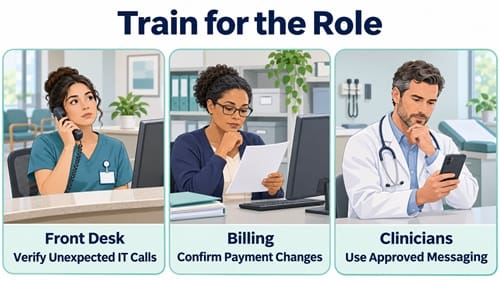
Generic training covers generic threats. The attacks hitting healthcare this year are specific, and your training should be too. This summer’s DentaQuest breach was attributed to ShinyHunters, a group that Health-ISAC says gets in through social engineering, including phone calls that talk employees into handing over access. Your front desk needs practice handling a caller who claims to be from IT, knows the office manager’s name, and needs a verification code read back to him right now. Billing staff should be able to spot a fraudulent request to change a vendor’s bank account, and clinicians need clear rules on texting PHI from personal phones, which we covered in Part 5 of this series. Training built around each role’s real-world exposure takes less time than the generic version and lands harder, because people recognize their own Tuesday afternoon in it. The single most valuable thing training can produce is a fast report. An employee who clicks a bad link and tells someone within 5 minutes has turned a potential breach into a contained incident. An employee who clicks and stays quiet because they’re afraid of getting written up has done the opposite. Your sanctions policy under 45 CFR § 164.308(a)(1)(ii)(C) should come down hard on snooping and deliberate violations, and it should go easy on people who make an honest mistake and report it immediately. Convey that in training, and then make sure your managers behave accordingly the first time it happens.
Let the Controls Carry Some of the Weight
The UC San Diego results make a case for better training, and they also make a case that training can’t be the only thing standing between a convincing email and your EHR. The practices that hold up best pair training with controls that make a mistake survivable: phishing-resistant MFA, banners that flag external email, a help desk that calls back on a known number before resetting anything, and payment changes that require a second person to confirm. Your risk analysis should drive those choices. If your risk analysis identifies phishing as a high risk and your only documented control is an annual slideshow, an OCR investigator is going to notice the mismatch before you finish explaining it.
Document It as If Someone Might Ask About It
Training records are among the first things OCR requests in an investigation, and “everybody did it” isn’t a record. You need to show who completed what, when they completed it, what the content covered, and how it connected to their role. Under 45 CFR §§ 164.530(j) and 164.316(b)(2), that documentation has to be retained for 6 years. Keep the reminders, the phishing simulation results, and the follow-up coaching in the same place as the annual completions. Together, they show OCR a program that responds to what’s happening in your practice, and they show you whether any of it is working, which is more than most practices have ever checked.

Recent Articles – Will Evertsen 


GlobalRPh Articles
Integrative Perspectives on Cognition, Emotion, and Digital Behavior

