Introducing the GlobalRPh Vancomycin Dosing and Bayesian AUC Calculator Advanced (Beta)
Five population models, conventional pharmacokinetics, Bayesian forecasting, and clinician-directed AUC dosing in one platform
A formal introduction to the Advanced calculator’s conventional AUC workflow, Bayesian mathematics, five population-specific models, model-selection safeguards, and clinician-directed regimen analysis.
Why vancomycin dosing requires more than a weight-based table
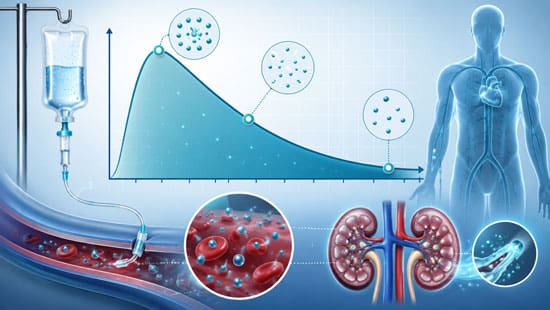
Vancomycin dosing has never been as simple as selecting a dose from a weight-based table. The drug’s pharmacokinetics vary substantially among hospitalized adults, and the consequences of imprecise exposure can be clinically important. A regimen that produces inadequate exposure in one patient may result in excessive accumulation in another. Renal function, body size, critical illness, fluid distribution, augmented renal clearance, renal replacement therapy, malignancy, neutropenia, and the timing of measured concentrations can all alter the relationship between a prescribed dose and the exposure ultimately achieved. The GlobalRPh Vancomycin Dosing and Bayesian AUC Calculator Advanced was created to address this complexity without abandoning the familiar pharmacokinetic methods clinicians have used for decades. It brings together conventional first-order pharmacokinetic dosing, two-level AUC estimation, empiric AUC-targeted dosing, Bayesian forecasting, five population-specific Bayesian priors, clinician-selected regimens, and automatic conventional fallback within one structured calculator. The result is not merely another dose estimator. It is a broader pharmacokinetic decision-support environment intended to help clinicians answer several different questions:
- What initial regimen is most likely to achieve the selected AUC target?
- What exposure is the current regimen likely to produce?
- What do one or two measured concentrations imply about the patient’s individual clearance and volume of distribution?
- Is a Bayesian population model appropriate for this patient?
- Would a conventional two-level calculation provide a more defensible estimate?
- What exact daily dose would mathematically achieve the chosen AUC?
- What would happen if the clinician selected a different dose, interval, or infusion duration?
The Advanced calculator is built on GlobalRPh’s long history of pharmacokinetic and renal-dosing tools. GlobalRPh and its related pharmacokinetic dosing calculators have historically generated more than one hundred thousand calculations each month, including calculations performed through its vancomycin AUC, aminoglycoside, single-level, trough-timing, dosing-by-levels, and advanced pharmacokinetic platforms.
Why vancomycin dosing moved beyond the trough
For many years, vancomycin monitoring centered on trough concentrations. A trough of 15 to 20 mg/L was commonly used as a practical surrogate for achieving an AUC-to-MIC ratio of at least 400 in serious methicillin-resistant Staphylococcus aureus infections. That approach was convenient, but it was not always an accurate representation of total exposure. Two patients may have similar trough concentrations while having meaningfully different 24-hour AUC values. Conversely, a patient may achieve an appropriate AUC with a trough below the historical 15-to-20 mg/L range. The 2020 multidisciplinary vancomycin consensus guideline recommended AUC-guided dosing and monitoring for serious MRSA infections. The guideline identifies a target AUC24/MIC of 400 to 600, assuming a broth-microdilution MIC of 1 mg/L, as the exposure range intended to balance efficacy and safety. It no longer recommends trough-only targeting of 15 to 20 mg/L for serious MRSA infection because higher trough-based exposure has been associated with greater nephrotoxicity without a consistently demonstrated improvement in outcomes.1 AUC-guided dosing reframes the question. Rather than asking whether one concentration falls within a predetermined range, the clinician estimates the patient’s cumulative vancomycin exposure over 24 hours.
This relationship illustrates why clearance is so important. When clearance decreases, the same daily dose produces a larger AUC. When clearance rises, as may occur with augmented renal clearance, critical illness, or some hematologic malignancies, the same dose produces less exposure. AUC-guided dosing therefore depends on obtaining the best available estimate of the patient’s vancomycin clearance.
Two legitimate pathways to AUC estimation
The consensus guideline describes two principal approaches to vancomycin AUC estimation:
- Conventional first-order pharmacokinetic equations using two measured concentrations
- Bayesian estimation using a population pharmacokinetic model and one or more patient concentrations
The Advanced calculator supports both. This is an important design choice. Bayesian forecasting is powerful, but it should not eliminate conventional pharmacokinetics. Conventional methods remain transparent, clinically familiar, and useful when two properly timed concentrations are available. They are also valuable when a patient does not reasonably match an available Bayesian population prior.
Conventional first-order pharmacokinetic dosing
Conventional vancomycin pharmacokinetics generally uses a one-compartment, first-order elimination framework. Two measured concentrations obtained after distribution allow the calculator to estimate the patient-specific elimination rate constant. For concentrations C1 and C2 measured at times t1 and t2:
The elimination half-life is then:
When volume of distribution is known or estimated:
The estimated clearance can then be used to calculate the AUC produced by the current regimen and the total daily dose required to achieve a selected target. The guideline-preferred conventional approach uses two timed, near-steady-state concentrations: a postdistributional level generally obtained 1 to 2 hours after completion of the infusion and a trough obtained near the end of the dosing interval. The two concentrations are used with first-order equations to estimate clearance and AUC.1
Trapezoidal and logarithmic interpolation
The area under a measured concentration-time segment can also be approximated using trapezoidal methods. For concentrations that change approximately linearly over a short interval:
When concentrations decline exponentially after distribution, a logarithmic trapezoidal method may better represent the area:
The Advanced calculator can display a linear/log-trapezoidal cross-check when the available concentrations and their timing make such an estimate appropriate. This should be understood as an equation-based approximation, not a substitute for a fully specified population model when the latter is suitable and well supported.
GlobalRPh’s conventional workflow remains the default
The Advanced calculator does not require a clinician to begin with Bayesian dosing. Its default pathway preserves the familiar GlobalRPh conventional AUC workflow developed through the Vancomycin Advanced AUC with CrCl Options calculator and related pharmacokinetic tools. That conventional pathway includes:
- Empiric AUC-targeted dosing before measured levels are available
- Selection of a desired AUC24 target
- Calculated creatinine clearance
- Manual creatinine-clearance entry when institutional practice or measured renal data justify overriding the calculated estimate
- Weight and obesity-related renal-function options
- One-level analysis
- Two levels at or near steady state
- Two levels obtained after the first dose
- Current-dose and current-interval analysis
- Adjustable volume-of-distribution assumptions where conventional estimation requires them
- Adjustable infusion duration
- Amputation-related weight adjustment
- Predicted peak, trough, AUC24, clearance, elimination rate, and half-life
- Exact-target dose calculations
- Clinician-selected custom dose, interval, and infusion-time analysis
The broader GlobalRPh calculator family also includes empiric AUC dosing, advanced single-level analysis, early-trough correction, estimated timing of the next dose after an elevated level, non-steady-state kinetics, multiple elimination-rate options, and traditional aminoglycoside and vancomycin pharmacokinetic dosing. The Advanced calculator consolidates these historical strengths rather than replacing them.

What Bayesian dosing adds
Bayesian dosing begins with a different mathematical question.
What pharmacokinetic parameters can be calculated directly from these measured concentrations?
Given what is known about vancomycin pharmacokinetics in a clinically similar population, and given this patient’s characteristics, doses, infusion times, and measured concentrations, what individual pharmacokinetic parameters are most probable?
Bayes’ theorem can be expressed conceptually as:
Where:
- θ represents the patient’s pharmacokinetic parameters, such as clearance and volume.
- P(θ) is the prior probability distribution derived from the selected population PK model.
- P(y | θ) is the likelihood of observing the patient’s measured concentrations if those parameter values were true.
- P(θ | y) is the posterior distribution after the patient’s data are incorporated.
The population model supplies the prior. The patient’s measured concentrations supply the new evidence. Bayesian estimation combines them to obtain a posterior estimate individualized to that patient. In practical vancomycin dosing, the process generally follows this sequence:
- A population model estimates typical clearance, volume, distribution, and variability for a patient with similar characteristics.
- The calculator reconstructs the patient’s exact dose history and infusion timing.
- The model predicts the concentrations expected from different individual clearance and volume values.
- Those predictions are compared with the measured concentration or concentrations.
- Parameter values that fit the concentrations well become more probable.
- Values that are physiologically implausible or inconsistent with the population model receive a probability penalty.
- The calculator identifies the posterior parameter set that best balances the population prior and the measured patient data.
- Those individualized parameters are used to estimate AUC and evaluate alternative regimens.
The calculator uses a maximum a posteriori approach:
This does not mean the calculator simply averages the population estimate and the measured concentration. The influence of each component depends on uncertainty. A highly variable population prior allows the measured concentration to exert greater influence. A tightly defined prior exerts more pull toward the typical population value. A concentration with substantial residual error receives less weight than a concentration measured accurately at a well-documented time.
Why one concentration can sometimes be enough
A Bayesian model may estimate AUC from one concentration because the population prior already supplies information about plausible clearance, volume, and distribution. The measured level updates those prior distributions. A conventional one-compartment calculation cannot identify every unknown parameter from a single concentration without making additional assumptions. Bayesian estimation can proceed because it is not starting from zero information. This is also why a one-level Bayesian estimate should not automatically be considered equivalent to a two-level estimate. With only one concentration, the posterior may remain influenced substantially by the prior. Two well-timed concentrations usually provide more information about the patient’s actual elimination and distribution. The consensus guideline permits Bayesian AUC estimation with one or two concentrations but states that two samples are preferred, particularly in special populations where trough-only estimation has less validation. Bayesian estimation may also permit earlier AUC assessment because it does not necessarily require waiting for steady state.1

The population prior is not a minor detail
A Bayesian engine cannot be separated from its population model. The population prior determines:
- The expected clearance
- The expected central and peripheral volumes
- The relationship between renal function and vancomycin elimination
- The effect of body size
- The expected degree of interindividual variability
- The expected residual difference between predicted and measured concentrations
- The plausible range within which patient-specific parameters can move
A model developed in stable general-medicine patients may not adequately describe a patient with septic shock, morbid obesity, CRRT, AML, neutropenia, or markedly augmented renal clearance. This is the reason the Advanced calculator does not rely on a single universal vancomycin model.
An unparalleled five-model GlobalRPh architecture
Within the GlobalRPh calculator ecosystem, the Advanced calculator’s defining feature is its five-model Bayesian architecture. Each model represents a different clinical population and a different set of pharmacokinetic assumptions. The calculator selects or permits selection of the prior that most closely reflects the patient’s circumstances.
Model 1: Goti 2018 general hospitalized-adult prior
The Goti model serves as the general hospitalized-adult foundation. It was developed from routine therapeutic-drug-monitoring data obtained at two academic medical centers and used nonlinear mixed-effects modeling to characterize vancomycin pharmacokinetics in hospitalized adults. The model identified age, renal-function measures, and dialysis status as important contributors to clearance and distinguished the substantially different pharmacokinetics of patients receiving hemodialysis.2 In the Advanced calculator, the non-hemodialysis component provides the general adult prior when the patient does not fall into a more specialized supported population. This is a broad two-compartment model. It recognizes that vancomycin does not instantly equilibrate throughout the entire apparent volume of distribution. Drug initially occupies a central compartment and subsequently distributes into peripheral tissues.
Model 2: Roberts 2011 critically ill or septic adult prior
Critically ill patients may exhibit expanded extracellular fluid volume, aggressive fluid resuscitation, altered albumin concentrations, augmented renal clearance, changing renal function, capillary leak, and extracorporeal support. These factors can affect both clearance and apparent volume. The Roberts model was developed in 206 adult septic critically ill patients. A one-compartment population model described vancomycin administered by continuous infusion. Total body weight was associated with volume of distribution, while 24-hour urinary creatinine clearance normalized to body-surface area was associated with vancomycin clearance.3 The Advanced calculator uses this model as a prior for critically ill, non-obese adults when a more specific CRRT or obesity model does not take priority.
Model 3: Zhang 2023/2024 obesity and obese-ICU prior
Obesity changes more than total body weight. It may affect extracellular fluid volume, lean mass, cardiac output, renal plasma flow, glomerular filtration, and the relationship between serum creatinine and drug clearance. The Zhang analysis pooled 1,188 therapeutic-drug-monitoring concentrations from 210 overweight or obese adults with varying renal function, including ward and ICU patients, with rich concentration-time data from morbidly obese subjects. The resulting model linked vancomycin clearance to total body weight and renal function and incorporated an ICU effect.4 The calculator uses this three-compartment prior for adults with a BMI of at least 30 kg/m². When the patient is both obese and critically ill, the obesity model remains the preferred automatic prior because it directly incorporates body size, renal function, and ICU status.
Model 4: Tsai 2024 CRRT prior
CRRT creates one of the most challenging vancomycin-dosing environments. Drug clearance may be influenced by modality, effluent rate, filter characteristics, treatment interruptions, filter clotting, residual urine output, native renal recovery, fluid accumulation, and differences between prescribed and delivered therapy. The Tsai model was developed in critically ill adults with and without CRRT or temporary mechanical circulatory support. The development dataset included 25 patients and 184 plasma samples. The final model used a two-compartment structure, with CRRT, serum creatinine, and body weight identified as significant predictors of clearance.5 In the Advanced calculator, the Tsai model receives priority when the patient is receiving supported CRRT. It should be viewed as a rational starting distribution, not a substitute for repeat measurement. CRRT interruptions, changing urine output, renal recovery, and filter performance can rapidly invalidate an earlier estimate.
Model 5: Belabbas 2023 hematologic-malignancy prior
Patients with hematologic malignancies may have unexpectedly high vancomycin clearance. AML, neutropenia, augmented renal clearance, fever, hyperdynamic circulation, chemotherapy, and changing renal function can make standard hospitalized-adult priors less reliable. The Belabbas model was developed from 148 adults with hematologic malignancies. Vancomycin pharmacokinetics were described using a one-compartment model. Creatinine clearance, AML, and neutropenia were significant covariates on clearance, while body weight influenced volume of distribution. The investigators reported that patients with AML required approximately 15% higher doses than non-AML patients independently of renal function.6 The Advanced calculator makes this model available when hematologic malignancy is identified, with additional inputs for AML and neutropenia.
Model selection is part of the clinical calculation
The Advanced calculator’s automatic model hierarchy is designed to select the most specific supported prior:
- CRRT model when supported CRRT is present
- Obesity model when BMI is at least 30 kg/m²
- Critically ill model when the patient is in the ICU and is not obese
- General hospitalized-adult model for other supported adults
- Hematologic-malignancy model as a deliberate optional selection when clinically appropriate
This hierarchy is not a claim that one model is always correct. It is a structured attempt to avoid using an obviously mismatched prior. The calculator reports which model was selected, why it was selected, and whether important overlap exists. An obese ICU patient, for example, receives the obesity model with its ICU adjustment rather than automatically receiving the non-obese Roberts prior.
What happens when no Bayesian model fits?
A responsible Bayesian calculator must be able to decline a Bayesian estimate. The Advanced calculator stops Bayesian calculation when required criteria are not satisfied, including unsupported renal-replacement modalities, pregnancy, incompatible manual-model selection, invalid pharmacokinetic parameters, or other model-exclusion conditions. When conventional AUC estimation remains clinically and mathematically reasonable, the calculator can offer or automatically apply a conventional pathway. This fallback is not a lesser-quality imitation of Bayesian dosing. It is a different method with different data requirements. With two suitable concentrations, the conventional method may provide a direct patient-specific estimate with fewer population assumptions. With one concentration, the calculation requires an assumed volume or other population parameter. With no measured levels, the result remains an empiric population-based estimate. The output clearly identifies which method was used.
Exact-target and clinician-selected regimens
The Advanced calculator does not stop after producing a preferred practical regimen. For conventional calculations, it also displays the unrounded mathematical regimen that would exactly achieve the selected AUC target:
For a selected interval:
This result is intentionally labeled as a mathematical target, not as a ready-to-administer order. Real-world doses must still account for available products, institutional rounding, infusion tolerability, maximum rates, patient status, and monitoring plans. The clinician can then enter a custom dose, interval, and infusion duration. The calculator recalculates the predicted AUC24, AUC/MIC, peak, trough, total daily dose, infusion rate, and deviation from the selected target. Changing infusion duration alters the peak, trough, and infusion rate. In a linear model, it does not change the total AUC when dose, interval, and clearance remain unchanged.
More transparent than a single recommended dose
A dosing calculator should show enough information for the clinician to understand the recommendation. The Advanced calculator therefore reports:
- Population model selected
- Calculation method
- Creatinine-clearance estimate or manual value
- Estimated vancomycin clearance
- Volume parameters
- Elimination rate
- Terminal half-life
- Predicted AUC24
- Predicted peak and trough
- Candidate regimens within the target
- Exact-target regimen
- Custom-regimen results
- Model-fit and safety warnings
- Reasons a Bayesian calculation was declined
- Conventional fallback status
This transparency matters because apparently precise numerical output can conceal considerable uncertainty. A calculated AUC of 500 mg·h/L should not be interpreted as proof that the true exposure is exactly 500. It is an estimate based on a model, laboratory measurements, dose history, renal data, and assumptions.
The importance of accurate input data
Bayesian mathematics cannot correct inaccurate timestamps. An incorrectly entered infusion start time, infusion duration, level time, omitted dose, delayed dose, or concentration drawn from a contaminated line may cause the model to fit the wrong clinical history. Before accepting a result, clinicians should confirm:
- Actual dose administration times
- Whether any dose was held, delayed, or stopped early
- Actual infusion duration
- Exact concentration-collection time
- Whether the sample was drawn from or near the infusion line
- Whether renal function is stable, improving, or deteriorating
- Whether CRRT was interrupted
- Whether urine output has changed
- Whether the patient’s body weight reflects current fluid status
- Whether the selected population model is clinically credible
A sophisticated model cannot compensate for an incorrect dose history.
Built for clinical decision support, not autonomous prescribing
The GlobalRPh Vancomycin Dosing and Bayesian AUC Calculator Advanced is intended for qualified healthcare professionals. It does not determine whether vancomycin is the appropriate antimicrobial, interpret susceptibility testing in isolation, diagnose acute kidney injury, or replace antimicrobial-stewardship and infectious-diseases review. The AUC24 target of 400 to 600 mg·h/L is principally supported for serious MRSA infections under the assumption of a broth-microdilution MIC of 1 mg/L. Extrapolation to noninvasive infections, other organisms, or different MIC conditions requires caution.1 Results should always be interpreted alongside infection source and severity, microbiology, clinical response, renal trajectory, concomitant nephrotoxins, source control, alternative antimicrobial options, local protocols, and repeat therapeutic-drug monitoring.
A new chapter in GlobalRPh pharmacokinetic dosing
GlobalRPh’s original pharmacokinetic calculators were built around practical bedside questions: How should creatinine clearance be estimated? Which body weight should be used? What does an early trough mean? When should the next dose be administered? What regimen will achieve a desired peak, trough, or AUC? Those questions remain relevant. What has changed is the ability to combine them with population pharmacokinetics, Bayesian updating, model-specific priors, early AUC estimation, and direct regimen simulation. The Advanced calculator brings both eras together. It preserves conventional, equation-based AUC dosing as the accessible default. It adds Bayesian forecasting when the patient fits a supported population. It provides five specialized priors instead of forcing every adult through one generic model. It offers a conventional alternative when Bayesian requirements are not met. It allows clinicians to test their own regimen rather than accepting a single recommendation. And it makes the mathematical and clinical assumptions visible. The objective is not to make vancomycin dosing appear simple. The objective is to make a complex decision more structured, transparent, reproducible, and clinically useful.
Detailed help, equations, and model documentation
For complete population-model equations, Bayesian mathematics, variable definitions, compartmental calculations, residual-error models, conventional PK equations, model-selection logic, safety exclusions, worked examples, and implementation details, see:
GlobalRPh Vancomycin Dosing and Bayesian AUC Calculator Advanced: Help and Technical Methods
References
- Rybak MJ, Le J, Lodise TP, et al. Therapeutic monitoring of vancomycin for serious methicillin-resistant Staphylococcus aureus infections: a revised consensus guideline and review by ASHP, IDSA, PIDS, and SIDP. Am J Health Syst Pharm. 2020;77(11):835-864. Source
- Goti V, Chaturvedula A, Fossler MJ, Mok S, Jacob JT. Hospitalized patients with and without hemodialysis have markedly different vancomycin pharmacokinetics: a population pharmacokinetic model-based analysis. Ther Drug Monit. 2018;40(2):212-221. Source
- Roberts JA, Taccone FS, Udy AA, Vincent JL, Jacobs F, Lipman J. Vancomycin dosing in critically ill patients: robust methods for improved continuous-infusion regimens. Antimicrob Agents Chemother. 2011;55(6):2704-2709. Source
- Zhang T, et al. How to dose vancomycin in overweight and obese patients with varying renal dysfunction in the novel era of AUC 400–600 mg·h/L-targeted dosing. Clin Pharmacokinet. Published online 2023; print publication 2024. Source
- Tsai MT, Wang WC, Roan JN, Luo CY, Chou CH. Population pharmacokinetics of vancomycin in intensive care patients with the time-varying status of temporary mechanical circulatory support or continuous renal replacement therapy. Infect Dis Ther. 2024;13(12):2617-2635. Source
- Belabbas T, Yamada T, Egashira N, et al. Population pharmacokinetic model and dosing optimization of vancomycin in hematologic malignancies with neutropenia and augmented renal clearance. J Infect Chemother. 2023;29(4):391-400. Source
- GlobalRPh. Vancomycin Advanced AUC with CrCl Options. Source
- GlobalRPh. Vancomycin AUC Dosing Calculator: Empiric Dosing. Source
- GlobalRPh. Vancomycin Single-Level Analysis, Advanced Version. Source
- GlobalRPh. Advanced Vancomycin AUC and Aminoglycoside Dosing Calculator. Source

Recent Articles


Integrative Perspectives on Cognition, Emotion, and Digital Behavior

Sleep-related:
Longevity/Nutrition & Diet:
Philosophical / Happiness / Social:
Other:
Modern Mind Unveiled
Developed under the direction of David McAuley, Pharm.D., this collection explores what it means to think, feel, and connect in the modern world. Drawing upon decades of clinical experience and digital innovation, Dr. McAuley and the GlobalRPh initiative translate complex scientific ideas into clear, usable insights for clinicians, educators, and students.
The series investigates essential themes–cognitive bias, emotional regulation, digital attention, and meaning-making—revealing how the modern mind adapts to information overload, uncertainty, and constant stimulation.
At its core, the project reflects GlobalRPh’s commitment to advancing evidence-based medical education and clinical decision support. Yet it also moves beyond pharmacotherapy, examining the psychological and behavioral dimensions that shape how healthcare professionals think, learn, and lead.
Through a synthesis of empirical research and philosophical reflection, Modern Mind Unveiled deepens our understanding of both the strengths and vulnerabilities of the human mind. It invites readers to see medicine not merely as a science of intervention, but as a discipline of perception, empathy, and awareness–an approach essential for thoughtful practice in the 21st century.
The Six Core Themes
I. Human Behavior and Cognitive Patterns
Examining the often-unconscious mechanisms that guide human choice-how we navigate uncertainty, balance logic with intuition, and adapt through seemingly irrational behavior.
II. Emotion, Relationships, and Social Dynamics
Investigating the structure of empathy, the psychology of belonging, and the influence of abundance and selectivity on modern social connection.
III. Technology, Media, and the Digital Mind
Analyzing how digital environments reshape cognition, attention, and identity- exploring ideas such as gamification, information overload, and cognitive “nutrition” in online spaces.
IV. Cognitive Bias, Memory, and Decision Architecture
Exploring how memory, prediction, and self-awareness interact in decision-making, and how external systems increasingly serve as extensions of thought.
V. Habits, Health, and Psychological Resilience
Understanding how habits sustain or erode well-being-considering anhedonia, creative rest, and the restoration of mental balance in demanding professional and personal contexts.
VI. Philosophy, Meaning, and the Self
Reflecting on continuity of identity, the pursuit of coherence, and the construction of meaning amid existential and informational noise.
Keywords
Cognitive Science • Behavioral Psychology • Digital Media • Emotional Regulation • Attention • Decision-Making • Empathy • Memory • Bias • Mental Health • Technology and Identity • Human Behavior • Meaning-Making • Social Connection • Modern Mind
Video Section