
HIPAA for the Clinician, Part 5: Telehealth, Remote Work, and the Perimeter That No Longer Exists

Introduction
It’s 21:40 on a Tuesday night, and one of your nurse practitioners is finishing chart notes at her kitchen table. The laptop is a family machine, and last month her teenage son installed a free game launcher on it that brought along a few extras nobody noticed. Her browser remembers the EHR password because typing it twice a day got old. She closes the lid at 22:15, satisfied that tomorrow starts with an empty task list. Across town, your practice’s firewall is doing exactly what you paid it to do, which is guarding a network that the “kitchen table laptop” has never touched. When something goes wrong on that kitchen table (and the game launcher suggests something will), the first question OCR asks will be whether your Security Risk Analysis knew the laptop existed. Plenty of practices would have to say no.
The Security Rule Never Cared About Your Walls
For most of the Security Rule’s history, practices built their security programs around a building. ePHI lived on a server in a closet, and the firewall marked the line between inside and outside. That model started eroding years ago and collapsed in 2020. Odds are your EHR now lives in a vendor’s data center, your providers see some patients by video from home offices and parked cars, and at least 1 member of your billing staff works remotely part of the week. The ePHI followed the people out the door, and the firewall stayed behind. The regulation was ready for this, even if most compliance programs weren’t. Under 45 CFR § 164.306(a)(1), you’re required to ensure the confidentiality, integrity, and availability of all ePHI you create, receive, maintain, or transmit. The obligation attaches to the data wherever the data happens to be. The definition of a workstation at 45 CFR § 164.304 explicitly includes laptops and any other device that performs similar functions, so the kitchen table counts.
The Pandemic Grace Period Ended in 2023
When the public health emergency began, OCR issued a Notification of Enforcement Discretion that let providers use everyday video tools like FaceTime and Skype for telehealth without facing penalties, even without a Business Associate Agreement in place. It also trained an entire profession to treat any video app as a telehealth platform. That discretion expired on May 11, 2023, and OCR gave covered entities a 90-day transition period that ended August 9, 2023. If any of your providers still conduct follow-ups over a consumer video app with no BAA behind it, they’re relying on a waiver that’s been dead for more than 3 years. A telehealth platform that transmits or stores ePHI on your behalf is a business associate, and the agreement requirements at 45 CFR § 164.504(e) apply in full. (Part 3 of this series covered what that agreement has to contain, and it’s worth a reread if your telehealth vendor’s BAA came bundled inside a clickwrap terms of service page you’ve never opened.) While you’re at it, find out whether the platform records sessions, where those recordings live, and who on the vendor’s side can reach them.
Your Provider’s Kitchen Table Is a Workstation
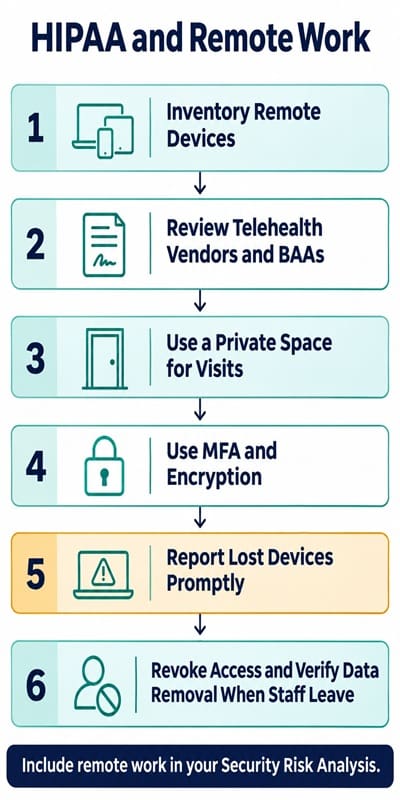
The physical safeguards at 45 CFR § 164.310 apply at home just as they do in your office. Section 164.310(b) requires policies specifying how workstations that access ePHI are used and what their physical surroundings should look like. Section 164.310(c) requires physical safeguards that restrict workstation access to authorized users. A family laptop shared with a teenager, a spouse, and whatever the teenager downloaded fails the second requirement on its face. Personal devices create the hardest version of this problem. When a provider accesses ePHI from a phone or laptop you don’t own, you’ve got limited visibility into its patch level, its security software, who else uses it, and what’s syncing to which cloud account. HIPAA doesn’t prohibit personal devices, but allowing them puts the burden on your policies to set conditions for their use and on your risk analysis to account for every one of them. Telehealth from home also reopens a Privacy Rule problem your exam rooms solved decades ago. The reasonable safeguards requirement at 45 CFR § 164.530(c) covers spoken information, and a psychiatric follow-up conducted from a dining room within earshot of a spouse and 2 houseguests stops looking incidental once you realize a closed door and a headset would have prevented it. Your providers need a private space for visits, and your policy should say so in writing.

Encryption and Authentication Decide Remote Breaches
Under the current Security Rule, encryption of stored ePHI (45 CFR § 164.312(a)(2)(iv)) and encryption of ePHI in transit (45 CFR § 164.312(e)(2)(ii)) are addressable implementation specifications. Addressable means you implement the control or document why an equivalent alternative is reasonable, and for a laptop that leaves the building every night, good luck writing that justification. Encryption also determines what happens after a device goes missing. The Breach Notification Rule applies to unsecured PHI as defined at 45 CFR § 164.402, and ePHI encrypted consistent with HHS guidance doesn’t qualify as unsecured. A stolen laptop with full disk encryption and a strong password is usually an incident report. The same laptop without encryption is presumed to be a reportable breach unless your documented risk assessment shows a low probability that the data was compromised, and that assessment is hard to win when you have no idea who has the device. Person or entity authentication at 45 CFR § 164.312(d) is a required standard, and a password alone is a thin way to satisfy it for remote access to systems containing ePHI. The Change Healthcare attack we covered earlier in this series began at a remote access portal that lacked multifactor authentication. If your staff can reach the EHR, your email, or your file shares from home with only a password, you’ve recreated that condition at a smaller scale. The proposed Security Rule overhaul would make encryption and MFA explicitly required, and HHS has pushed its projected final action to July 2027. The current rule remains fully enforceable in the meantime, and a remote access gap you’ve documented and left open will look far worse in an investigation than one you’ve already closed.
Scope Your Risk Analysis to Where the Work Happens
Your Security Risk Analysis under 45 CFR § 164.308(a)(1)(ii)(A) has to cover every place ePHI goes, and remote work multiplies those places. A defensible analysis identifies which workforce members access ePHI remotely, which devices they use and who owns them, what networks they connect through, and which telehealth and remote access tools sit in the path. Each of those becomes a line item with its own threats, vulnerabilities, and risk rating. That work carries more weight than it did a year ago. OCR has widened its enforcement focus from whether you completed a risk analysis to whether you managed the risks it found, under the risk management standard at 45 CFR § 164.308(a)(1)(ii)(B). A risk analysis that rates unencrypted home laptops as high risk and then sits untouched for 18 months is evidence against you. Your termination procedures under 45 CFR § 164.308(a)(3)(ii)(C) need the same remote lens. When a remote biller leaves, revoking her EHR account is step 1. Confirming that the patient spreadsheet she downloaded to her personal laptop in March is gone is the step that’s easy to skip.
A remote work and telehealth policy gives your workforce something specific to follow and gives OCR something specific to read. It should state which devices may access ePHI and under what conditions, require encryption and multifactor authentication for remote access, and set expectations for where telehealth visits happen and who can overhear them. It should also spell out how quickly a lost or stolen device must be reported, to whom, and what happens to ePHI on personal devices when someone leaves. Under 45 CFR § 164.316, you must document the policy, the training, and each workforce member’s acknowledgment. Then train on it. Your security awareness program under 45 CFR § 164.308(a)(5) should address the threats remote staff face, including phishing that arrives through personal email and the home router nobody has updated since the cable company installed it. The nurse practitioner at the kitchen table thinks she’s being conscientious, and by most measures she is. She finishes her notes on time, which is more than some of your providers manage. The gap belongs to a compliance program that never told her the rules and never counted her laptop as part of your environment. Closing it now costs far less than explaining it to an investigator after that game launcher does what it was built to do.
Recent Articles – Will Evertsen 


GlobalRPh Articles
Integrative Perspectives on Cognition, Emotion, and Digital Behavior

