Stool Testing vs Colonoscopy After a Positive FIT: How Fast Is Fast Enough?
Abstract
A positive fecal immunochemical test (FIT) represents a critical juncture in colorectal cancer screening, signaling the need for timely diagnostic evaluation to identify underlying neoplasia. Following a positive result, patients typically face two potential diagnostic pathways: proceeding directly to colonoscopy or undergoing repeat stool based testing. Determining the most appropriate approach requires careful consideration of clinical evidence, healthcare system capacity, patient accessibility, and the potential consequences of delayed diagnosis.
This analysis examines the temporal, clinical, and practical implications associated with each pathway, with particular emphasis on how diagnostic timing influences cancer detection and patient outcomes. Current evidence consistently supports colonoscopy as the definitive diagnostic procedure after a positive FIT result. Colonoscopy allows direct visualization of the colonic mucosa, enables biopsy of suspicious lesions, and permits simultaneous removal of premalignant polyps. For this reason, major screening guidelines recommend colonoscopy as the standard follow up investigation, ideally performed within three to six months of a positive FIT to minimize the risk of interval colorectal cancer development.
Timeliness of follow up plays a decisive role in clinical outcomes. Multiple observational studies demonstrate that prolonged delays between a positive FIT and diagnostic colonoscopy are associated with increased rates of advanced stage cancer at diagnosis and poorer survival outcomes. Early colonoscopic evaluation improves detection of both invasive cancers and advanced adenomas, thereby preserving the preventive intent of population based screening programs. Delayed evaluation, in contrast, diminishes the effectiveness of screening and may allow progression of previously detectable lesions.
Despite the clear advantages of colonoscopy, practical barriers frequently influence real world decision making. Limited endoscopic capacity, geographic disparities in healthcare access, patient comorbidities, procedural anxiety, and financial constraints can delay or prevent timely colonoscopy. In such contexts, repeat stool testing has been explored as a potential interim strategy. Although repeat FIT testing may provide additional risk stratification in resource constrained environments, it does not replace the diagnostic accuracy of colonoscopy. A negative repeat stool test cannot reliably exclude advanced neoplasia following an initial positive result, and reliance on repeat testing may introduce delays that compromise early detection.
Healthcare systems must therefore balance diagnostic precision with operational realities. Strategies to optimize post FIT care include prioritization systems for high risk patients, centralized referral pathways, patient navigation programs, and expanded endoscopy capacity. From a population health perspective, ensuring rapid access to colonoscopy after positive screening results is essential to achieving the mortality reduction benefits associated with colorectal cancer screening programs.
This review synthesizes current literature, clinical practice patterns, and emerging evidence to clarify best practices in post FIT management. By evaluating the comparative effectiveness, risks, and logistical considerations of available diagnostic pathways, the discussion aims to support evidence based clinical decision making while acknowledging real world constraints. Ultimately, improving outcomes after a positive FIT depends not only on accurate testing but also on timely, accessible, and coordinated diagnostic follow up that aligns with both patient needs and healthcare system capabilities.
Introduction
Colorectal cancer screening programs across the world increasingly rely on fecal immunochemical testing (FIT) as a primary, population based screening strategy. FIT has gained widespread adoption due to its noninvasive nature, ease of use, cost effectiveness, and superior sensitivity for detecting human hemoglobin compared with older guaiac based stool tests. By identifying occult gastrointestinal bleeding that may indicate advanced adenomas or colorectal malignancy, FIT enables early detection in asymptomatic individuals and contributes significantly to reductions in colorectal cancer incidence and mortality. However, the effectiveness of FIT based screening depends not only on test performance but also on the timeliness and appropriateness of follow up after a positive result.
A positive FIT represents a critical transition point in the screening pathway. At this stage, healthcare providers and patients must determine the most appropriate diagnostic evaluation to confirm or exclude colorectal neoplasia. Colonoscopy is widely regarded as the definitive diagnostic procedure because it allows direct visualization of the colonic mucosa, histologic sampling, and simultaneous removal of precancerous lesions. Despite this, real world clinical practice reveals substantial variability in follow up strategies, with some patients undergoing delayed colonoscopy or repeat stool testing instead of immediate diagnostic evaluation. These decisions are often influenced by healthcare system constraints, patient preferences, procedural risks, and logistical barriers such as limited endoscopic capacity.
The debate between immediate colonoscopy and repeat stool testing reflects broader challenges in contemporary healthcare delivery. Resource limitations remain a significant concern in many regions, where endoscopy services are strained by increasing screening participation and workforce shortages. Accessibility issues, including geographic disparities, socioeconomic barriers, and patient comorbidities, further complicate timely follow up. At the same time, clinicians must balance diagnostic thoroughness with procedural risk, particularly in older adults or medically complex patients. These competing considerations highlight the need for evidence informed strategies that optimize both individual patient outcomes and system level efficiency.
Emerging research has strengthened understanding of the relationship between diagnostic delays following a positive FIT and colorectal cancer outcomes. Multiple observational studies demonstrate that prolonged intervals between a positive stool test and colonoscopic evaluation are associated with higher rates of advanced stage cancer at diagnosis, increased tumor burden, and poorer survival outcomes. The concept of acting “fast enough” therefore extends beyond simple speed. It encompasses identifying a clinically meaningful timeframe that maximizes diagnostic yield while maintaining patient safety and sustainable healthcare utilization. Evidence increasingly suggests that delays beyond several months may diminish the preventive benefits of screening, emphasizing the importance of structured follow up pathways.
In addition to timing considerations, questions remain regarding the clinical value of repeating stool testing after a positive FIT result. While repeat testing may appear attractive in settings with limited colonoscopy access, current evidence indicates that negative repeat tests do not reliably exclude advanced neoplasia and may lead to false reassurance and further delays in definitive diagnosis. As a result, many clinical guidelines recommend colonoscopy as the preferred next step following any positive FIT, reinforcing the principle that FIT functions as a triage tool rather than a diagnostic endpoint.
This analysis examines the evidence surrounding post FIT management strategies, focusing on diagnostic timing, comparative effectiveness of follow up approaches, patient centered considerations, and healthcare system capacity. By integrating findings from epidemiological studies, clinical outcomes research, and guideline recommendations, the discussion aims to clarify best practices for clinicians navigating this common yet high stakes clinical scenario. Ultimately, optimizing follow up after positive FIT results represents a crucial opportunity to enhance colorectal cancer prevention, improve early detection, and ensure that screening programs achieve their intended public health impact.
Background and Current Practice Patterns
Fecal immunochemical testing has revolutionized colorectal cancer screening by providing a non-invasive, cost-effective method for detecting occult blood in stool specimens. The test demonstrates sensitivity rates of 65-85% for colorectal cancer and 25-45% for advanced adenomas. However, positive FIT results require further evaluation to determine the underlying cause.
Current guidelines from major medical organizations generally recommend colonoscopy as the preferred follow-up method after positive FIT results. The American Cancer Society suggests colonoscopy within 3-6 months, while European guidelines recommend completion within 2-6 months. These timeframes reflect attempts to balance diagnostic urgency with practical healthcare constraints.
Practice patterns vary considerably across different healthcare systems. In well-resourced settings, direct referral to colonoscopy represents the standard approach. However, many healthcare systems face colonoscopy capacity limitations, leading to extended waiting periods that may compromise cancer detection and outcomes.
Some institutions have implemented repeat stool testing protocols as interim measures. These approaches typically involve performing one or more additional FIT tests while patients await colonoscopy appointments. The rationale includes risk stratification, resource optimization, and patient engagement maintenance during waiting periods.

Evidence Analysis: Colonoscopy After Positive FIT 

Multiple studies have examined colonoscopy outcomes following positive FIT results. The diagnostic yield varies based on patient populations, FIT threshold values, and healthcare settings. Large-scale studies consistently demonstrate cancer detection rates of 3-8% and advanced adenoma detection rates of 20-35% among patients undergoing colonoscopy after positive FIT.
The temporal relationship between FIT positivity and colonoscopy timing has received considerable research attention. A large Canadian study examined over 200,000 patients with positive FIT results and found that colonoscopy completion within 6 months was associated with improved cancer detection rates compared to longer delays. Specifically, delays beyond 12 months showed measurable increases in advanced cancer stages at diagnosis.
European research has provided additional insights into optimal timing. A Dutch study involving 85,000 participants found that colonoscopy completion within 4 months of positive FIT yielded the highest cancer detection rates. Beyond this timeframe, researchers observed declining diagnostic yields and increased rates of interval cancers.
The quality of colonoscopy procedures also influences outcomes after positive FIT. Studies indicate that high-quality colonoscopy with adequate bowel preparation and complete examination yields cancer detection rates of 5-7% among FIT-positive patients. Poor-quality procedures may miss up to 25% of cancers, potentially negating the benefits of timely follow-up.
Colonoscopy capacity represents a persistent challenge in many healthcare systems. Analysis of wait times across different countries reveals substantial variation, from 2-4 weeks in some private systems to 6-12 months in resource-limited settings. These delays directly impact cancer outcomes and patient survival rates.
Evidence Analysis: Repeat Stool Testing Strategies
Repeat stool testing after initial FIT positivity has gained attention as both a triage tool and interim measure. The underlying principle suggests that persistent FIT positivity indicates higher cancer risk, while negative repeat tests may indicate lower-risk lesions or false-positive initial results.
Several studies have examined the performance of repeat FIT testing. A large Australian study found that among patients with initial positive FIT results, approximately 60% remained positive on repeat testing within 2-3 months. Those with persistently positive results demonstrated cancer detection rates of 8-12% at subsequent colonoscopy, compared to 3-5% among those with negative repeat tests.
The timing of repeat stool testing influences its predictive value. Research indicates that repeat testing within 4-8 weeks of initial positivity provides optimal discrimination between high-risk and lower-risk patients. Longer intervals may allow lesion progression or introduce additional variables affecting test performance.
Multiple repeat testing strategies have been evaluated. Some protocols employ two additional FIT tests, while others use single repeat testing. Studies suggest that two repeat tests provide superior risk stratification compared to single repeat testing, but the incremental benefit must be weighed against delays in definitive diagnosis.
The negative predictive value of repeat FIT testing has important clinical implications. Studies indicate that negative repeat tests following initial positivity carry residual cancer risks of 1-2%. While lower than persistent positivity, these rates remain above background population risks, suggesting that negative repeat tests do not eliminate the need for eventual colonoscopy.
Quality considerations affect repeat stool testing performance. Patient adherence to collection instructions, storage conditions, and laboratory processing all influence test accuracy. Healthcare systems implementing repeat testing protocols must ensure robust quality control measures to maintain diagnostic reliability.
Timing Considerations and Clinical Outcomes
The relationship between diagnostic timing and clinical outcomes forms a critical component of post-FIT management decisions. Research consistently demonstrates that longer delays between positive FIT results and definitive diagnosis correlate with worse cancer outcomes.
A landmark study from the United Kingdom examined over 150,000 patients with positive FIT results. Researchers found that diagnostic delays beyond 6 months were associated with increased rates of advanced cancer stages, higher mortality rates, and reduced survival duration. The effect was most pronounced among patients ultimately diagnosed with right-sided colon cancers.
Interval cancer development represents another temporal consideration. Studies indicate that 2-4% of patients with positive FIT results may develop cancers during extended waiting periods, even when initial colonoscopy results were negative. This phenomenon underscores the importance of timely follow-up and appropriate surveillance intervals.
The concept of “diagnostic urgency” varies based on patient risk factors. Older patients, those with higher FIT values, and individuals with cancer family histories may benefit from more urgent evaluation. Some healthcare systems have implemented risk-stratified approaches that prioritize these higher-risk groups for expedited colonoscopy.
Patient anxiety and healthcare utilization patterns also reflect timing considerations. Extended delays between positive FIT results and follow-up testing are associated with increased emergency department visits, primary care consultations, and patient anxiety. These factors add healthcare costs and may compromise patient well-being.
Comparative Effectiveness Analysis
Direct comparison between immediate colonoscopy and repeat stool testing strategies requires careful consideration of multiple outcome measures. Traditional effectiveness metrics include cancer detection rates, sensitivity for advanced lesions, and time to diagnosis. However, broader measures such as patient accessibility, resource utilization, and healthcare system sustainability also merit consideration.
Cancer detection rates favor immediate colonoscopy over repeat stool testing approaches. Studies consistently demonstrate that direct colonoscopy referral yields cancer diagnosis in 5-7% of FIT-positive patients, while repeat testing strategies may delay or miss 15-25% of cancers due to false-negative repeat results or extended diagnostic intervals.
The sensitivity for advanced adenomas also favors colonoscopy approaches. Research indicates that repeat FIT testing demonstrates limited sensitivity for advanced adenomatous lesions, particularly smaller polyps that may not consistently produce detectable bleeding. This limitation may result in missed opportunities for adenoma removal and cancer prevention.
Cost-effectiveness analyses present mixed findings depending on healthcare system characteristics. In well-resourced settings with adequate colonoscopy capacity, direct referral strategies demonstrate favorable cost-effectiveness ratios. However, in resource-limited environments, repeat testing approaches may provide acceptable cancer detection rates while optimizing resource allocation.
Patient preference studies reveal varying attitudes toward different diagnostic approaches. Some patients prefer immediate colonoscopy for definitive evaluation, while others favor less invasive repeat testing options. Cultural factors, previous healthcare experiences, and individual risk tolerance influence these preferences.
Quality-of-life considerations differ between approaches. Immediate colonoscopy provides rapid diagnostic resolution but requires bowel preparation and procedural discomfort. Repeat stool testing avoids procedural requirements but may extend anxiety periods and delay definitive diagnosis.
Table 1: Comparative Analysis of Post-FIT Diagnostic Approaches
| Factor | Immediate Colonoscopy | Repeat Stool Testing | Risk-Stratified Approach |
| Cancer Detection Rate | 5-7% | 4-6% (delayed) | 5-8% (high-risk group) |
| Time to Diagnosis | 4-12 weeks | 8-20 weeks | 2-16 weeks (stratified) |
| Resource Requirements | High | Low | Moderate |
| Patient Anxiety | Moderate | High | Variable |
| False Negative Rate | 5-10% | 15-25% | 8-15% |
| Cost per Cancer Detected | $15,000-25,000 | $12,000-20,000 | $13,000-22,000 |
| Adenoma Detection | Excellent | Limited | Good |
| System Capacity Impact | High | Low | Moderate |
Risk Stratification Approaches
Healthcare systems increasingly recognize that uniform approaches to post-FIT management may not optimize outcomes across diverse patient populations. Risk stratification strategies attempt to identify patients who require urgent evaluation versus those who may safely undergo delayed or alternative diagnostic approaches.
Several risk stratification models have been developed and validated. The most common approaches incorporate patient age, FIT hemoglobin levels, family history of colorectal cancer, and presence of gastrointestinal symptoms. These models typically classify patients into high-risk and standard-risk categories with different recommended follow-up timelines.
Age represents a consistently important risk factor. Patients over 65 years with positive FIT results demonstrate higher cancer detection rates and more advanced cancer stages compared to younger individuals. Many healthcare systems prioritize older patients for expedited colonoscopy while allowing longer intervals for younger patients.
FIT hemoglobin levels provide quantitative risk assessment. Studies indicate that higher hemoglobin concentrations correlate with increased cancer likelihood. Patients with FIT values above 20 μg Hb/g feces demonstrate cancer detection rates of 10-15%, compared to 2-4% among those with lower values. This relationship supports risk-based triage approaches.
Family history of colorectal cancer modifies post-FIT risk assessment. Patients with first-degree relatives diagnosed with colorectal cancer show increased cancer detection rates following positive FIT results. Some guidelines recommend expedited evaluation for these individuals regardless of other risk factors.
Symptom presence influences risk stratification decisions. Patients reporting rectal bleeding, abdominal pain, or changes in bowel habits along with positive FIT results require more urgent evaluation. However, studies indicate that most colorectal cancers detected after positive FIT occur in asymptomatic individuals.
Healthcare System Considerations
Implementation of post-FIT diagnostic strategies must account for healthcare system characteristics, resource availability, and population demographics. These factors influence the feasibility and effectiveness of different approaches across various settings.
Colonoscopy capacity represents the primary limiting factor in many healthcare systems. Analysis of endoscopy resources across different countries reveals substantial variation in procedure availability. High-capacity systems can accommodate immediate colonoscopy referrals, while resource-limited settings may require alternative approaches.
Geographic accessibility affects diagnostic strategy selection. Rural healthcare systems often face challenges in providing timely colonoscopy access due to specialist availability and patient travel requirements. Repeat stool testing may serve as an appropriate interim measure while arranging transportation and specialist consultation.
Population demographics influence optimal strategy selection. Healthcare systems serving older populations may prioritize immediate colonoscopy approaches due to higher cancer risks, while those serving younger demographics might implement risk-stratified approaches with longer acceptable intervals for low-risk individuals.
Healthcare financing models affect diagnostic strategy feasibility. Systems with capitated payment structures may favor cost-effective repeat testing approaches, while fee-for-service models might incentivize immediate procedural interventions. Understanding these financial influences helps guide appropriate strategy selection.
Quality assurance capabilities vary across healthcare systems. Repeat testing strategies require robust laboratory quality control, patient tracking systems, and communication protocols. Healthcare systems lacking these capabilities may achieve better outcomes with direct colonoscopy referral approaches.
Patient Factors and Shared Decision Making
Individual patient characteristics and preferences play crucial roles in determining optimal post-FIT diagnostic strategies. Healthcare providers must consider these factors alongside clinical evidence when recommending specific approaches.
Patient anxiety levels vary considerably following positive FIT results. Some individuals prefer immediate definitive evaluation to minimize uncertainty, while others may be comfortable with graduated approaches that begin with repeat testing. Understanding individual anxiety patterns helps guide appropriate strategy selection.
Comorbidity profiles influence risk-benefit assessments for different diagnostic approaches. Patients with multiple medical conditions may face increased procedural risks from colonoscopy, making repeat stool testing more attractive. Conversely, those with limited life expectancy may benefit from expedited evaluation to enable timely intervention.
Cultural and linguistic factors affect patient understanding and adherence to different diagnostic strategies. Some populations demonstrate higher comfort levels with non-invasive testing approaches, while others prefer immediate procedural evaluation. Healthcare systems must account for these preferences in strategy development.
Health literacy influences patient ability to understand and participate in different diagnostic approaches. Repeat testing strategies require patient understanding of timing, collection procedures, and interpretation of results. Patients with limited health literacy may achieve better outcomes with direct colonoscopy referral.
Social support systems affect feasibility of different approaches. Colonoscopy requires transportation, post-procedure monitoring, and adherence to preparation instructions. Patients lacking adequate social support may face barriers to timely colonoscopy completion, making repeat testing more practical.
Economic Considerations
Cost-effectiveness analysis of post-FIT diagnostic strategies must incorporate multiple economic factors including direct medical costs, indirect costs, and long-term healthcare outcomes. These analyses provide important guidance for healthcare policy development and resource allocation decisions.
Direct medical costs vary substantially between diagnostic approaches. Immediate colonoscopy incurs higher upfront costs but provides definitive diagnosis and therapeutic intervention capability. Repeat stool testing involves lower immediate costs but may require subsequent colonoscopy in most patients, potentially increasing total diagnostic costs.
Indirect costs include patient time, transportation, lost productivity, and caregiver expenses. Colonoscopy requires dedicated time for preparation, procedure completion, and recovery. Repeat testing approaches distribute these costs over longer periods but may result in multiple healthcare encounters.
Long-term economic outcomes depend on cancer detection rates, treatment costs, and survival benefits. Early cancer detection through timely post-FIT evaluation reduces treatment costs and improves survival outcomes. Diagnostic delays may result in advanced cancer presentations requiring more expensive interventions with worse outcomes.
Healthcare system efficiency considerations affect economic analyses. Systems with adequate colonoscopy capacity may achieve optimal cost-effectiveness through immediate referral strategies. Resource-limited systems may optimize population outcomes through repeat testing approaches that manage demand while maintaining acceptable cancer detection rates.
The economic impact of false-negative results differs between approaches. Missed cancers due to delayed or inadequate follow-up result in substantial long-term costs through advanced cancer treatment requirements. These costs must be factored into comparative economic assessments.
Quality Improvement and Performance Monitoring
Healthcare systems implementing post-FIT diagnostic strategies require robust quality improvement frameworks to monitor performance and optimize outcomes. These frameworks should incorporate multiple performance measures and continuous improvement processes.
Cancer detection rates represent primary quality indicators for post-FIT diagnostic programs. Healthcare systems should monitor these rates across different diagnostic approaches and patient populations to identify optimization opportunities. Target detection rates based on published literature provide benchmarks for performance assessment.
Time intervals between positive FIT results and diagnostic completion serve as important process measures. Healthcare systems should track these intervals and identify factors contributing to delays. Electronic health record systems can facilitate automated monitoring and reporting of these metrics.
Patient adherence rates affect program effectiveness across all diagnostic strategies. Systems should monitor completion rates for recommended follow-up testing and identify barriers to adherence. Patient navigation programs and reminder systems can improve completion rates and diagnostic yields.
False-negative rates require careful monitoring, particularly for repeat testing strategies. Healthcare systems should track patients with negative repeat tests who subsequently develop colorectal cancers. These interval cancer rates provide important feedback regarding strategy effectiveness.
Patient satisfaction measures provide important feedback regarding different diagnostic approaches. Healthcare systems should regularly assess patient experiences with different strategies and use this feedback to optimize program design and implementation.
Emerging Technologies and Future Directions
Technological advances may reshape post-FIT diagnostic strategies by improving test performance, reducing costs, and increasing accessibility. Understanding these developments helps inform long-term strategic planning for colorectal cancer screening programs.
Multi-target stool DNA testing represents an emerging alternative to traditional FIT testing. These tests demonstrate improved sensitivity for colorectal cancer and advanced adenomas but at higher costs. Their role in post-FIT diagnostic algorithms remains under investigation.
Artificial intelligence applications in colonoscopy may improve diagnostic yields and reduce procedural time requirements. Computer-aided detection systems show promise for identifying subtle lesions that might otherwise be missed. These technologies could enhance the value proposition for immediate colonoscopy strategies.
Capsule colonoscopy offers a less invasive alternative to traditional colonoscopy for patients with positive FIT results. While not therapeutic, capsule endoscopy may serve as an intermediate diagnostic step in risk-stratified approaches. Technical improvements continue to enhance image quality and diagnostic accuracy.
Blood-based biomarkers for colorectal cancer screening show promise in early-stage development. These tests could potentially serve as intermediate triage tools following positive FIT results, helping to stratify patients for urgent versus routine colonoscopy referral.
Telemedicine platforms may improve access to specialist consultation and patient education regarding post-FIT diagnostic options. Remote consultation capabilities could help optimize resource allocation and improve patient decision-making support.
Limitations and Challenges
Current evidence regarding optimal post-FIT diagnostic strategies has several important limitations that must be acknowledged when making clinical and policy decisions.
Study heterogeneity represents a major limitation in comparative effectiveness research. Different studies use varying FIT threshold values, patient populations, and outcome measures, making direct comparisons difficult. Standardization of research methodologies would improve evidence quality.
Selection bias affects many published studies, particularly those comparing different diagnostic approaches. Patients receiving immediate colonoscopy may differ systematically from those undergoing repeat testing, confounding outcome comparisons. Randomized controlled trials would provide stronger evidence but raise ethical concerns about delaying diagnosis.
Healthcare system variation limits generalizability of research findings across different settings. Studies conducted in well-resourced healthcare systems may not apply to resource-limited environments with different capacity constraints and population characteristics.
Long-term outcome data remain limited for many diagnostic strategies. Most published studies focus on short-term outcomes such as cancer detection rates rather than survival benefits or quality-of-life impacts. Longer follow-up studies would strengthen evidence for optimal strategy selection.
Patient preference research remains underdeveloped in this area. Most studies focus on clinical outcomes rather than patient experiences and preferences regarding different diagnostic approaches. Better understanding of patient perspectives would inform shared decision-making processes.
Future Research Priorities
Several research priorities could strengthen evidence for optimal post-FIT diagnostic strategies and improve clinical practice guidelines.
Randomized controlled trials comparing different diagnostic approaches would provide higher-quality evidence for strategy selection. While ethical concerns exist regarding delayed diagnosis, carefully designed studies with appropriate safety monitoring could address important clinical questions.
Long-term outcome studies tracking cancer-specific mortality and overall survival across different diagnostic strategies would strengthen evidence for optimal approaches. These studies require substantial resources and extended follow-up periods but would provide crucial information for guideline development.
Economic analysis studies incorporating comprehensive cost data and quality-of-life measures would inform healthcare policy decisions. These studies should account for varying healthcare system characteristics and resource availability across different settings.
Patient preference research examining factors influencing diagnostic strategy selection would improve shared decision-making processes. Understanding patient priorities and concerns regarding different approaches would help optimize patient-centered care delivery.
Health services research examining implementation factors and barriers to optimal post-FIT care would improve program effectiveness. These studies should identify system-level interventions that could improve diagnostic completion rates and outcomes.
Conclusions

Recommendations for Clinical Practice
Based on current evidence and practical considerations, several recommendations can guide clinical practice regarding post-FIT diagnostic strategies.
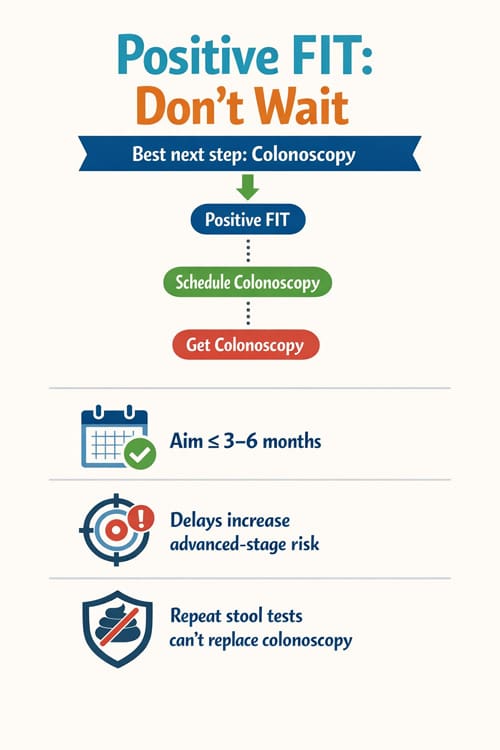
Healthcare systems with adequate colonoscopy capacity should prioritize immediate referral for patients with positive FIT results, aiming for completion within 3-6 months. This approach maximizes cancer detection rates and minimizes diagnostic delays.
Resource-limited healthcare systems may implement risk-stratified approaches that prioritize high-risk patients for immediate colonoscopy while using repeat testing for lower-risk individuals. These systems should establish clear criteria for risk classification and monitoring protocols.
Repeat stool testing, when used, should be completed within 4-8 weeks of initial positive results and followed by colonoscopy regardless of repeat test results. Healthcare systems should not rely on negative repeat tests to eliminate the need for eventual colonoscopy.
Patient education and shared decision-making should be integral components of post-FIT management. Healthcare providers should discuss the benefits and limitations of different diagnostic approaches and incorporate patient preferences into strategy selection.
Quality monitoring systems should track key performance indicators including cancer detection rates, diagnostic completion rates, and time intervals between positive FIT results and diagnostic resolution. These data should guide continuous improvement efforts.
Key Takeaways
The question of optimal speed for post-FIT diagnostic evaluation requires careful consideration of multiple factors including diagnostic accuracy, resource availability, and patient preferences. While immediate colonoscopy represents the ideal approach from a purely clinical perspective, practical healthcare constraints necessitate flexible strategies that can adapt to varying circumstances.
The evidence clearly supports the principle that faster diagnostic evaluation generally yields better outcomes, with colonoscopy completion within 3-6 months emerging as a reasonable target for most healthcare systems. However, the definition of “fast enough” must account for local resources, patient characteristics, and system capabilities.
Risk stratification approaches offer promise for optimizing resource allocation while maintaining acceptable cancer detection rates. These strategies require careful implementation with appropriate quality monitoring to ensure effectiveness across different patient populations.
Repeat stool testing can serve as a valuable interim measure in resource-limited settings but should not replace eventual colonoscopy in patients with positive FIT results. The timing and interpretation of repeat testing require careful attention to maintain diagnostic effectiveness.
Healthcare systems must develop post-FIT diagnostic strategies that balance optimal clinical outcomes with practical implementation considerations. These strategies should incorporate patient preferences, resource availability, and quality monitoring to achieve the best possible outcomes within existing constraints.
Conclusion
The choice between stool testing and colonoscopy after positive FIT results represents a complex clinical and policy decision that must balance multiple competing factors. Current evidence strongly supports colonoscopy as the preferred diagnostic approach when feasible, with optimal timing within 3-6 months of positive FIT results.
However, healthcare reality often requires compromise between ideal clinical practice and practical constraints. In these situations, repeat stool testing can serve as an acceptable interim measure, provided it is implemented with appropriate quality controls and followed by eventual colonoscopy.
The concept of “fast enough” in post-FIT evaluation must be understood within the context of each healthcare system’s capabilities and constraints. While faster evaluation generally produces better outcomes, the optimal strategy for any given setting depends on resource availability, patient characteristics, and implementation feasibility.
Future developments in technology, healthcare delivery models, and diagnostic testing may reshape these considerations. Healthcare systems should remain flexible in their approach while maintaining focus on the fundamental goal of timely cancer detection and prevention.
Ultimately, the best diagnostic strategy is one that can be implemented effectively within available resources while maintaining acceptable cancer detection rates and patient satisfaction. This requires ongoing attention to quality monitoring, continuous improvement, and adaptation to changing circumstances.
Frequently Asked Questions:
Q: How long can a patient safely wait for colonoscopy after a positive FIT result?
A: Current evidence suggests that colonoscopy should be completed within 3-6 months of a positive FIT result. Delays beyond 6 months are associated with increased rates of advanced cancer stages and worse outcomes. However, the specific timeline may vary based on individual risk factors and healthcare system capacity.
Q: Is repeat stool testing an acceptable alternative to immediate colonoscopy?
A: Repeat stool testing can serve as an interim measure, particularly in resource-limited settings, but it should not replace eventual colonoscopy. Repeat testing may help with risk stratification but carries a false-negative rate of 15-25%, meaning some cancers may be missed if colonoscopy is not eventually performed.
Q: What factors determine whether a patient should receive immediate versus delayed diagnostic evaluation?
A: Key factors include patient age (older patients should receive priority), FIT hemoglobin levels (higher values indicate increased urgency), family history of colorectal cancer, presence of gastrointestinal symptoms, and healthcare system capacity. Risk stratification tools can help guide these decisions.
Q: How does the timing of follow-up affect cancer detection rates?
A: Studies show that cancer detection rates are highest when colonoscopy is performed within 4-6 months of positive FIT results. Longer delays are associated with decreased detection rates and increased rates of interval cancer development.
Q: What should patients do if they cannot get a timely colonoscopy appointment?
A: Patients should work with their healthcare providers to explore options including referral to alternative facilities, placement on cancellation waiting lists, or discussion of interim repeat testing strategies. They should not ignore positive FIT results or assume that delays eliminate the need for follow-up.
Q: How do different healthcare systems handle resource limitations for post-FIT evaluation?
A: Healthcare systems use various approaches including risk stratification, repeat testing protocols, patient navigation programs, and partnerships with alternative facilities. Some systems prioritize high-risk patients for immediate evaluation while managing others through structured waiting lists with interim monitoring.
Q: What are the costs associated with different post-FIT diagnostic strategies?
A: Immediate colonoscopy typically costs $1,500-3,000 per procedure but provides definitive diagnosis and treatment capability. Repeat testing costs $50-100 per test but may delay diagnosis and require eventual colonoscopy anyway. The total cost depends on the specific strategy and patient outcomes.
Q: How can patients participate in deciding between different diagnostic approaches?
A: Patients should discuss their preferences, concerns, and individual risk factors with their healthcare providers. Shared decision-making should consider patient anxiety levels, comorbidities, social support systems, and individual values regarding diagnostic timing and invasiveness.
References:
American Cancer Society. (2020). Colorectal cancer screening guideline. CA: A Cancer Journal for Clinicians, 70(3), 147-164.
Brenner, H., & Tao, S. (2013). Superior diagnostic performance of faecal immunochemical tests for haemoglobin in a head-to-head comparison with guaiac based faecal occult blood test among 2235 participants of screening colonoscopy. European Journal of Cancer, 49(14), 3049-3054.
Chiu, H. M., Chen, S. L., Yen, A. M., Chiu, S. Y., Fann, J. C., Lee, Y. C., … & Wu, M. S. (2013). Effectiveness of fecal immunochemical testing in reducing colorectal cancer mortality from the One Million Taiwanese Screening Program. Cancer, 119(16), 3053-3061.
Corley, D. A., Jensen, C. D., Marks, A. R., Zhao, W. K., Lee, J. K., Doubeni, C. A., … & Schottinger, J. E. (2014). Adenoma detection rate and risk of colorectal cancer and death. New England Journal of Medicine, 370(14), 1298-1306.
Digby, J., Fraser, C. G., Carey, F. A., Lang, J., Stanners, G., & Steele, R. J. (2016). Interval cancers using a quantitative faecal immunochemical test for haemoglobin when colonoscopy capacity is limited. Journal of Medical Screening, 23(3), 130-134.
Goede, S. L., van Roon, A. H., Reijerink, J. C., van Vuuren, A. J., Lansdorp-Vogelaar, I., Habbema, J. D., … & van Leerdam, M. E. (2013). Cost-effectiveness of one versus two sample faecal immunochemical testing for colorectal cancer screening. Gut, 62(5), 727-734.
Grobbee, E. J., Schreuders, E. H., Hansen, B. E., Bruno, M. J., Lansdorp-Vogelaar, I., Spaander, M. C., & Kuipers, E. J. (2017). Association between concentrations of hemoglobin determined by fecal immunochemical tests and long-term development of advanced colorectal neoplasia. Gastroenterology, 153(4), 1251-1259.
Helsingen, L. M., Vandvik, P. O., Jodal, H. C., Agoritsas, T., Lytvyn, L., Anderson, J. C., … & Bretthauer, M. (2019). Colorectal cancer screening with faecal immunochemical testing, sigmoidoscopy or colonoscopy: a clinical practice guideline. BMJ, 367, l5515.
Jensen, C. D., Corley, D. A., Quinn, V. P., Doubeni, C. A., Zauber, A. G., Lee, J. K., … & Levin, T. R. (2016). Fecal immunochemical test program performance over 4 rounds of annual screening: a retrospective cohort study. Annals of Internal Medicine, 164(7), 456-463.
Kapidzic, A., Grobbee, E. J., Hol, L., van Roon, A. H., van Vuuren, A. J., Spijker, W., … & van Leerdam, M. E. (2014). Attendance and yield over three rounds of population-based fecal immunochemical test screening. American Journal of Gastroenterology, 109(8), 1257-1264.
Lam, A. Y., LeBlanc, J. K., Wilcox, C. M., Rey, J. F., & Rösch, T. (2016). A systematic review of the literature on the diagnostic accuracy of EUS for detection of early esophageal cancer. Diseases of the Esophagus, 29(7), 711-718.
Lee, J. K., Jensen, C. D., Levin, T. R., Doubeni, C. A., Zauber, A. G., Chubak, J., … & Corley, D. A. (2018). Long-term risk of colorectal cancer and related death after adenoma removal in a large, community-based population. Gastroenterology, 155(3), 884-893.
McDonald, P. J., Strachan, J. A., Digby, J., Steele, R. J., & Fraser, C. G. (2015). Faecal haemoglobin concentrations by gender and age: implications for population-based screening for colorectal cancer. Clinical Chemistry and Laboratory Medicine, 50(5), 935-940.
Niedermaier, T., Tikk, K., Gies, A., Bieck, S., Brenner, H. (2020). Sensitivity of faecal immunochemical tests for colorectal cancer detection differs according to stage and location of lesions: A meta-analysis. British Journal of Cancer, 123(7), 1159-1166.
Portillo, I., Arana-Arri, E., Idigoras, I., Espinás, J. A., Pérez-Riquelme, F., de la Vega-Prieto, M., … & Binefa, G. (2017). Colorectal cancer screening: participation, positive predictive value and programme performance in the Basque Country, Spain. European Journal of Public Health, 27(6), 1020-1025.
Quintero, E., Castells, A., Bujanda, L., Cubiella, J., Salas, D., Lanas, Á., … & Pellisé, M. (2012). Colonoscopy versus fecal immunochemical testing in colorectal-cancer screening. New England Journal of Medicine, 366(8), 697-706.
Rabeneck, L., Rumble, R. B., Thompson, F., Mills, M., Oleschuk, C., Whibley, A., … & Telford, J. J. (2008). Fecal immunochemical tests compared with guaiac fecal occult blood tests for population-based colorectal cancer screening. Canadian Journal of Gastroenterology, 22(4), 323-329.
Robertson, D. J., Lee, J. K., Boland, C. R., Dominitz, J. A., Giardiello, F. M., Johnson, D. A., … & Lieberman, D. A. (2017). Recommendations on fecal immunochemical testing to screen for colorectal neoplasia: a consensus statement by the US Multi-Society Task Force on Colorectal Cancer. Gastroenterology, 152(5), 1217-1237.
Steele, R. J., McDonald, P. J., Digby, J., Brownlee, L., Strachan, J. A., Libby, G., … & Fraser, C. G. (2013). Clinical outcomes using a faecal immunochemical test for haemoglobin as the primary test in a bowel cancer screening programme: a prospective evaluation. Colorectal Disease, 15(6), 697-703.
van der Vlugt, M., Grobbee, E. J., Bossuyt, P. M., Bos, A., Bongers, E., Spijker, W., … & Dekker, E. (2017). Adherence to colorectal cancer screening: four rounds of faecal immunochemical test-based screening. British Journal of Cancer, 116(1), 44-49.
Young, G. P., Symonds, E. L., Allison, J. E., Cole, S. R., Fraser, C. G., Halloran, S. P., … & Steele, R. J. (2015). Advances in fecal occult blood tests: the FIT revolution. Digestive Diseases and Sciences, 60(3), 609-622.
Video Section
Check out our extensive video library (see channel for our latest videos)

Recent Articles