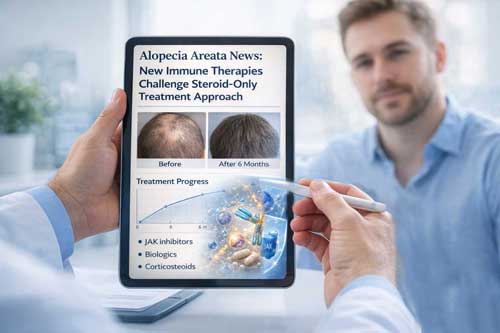
Alopecia Areata News: New Immune Therapies Challenge Steroid-Only Treatment Approach
Key Takeaways
The alopecia areata treatment landscape has transformed dramatically, moving beyond ineffective steroid-only approaches to targeted immune therapies that offer real hope for patients with severe hair loss.
- Three FDA-approved JAK inhibitors are now available: Baricitinib (adults), ritlecitinib (age 12+), and deuruxolitinib, which achieve 23-40% hair regrowth rates versus historical steroid failure rates.
- Patient selection is crucial for success: Best candidates have 50%+ scalp hair loss, disease duration under 10 years, and significant psychosocial impact requiring 6-18 months for optimal results.
- JAK inhibitors work differently than steroids: They directly target autoimmune attacks on hair follicles through JAK-STAT pathway suppression, offering sustained regrowth with milder side effects.
- Emerging biologics expand treatment options: Dupilumab shows 48-97% improvement in atopic alopecia areata patients, while topical JAK inhibitors offer localized treatment alternatives.
- Safety monitoring is essential: Upper respiratory infections affect 30% of patients, with serious infections in 11%, requiring regular blood work and cardiovascular risk assessment.
These breakthrough treatments represent the first FDA-approved systemic options for severe alopecia areata, offering evidence-based alternatives to decades of limited steroid therapy. Success requires proper patient selection, realistic expectations for the timeline, and comprehensive safety monitoring.
Recent alopecia areata news marks a turning point for patients with severe hair loss. A little over a year ago, no FDA-approved treatments existed for severe alopecia areata. Now, there are two approved options, with a third recently added. This autoimmune condition affects an estimated 7 million people in the U.S., with a lifetime risk of 2.1% across the population. Mental health complications are common, particularly for those with severe presentations. The new alopecia treatment landscape includes three FDA-approved JAK inhibitors: baricitinib for adults, ritlecitinib for patients aged 12 and older, and deuruxolitinib requiring genetic testing. This article examines how these new alopecia areata medications work, patient selection criteria, and emerging immune therapies beyond JAK inhibitors.
From Steroids to JAK Inhibitors: The Treatment Shift in Alopecia Areata 

Why Steroid-Only Treatment Had Limited Success
Corticosteroid therapy for alopecia areata has been used since the 1950s, yet its biochemical mechanisms remain poorly understood. Research reveals a fundamental problem: patients with alopecia areata show elevated unoccupied type II glucocorticoid receptors compared to controls, while thioredoxin levels, which activate these receptors, are decreased [1]. This cellular transcription inhibition explains the variable hair regrowth responses seen clinically.
Clinical outcomes with steroid monotherapy ranged from 30% to 80% across studies, but relapse rates were equally problematic [1]. Systemic pulse therapy showed initial response rates of 11.4% to 47%, though benefits lasted only as long as treatment continued [2]. One randomized trial found 25% of patients relapsed within three months after discontinuing weekly prednisolone [2]. Adverse effects occurred in 55% of patients versus 13% with placebo, including acne, weight gain, striae, obesity, and hypertension [1][3].
Topical and intralesional steroids offered safer alternatives but limited efficacy. Clobetasol propionate under occlusion benefited 29% of patients with alopecia universalis or totalis, though long-term benefit dropped to 17.8% after follow-up [2]. Intralesional triamcinolone acetonide showed higher success rates than topical formulations but remained limited by procedural pain and moderate effectiveness [4].
Three FDA-Approved JAK Inhibitors Now Available
Baricitinib received FDA approval in June 2022 as the first systemic medication for severe alopecia areata in adults [5]. Clinical trials demonstrated that 32% to 35% of patients achieved 80% or more scalp hair coverage at 36 weeks with the 4 mg dose [5]. Longer-term data proved more encouraging: 90% of patients had 80% or more scalp hair coverage after 104 weeks of continuous treatment [5].
Ritlecitinib followed in June 2023, becoming the first approved treatment for adolescents aged 12 and older [6]. Deuruxolitinib was approved in July 2024, with more than 30% of patients achieving 80% or more scalp hair coverage at 24 weeks, and up to 25% achieving nearly complete regrowth [7]. Discontinuation rates due to adverse reactions remained low at 3.1% [5].
How JAK Inhibitors Work Differently Than Steroids
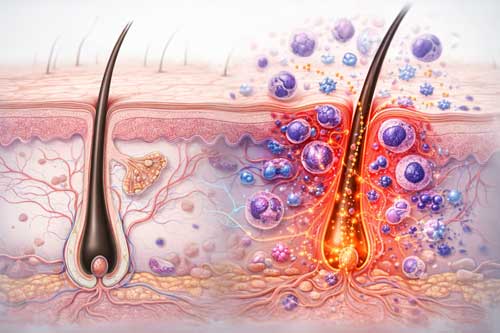
JAK inhibitors suppress the JAK-STAT signaling pathway, blocking downstream cytokine signaling and decreasing perifollicular T-cell infiltration [6]. This mechanism directly addresses the autoimmune attack on hair follicles. These medications promote hair follicle stem cell formation, trigger angiogenesis during the growth phase, and accelerate the transition from telogen to anagen phase [3].
Unlike steroids, which show variable receptor activation, JAK inhibitors provide targeted immune modulation with milder, more tolerable adverse reactions [3].
New Alopecia Areata Medication: Baricitinib, Ritlecitinib, and Deuruxolitinib
Baricitinib (Olumiant): First FDA-Approved Treatment for Adults
Baricitinib gained FDA approval in June 2022 for adults with severe alopecia areata, defined as 50% or more scalp hair loss. The BRAVE-AA clinical program enrolled 1,200 patients and evaluated both 2-mg and 4-mg daily dosing [3].
Dosing recommendations include:
- Standard dose: 2 mg once daily, with an increase to 4 mg if response proves inadequate
- Patients with nearly complete or complete scalp hair loss: consider starting with 4 mg daily
- Once adequate response achieved on 4 mg: decrease to 2 mg for maintenance [3]
At 36 weeks, 17-22% of patients taking 2 mg achieved 80% or more scalp coverage, while 32-35% of patients taking 4 mg reached this threshold [3]. Eyebrow and eyelash improvements occurred among patients with substantial baseline loss [3]. Discontinuation rates remained low at 2.2% due to adverse events [3].
Ritlecitinib (Litfulo): Approved for Adolescents Age 12+
Ritlecitinib received approval in June 2023 as the first treatment option for adolescents aged 12 and older with severe alopecia areata [8]. The ALLEGRO phase 2b/3 trial enrolled 718 patients with 50% or more scalp hair loss [9]. At week 24, 23% of patients receiving the approved 50-mg daily dose achieved 80% or more scalp coverage [8]. Response rates improved to 43.2% by week 48 [8].
Deuruxolitinib (Leqselvi): Requires Genetic Testing Before Use
Deuruxolitinib, approved in July 2024, carries a unique contraindication for CYP2C9 poor metabolizers [10]. Patients require CYP2C9 genotype testing before initiating the 8-mg twice-daily regimen [1].
The THRIVE-AA trials demonstrated that 29-32% of patients achieved 80% or more scalp coverage at week 24 [1]. Additionally, 20-24% reached 90% or more coverage [1].
Clinical Trial Results: 23-40% Hair Regrowth Rates
Meta-analysis across trials reveals baricitinib 4 mg produces 35-40% response rates at 36 weeks [11]. Ritlecitinib achieves 23% at 24 weeks [11], while deuruxolitinib reaches 31% [11].
Immune Therapies Beyond JAK Inhibitors: Biologics and Checkpoint Modulators
Dupilumab for Th2-Pathway Targeting in Atopic AA Patients
Dupilumab targets IL-4 receptor alpha subunit, blocking both IL-4 and IL-13 signaling within the Th2 immune pathway [12]. This monoclonal antibody demonstrates particular efficacy in patients with atopic alopecia areata. Phase II trials showed 32.5% of patients achieved SALT30 improvement by week 48, with 22.5% reaching SALT50 thresholds [13]. Atopic patients experienced more pronounced results: 48% improvement in lesional scalp profile at week 24, escalating to 97% by week 48 [5].
The mechanism involves suppression of Th2-related markers, including CCL13, CCL18, and CCL26, coupled with upregulation of hair keratins preceding clinical regrowth [5]. Pediatric patients resistant to JAK inhibitors showed favorable responses, suggesting dupilumab as an alternative when standard therapies fail [14]. Three-year efficacy data confirm sustained hair regrowth in patients with concurrent atopic dermatitis [12].
IL-17 and IL-12/IL-23 Inhibitors in Clinical Testing
Ustekinumab, an IL-12/23p40 antagonist, produced 25% to 97% hair regrowth across three extensive alopecia areata patients after 20 weeks [15]. The patient with alopecia universalis achieved 97% regrowth by week 49 [15]. By contrast, secukinumab trials demonstrated limited efficacy, with 71.4% showing no response at week 24 [13]. Tildrakizumab yielded partial responses in 22.2% of patients, with SALT score reductions of 11-18 points by week 28 [13]. Nonetheless, murine models using IL-23p19 antibodies failed to prevent hair loss development [16].
PD-1 and CTLA-4 Checkpoint Modulators Under Investigation
Immune checkpoint inhibitors targeting PD-1 and CTLA-4 pathways produce alopecia areata in 1% to 2% of cancer patients receiving these agents [17][3]. Disruption of hair follicle immune privilege through PD-L1 blockade triggers the inflammatory cascade [17]. Intralesional triamcinolone achieved full regrowth in checkpoint inhibitor-associated cases while maintaining immunotherapy [17].
Topical JAK Inhibitors for Localized Hair Loss
Topical formulations remain experimental without FDA approval [18]. Tofacitinib achieved SALT50 reductions in 32.2% of cases, while ruxolitinib and delgocitinib comprised 41.5% and 14.8% of documented treatments [18]. Mean treatment duration extended 142.6 days, producing 24.9% reduction from baseline SALT scores [18]. Adverse events occurred in 3.7% of cases, primarily scalp irritation and folliculitis [18].
Who Benefits from New Treatment for Alopecia: Patient Selection and Outcomes
Moderate-to-Severe AA: Best Candidates for Oral JAK Inhibitors
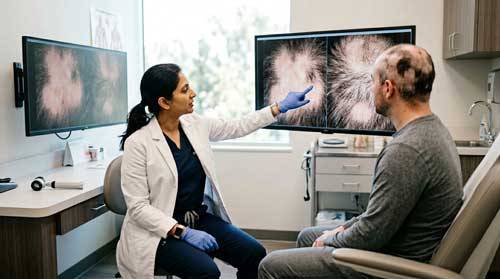
JAK inhibitors demonstrate optimal efficacy in patients with SALT scores of 50 or higher, representing moderate-to-severe disease [19][20]. Australian consensus guidelines recommend JAK inhibitors as nearly always the best option for patients with 50% or more scalp hair loss, and usually optimal for those with 21-49% loss [20]. Beyond disease severity, rapid progression (more than 10 SALT points over 6 weeks), refractory disease, and poorly camouflaged hair loss patterns, such as ophiasis, increase treatment suitability [20]. Psychosocial factors matter: patients with DLQI scores of 11 or higher, anxiety, depression, or social impairment warrant consideration [20]. Disease duration of less than 10 years correlates with better outcomes, whereas episodes exceeding this threshold show delayed responses [9][20].
Treatment Response Rates and Timeline Expectations
Real-world data show 61% of patients achieve substantial regrowth at a median of 7 months [8]. However, 10.5% of responders require more than one year of treatment before achieving SALT scores of 20 or less [21]. Clinicians cannot assess treatment efficacy for at least 6 months, and some patients may require 12-18 months for complete regrowth [22]. Among responders, 93% sustain clinical response through 24 months, and 46% achieve complete regrowth (SALT score 0) [21]. Female sex, shorter disease duration, and less extensive baseline hair loss are associated with a higher likelihood of response [21].
Side Effects: Infection Risk and Long-Term Safety Monitoring
Upper respiratory infections occur in 30.6% of patients on JAK inhibitors [8]. Acne affects 20.8%, while gastrointestinal symptoms emerge in 25% [8]. Serious infections requiring treatment develop in 11.1% of cases, including herpes zoster and urinary tract infections [8]. Baricitinib carries an increased risk for acne, urinary tract infections, and hyperlipidemia compared to other agents [10]. Black box warnings encompass serious infections, malignancy, cardiovascular events, and thrombosis [22]. Regular monitoring includes liver function tests, lipid panels, and complete blood counts [1]. Patients over 65, those with cardiovascular risk factors, and current or former smokers require careful risk-benefit assessment [1].
When Conventional Treatments Still Make Sense
Localized alopecia areata with less than 50% scalp involvement responds well to intralesional corticosteroids, achieving 50% or more regrowth in over 80% of patients within 12 weeks [23]. Topical immunotherapy achieves success rates of 17% to 75% in extensive cases [23]. For patients under age 12, no FDA-approved JAK inhibitors exist; thus, conventional approaches or off-label prescribing remain necessary [24].

Conclusion

The treatment paradigm for severe alopecia areata has fundamentally shifted. Three FDA-approved JAK inhibitors now offer 23-40% response rates, far exceeding historical steroid outcomes. Key developments include:
- Targeted immune modulation through JAK-STAT pathway suppression
- Extended treatment timelines yielding sustained regrowth
- Emerging biologics for atopic subtypes
Patient selection remains critical. Disease severity, duration, and psychosocial impact guide therapy choice. As research advances, clinicians have evidence-based tools to effectively address this challenging autoimmune condition.
FAQ
Q1. Which JAK inhibitors are currently FDA-approved for the treatment of alopecia areata? Three JAK inhibitors have received FDA approval: Baricitinib (Olumiant) for adults 18 and older, Ritlecitinib (Litfulo) for patients aged 12 and up, and Deuruxolitinib (Leqselvi), which requires genetic testing before use. These medications represent the first FDA-approved systemic treatments for severe alopecia areata.
Q2. How do JAK inhibitors differ from traditional steroid treatments for alopecia areata? JAK inhibitors work by inhibiting the JAK-STAT signaling pathway, thereby blocking the autoimmune attack on hair follicles. Unlike steroids, which show variable receptor activation and limited long-term success, JAK inhibitors provide targeted immune modulation with more consistent results and generally milder side effects.
Q3. What kind of results can patients expect from JAK inhibitor treatment? Clinical trials show that 23-40% of patients achieve 80% or more scalp hair coverage, depending on the specific medication and dosage. However, patience is essential—most patients require 6-12 months of treatment before seeing significant results, and some may need up to 18 months for complete regrowth.
Q4. Who are the best candidates for JAK inhibitor therapy? Patients with moderate-to-severe alopecia areata (50% or more scalp hair loss) are ideal candidates for JAK inhibitors. Those with shorter disease duration (under 10 years), rapid progression, or significant psychosocial impact from hair loss also benefit most from these treatments.
Q5. What are the main side effects of JAK inhibitors for alopecia areata? Common side effects include upper respiratory infections (30.6% of patients), acne (20.8%), and gastrointestinal symptoms (25%). More serious risks include infections requiring treatment, cardiovascular events, and thrombosis. Regular monitoring through blood tests and lipid panels is necessary during treatment.
References:
[1] – https://pmc.ncbi.nlm.nih.gov/articles/PMC12454744/
[2] – https://cdn.mdedge.com/files/s3fs-public/issues/articles/vol28_i1_Alopecia_Areata.pdf
[3] – https://pmc.ncbi.nlm.nih.gov/articles/PMC5459625/
[4] – https://pmc.ncbi.nlm.nih.gov/articles/PMC12126370/
[5] – https://pubmed.ncbi.nlm.nih.gov/36271804/
[6] – https://www.ajmc.com/view/review-approving-using-jak-inhibitors-for-better-alopecia-areata-outcomes
[8] – https://pmc.ncbi.nlm.nih.gov/articles/PMC11995430/
[9] – https://pmc.ncbi.nlm.nih.gov/articles/PMC10373824/
[10] – https://pmc.ncbi.nlm.nih.gov/articles/PMC12375599/
[11] – https://pubmed.ncbi.nlm.nih.gov/40794245/
[12] – https://pmc.ncbi.nlm.nih.gov/articles/PMC9235915/
[13] – https://www.mdpi.com/2673-8449/5/2/11
[14] – https://www.frontiersin.org/journals/medicine/articles/10.3389/
fmed.2023.1253795/full
[15] – https://www.jidonline.org/article/S0022-202X(16)30378-5/fulltext
[16] – https://www.jidonline.org/article/S0022-202X(19)30372-0/fulltext
[17] – https://pmc.ncbi.nlm.nih.gov/articles/PMC11750434/
[18] – https://pmc.ncbi.nlm.nih.gov/articles/PMC9902965/
[19] – https://www.ajmc.com/view/fda-approves-deuruxolitinib-for-alopecia-areata
[20] – https://pmc.ncbi.nlm.nih.gov/articles/PMC12633699/
[21] – https://pmc.ncbi.nlm.nih.gov/articles/PMC12105426/
[22] – https://www.naaf.org/navigation-toolkit/expectations-for-jak-inhibitor-treatment/
[23] – https://www.aad.org/public/diseases/hair-loss/types/alopecia/treatment
[24] – https://www.naaf.org/navigation-toolkit/fda-approved-jak-inhibitors/
Video Section
Check out our extensive video library (see channel for our latest videos)

Recent Articles