
Forty Rules of High-Impact Living: A Research-Backed, Real-World System for Happiness, Achievement, Emotional Stability, and Relationship Quality
Abstract
This paper presents a research-based framework consisting of forty evidence-based principles for improving life quality across multiple dimensions. The methodology draws from peer-reviewed studies in psychology, neuroscience, behavioral economics, and social science to identify practices that measurably enhance well-being, performance, emotional regulation, and interpersonal relationships. The analysis reveals that certain behaviors and mindsets consistently correlate with positive life outcomes when implemented systematically. These findings suggest that structured approaches to personal development can produce reliable improvements in mental health, productivity, and social connections. The framework provides practitioners with actionable interventions supported by empirical evidence, offering clear implementation strategies for diverse populations seeking enhanced life satisfaction and achievement.
Recent articles. Check out our extensive video library.
Introduction
The pursuit of optimal human functioning has long been a focus of scientific inquiry. Recent decades have witnessed remarkable advances in understanding the psychological, neurobiological, and social factors that contribute to flourishing. Unlike traditional approaches that often focus on single variables, contemporary research reveals that well-being emerges from the interaction of multiple behavioral patterns, cognitive strategies, and environmental factors.
The purpose of this analysis is to synthesize current evidence into a practical system that individuals can apply to improve their life outcomes. The forty rules presented here represent distillations of research findings that have demonstrated measurable effects on human flourishing. Each principle has been selected based on replication across studies, effect size, and practical applicability.
The significance of this work lies in its integration of diverse research streams into a coherent framework. Rather than requiring individuals to navigate disparate literature across multiple disciplines, this system provides organized, actionable guidance grounded in scientific evidence. The approach recognizes that lasting change requires systematic implementation rather than sporadic efforts.
Literature Review and Theoretical Foundation
Psychological Well-being Research
Contemporary positive psychology research has identified several core components of psychological well-being. Diener and Biswas-Diener (2019) demonstrated that subjective well-being consists of both affective and cognitive components. Their longitudinal studies show that individuals who report higher life satisfaction engage in specific behavioral patterns that can be learned and practiced.
Seligman’s PERMA model (Positive emotions, Engagement, Relationships, Meaning, and Achievement) has received extensive empirical support (Seligman, 2018). Studies following participants over multiple years indicate that deliberate cultivation of these five elements produces measurable improvements in mood, life satisfaction, and resilience.
Neuroscientific Foundations
Brain imaging studies have revealed the neuroplasticity underlying behavioral change. Davidson and Lutz (2020) found that meditation practices produce structural changes in areas associated with attention regulation and emotional processing. These findings suggest that specific mental training can create lasting neurobiological adaptations.
Research on habit formation indicates that behavior change follows predictable neural pathways. Duhigg’s analysis of habit loops demonstrates that environmental cues, behavioral routines, and reward systems can be deliberately structured to support positive changes (Duhigg, 2021).
Social and Relationship Science
The Harvard Study of Adult Development, spanning over 80 years, provides robust evidence for the primacy of relationships in determining life satisfaction (Waldinger & Schulz, 2023). Their data show that relationship quality predicts health outcomes, emotional stability, and longevity more strongly than other commonly measured variables.
Research on social support mechanisms reveals that both giving and receiving support contribute to well-being, but through different pathways (House, 2018). These findings inform strategies for building mutually beneficial social networks.

The Forty Rules Framework 

Category 1: Foundation Building (Rules 1-10)
Rule 1: Establish Non-Negotiable Sleep Hygiene
Sleep research consistently shows that adults requiring 7-9 hours of quality sleep per night demonstrate superior cognitive performance, emotional regulation, and physical health (Walker, 2022). Sleep deprivation impairs decision-making, increases emotional reactivity, and weakens immune function.
Examples and Applications:
-
A physician who sets a strict bedtime of 10:30 PM every night, including weekends, discovers that her patient interactions become more empathetic and her diagnostic accuracy improves. She creates a bedroom environment free from electronic devices and maintains the same wake time regardless of her shift schedule.
-
An executive struggling with afternoon energy crashes begins a consistent sleep routine by dimming lights two hours before bedtime and avoiding caffeine after 2 PM. Within three weeks, he notices improved decision-making during late-day meetings and reduced reliance on stimulants.
-
A graduate student who previously stayed up late studying implements a rule of no screen time after 9 PM and uses blackout curtains. Her memory retention during exams improves markedly, and she requires less total study time due to enhanced cognitive processing.

Rule 2: Implement Daily Movement
Physical activity research indicates that even moderate exercise produces measurable improvements in mood, cognitive function, and stress resilience (Ratey & Hagerman, 2020). The neurochemical changes associated with regular movement extend far beyond physical health benefits.
Examples and Applications:
-
A software engineer takes a 15-minute walk after every two-hour work block, even during winter. His afternoon productivity increases, and his team notices improved creativity during brainstorming sessions. The walking breaks also reduce his chronic back pain from prolonged sitting.
-
A busy parent of three young children commits to doing 10 minutes of bodyweight exercises immediately after her morning coffee, before the children wake up. This small routine provides mental clarity for handling daily chaos and improves her patience during stressful moments.
-
A retiree dealing with mild depression begins swimming three times per week at the local community center. The combination of physical movement and social interaction with other swimmers creates a natural antidepressant effect that reduces his need for medication adjustments.

Rule 3: Practice Nutritional Mindfulness
Studies on nutrition and cognition demonstrate clear links between dietary choices and mental performance (Gómez-Pinilla, 2021). Processed foods and blood sugar fluctuations directly impact attention, mood stability, and decision-making capacity.
Examples and Applications:
-
A teacher notices that eating a protein-rich breakfast with complex carbohydrates helps her maintain steady energy throughout morning classes, while skipping breakfast or eating pastries leads to irritability with students. She prepares overnight oats with nuts and berries as her standard morning meal.
-
A financial advisor tracks his food choices and discovers that high-sugar lunches correlate with poor client presentations in the afternoon. He switches to salads with lean protein and notices improved mental sharpness during important client meetings.
-
A college student struggling with focus during study sessions realizes that vending machine snacks create energy spikes followed by crashes. She begins packing mixed nuts, fruit, and water for study sessions, finding she can concentrate for longer periods without mental fatigue.

Rule 4: Create Environmental Order
Environmental psychology research shows that physical surroundings influence psychological states and productivity (Mehta, Zhu, & Cheema, 2019). Organized spaces reduce cortisol levels and improve focus.
Examples and Applications:
-
A therapist organizes her home office so that all materials have designated places, creating a calming environment for both herself and clients. She notices that sessions flow more smoothly when the space feels orderly, and her own stress levels decrease between appointments.
-
A working mother implements a “one-touch” rule for mail and paperwork, immediately filing, acting on, or discarding each item. This prevents paper clutter accumulation and reduces the mental load of seeing unfinished tasks throughout the day.
-
A graduate student creates a dedicated study space free from visual distractions, using only items necessary for the current project. His ability to enter focused work states improves dramatically when his environment supports rather than competes with his attention.
Rule 5: Establish Morning Routines
Research on circadian rhythms and behavioral consistency indicates that structured morning routines improve self-regulation throughout the day (Roenneberg, 2021). Predictable start patterns reduce decision fatigue and create momentum.
Examples and Applications:
-
A surgeon develops a morning routine of stretching, reviewing the day’s surgical cases, and eating the same nutritious breakfast. This consistency helps him feel prepared and calm before entering the operating room, improving his focus during complex procedures.
-
An entrepreneur struggling with procrastination creates a morning sequence: exercise, meditation, and tackling the most challenging task first. This routine builds momentum that carries through the entire day, reducing his tendency to avoid difficult decisions.
-
A stay-at-home parent establishes a morning routine that includes 20 minutes of reading before children wake up, followed by preparing healthy breakfasts. This personal time creates emotional reserves for handling the demands of childcare throughout the day.
Rule 6: Practice Deep Breathing
Controlled breathing techniques have been shown to activate the parasympathetic nervous system, reducing stress hormones and improving emotional regulation (Brown & Gerbarg, 2020). These practices can be implemented immediately and produce measurable physiological changes.
Examples and Applications:
-
An emergency room nurse uses box breathing (4 counts in, 4 hold, 4 out, 4 hold) between patient encounters to reset her nervous system. This practice helps her maintain composure during traumatic cases and prevents emotional exhaustion at the end of shifts.
-
A public speaker implements three deep breaths before every presentation, using this technique to transform nervous energy into focused attention. His presentations become more natural and engaging as his anxiety decreases.
-
A parent dealing with a tantrum-prone toddler uses deep breathing to maintain patience during difficult moments. The child often mirrors this calm response, de-escalating situations more quickly than when the parent reacts with frustration.
Rule 7: Limit Information Overconsumption
Studies on information processing and attention demonstrate that excessive information consumption impairs decision-making and increases anxiety (Rosen et al., 2019). Strategic information diet improves focus and emotional stability.
Examples and Applications:
-
A news journalist limits news consumption to two specific times per day rather than constant updates, discovering that this focused approach actually improves the quality of her reporting while reducing background anxiety about world events.
-
A business owner stops checking industry newsletters and blogs constantly, instead dedicating one hour per week to strategic industry reading. This change allows deeper focus on business operations and reduces the feeling of always being behind on information.
-
A retiree realizes that excessive social media consumption increases feelings of inadequacy and social isolation. By limiting social media to 30 minutes per day and focusing on direct communication with friends, his mood and sense of connection improve markedly.
Rule 8: Establish Digital Boundaries
Research on technology use and mental health shows clear correlations between excessive screen time and decreased well-being (Twenge, 2021). Intentional digital boundaries protect attention resources and social relationships.
Examples and Applications:
-
A family implements a “device-free dinner hour” where all phones and tablets are placed in a designated basket. Family conversations deepen, and children begin sharing more about their daily experiences without digital distractions.
-
A marketing professional creates separate devices for work and personal use, completely shutting down work devices after 7 PM. This boundary allows genuine relaxation and improves her relationships with family members who previously felt ignored.
-
A teenager struggling with sleep problems removes all screens from her bedroom and uses an analog alarm clock instead of her phone. Her sleep quality improves dramatically, and she finds herself naturally waking up more rested.
Rule 9: Practice Regular Reflection
Studies on metacognition demonstrate that individuals who engage in structured self-reflection show improved learning, decision-making, and goal achievement (Schraw & Moshman, 2018).
Examples and Applications:
-
A project manager spends 10 minutes every Friday reviewing what worked well during the week and what could be improved. This reflection leads to process improvements that benefit his entire team and prevents repeating the same mistakes.
-
A medical resident keeps a brief journal noting challenging cases and her emotional responses. This practice helps her identify patterns in her clinical reasoning and develop better coping strategies for difficult situations.
-
A small business owner conducts monthly reviews of both business metrics and personal satisfaction, asking himself whether current activities align with long-term goals. These reflections lead to strategic pivots that improve both profitability and personal fulfillment.
Rule 10: Cultivate Gratitude Practices
Gratitude research indicates that regular appreciation practices produce measurable improvements in mood, sleep quality, and relationship satisfaction (Emmons, 2020). These effects compound over time.
Examples and Applications:
-
A healthcare worker starts each day by mentally noting three things she appreciates about her job before entering the hospital. This practice helps her maintain perspective during difficult shifts and increases her job satisfaction despite challenging working conditions.
-
A couple implements a practice of sharing one thing they appreciate about each other during their evening meal. This simple routine strengthens their relationship bond and helps them focus on positive aspects during stressful periods.
-
An elderly man dealing with health issues begins writing weekly letters to people who have positively impacted his life. This practice shifts his focus from physical limitations to life’s meaningful connections, improving both his mood and relationships.
Category 2: Emotional Mastery (Rules 11-20)
Rule 11: Develop Emotional Awareness
Research on emotional intelligence shows that individuals who can accurately identify and label emotions demonstrate better regulation and interpersonal effectiveness (Brackett, 2019). This skill can be developed through deliberate practice.
Examples and Applications:
-
A middle manager begins checking in with her emotional state three times per day, using specific emotion words rather than general terms like “fine” or “stressed.” She discovers that what she labeled as anger is often disappointment, leading to more effective communication with her team.
-
A teacher notices that certain classroom situations trigger frustration and begins tracking these patterns. By identifying that overcrowding and noise create anxiety for him, he develops proactive strategies that improve his teaching effectiveness and student relationships.
-
A parent realizes that her “bad mood” in the evenings stems from feeling overwhelmed rather than genuinely angry at her children. This awareness allows her to address the root cause through better time management rather than taking frustration out on family members.
Rule 12: Practice Response Rather Than Reaction
Studies on emotional regulation indicate that the pause between stimulus and response can be lengthened through training (Gross, 2019). This space allows for more thoughtful, effective responses to challenging situations.
Examples and Applications:
-
A customer service representative learns to count to three before responding to angry customers. This brief pause allows her to respond with empathy rather than defensiveness, leading to more successful problem resolution and reduced personal stress.
-
A teenager dealing with peer pressure implements a “24-hour rule” before making decisions in emotionally charged situations. This practice helps him avoid impulsive choices that he later regrets and builds respect among his peers for his thoughtful approach.
-
A surgeon facing unexpected complications during procedures uses a mental protocol of taking one deep breath before proceeding. This pause allows clear thinking during high-stress moments, improving patient outcomes and reducing his own anxiety.
Rule 13: Accept Difficult Emotions
Acceptance and Commitment Therapy research demonstrates that attempting to avoid or suppress negative emotions often intensifies them (Hayes et al., 2021). Acceptance strategies reduce emotional suffering and improve psychological flexibility.
Examples and Applications:
-
A graduate student facing dissertation anxiety learns to acknowledge her fear without trying to eliminate it immediately. Instead of procrastinating when anxiety arises, she says “I notice I’m feeling anxious about writing” and continues working, finding that the anxiety often diminishes naturally.
-
A divorced father experiencing sadness about missing time with his children stops trying to “stay positive” all the time. By allowing himself to feel sad while continuing to be present during his parenting time, he models emotional honesty for his children and experiences deeper satisfaction in their relationship.
-
A healthcare worker dealing with patient loss learns to sit with grief rather than immediately distracting herself with busy work. This acceptance allows natural healing and prevents emotional numbing that could affect her compassion with future patients.
Rule 14: Reframe Negative Situations
Cognitive reframing research shows that changing interpretations of events can measurably alter emotional responses and outcomes (Beck & Beck, 2020). These cognitive skills can be learned and practiced systematically.
Examples and Applications:
-
A sales professional reframes client rejections as opportunities to refine his pitch rather than personal failures. This shift reduces discouragement and maintains motivation during difficult sales cycles, ultimately improving his success rate.
-
A student who fails an important exam reframes the experience as valuable feedback about study methods rather than evidence of inadequacy. This perspective leads to improved study strategies and better performance on subsequent exams.
-
A mother dealing with her teenager’s defiant behavior reframes these incidents as signs of healthy identity development rather than personal attacks. This shift reduces family conflict and allows more effective parenting responses that support her child’s growth.
Rule 15: Practice Self-Compassion
Studies on self-compassion indicate that treating oneself with kindness during difficulties produces better outcomes than self-criticism (Neff, 2021). Self-compassionate individuals show greater resilience and motivation.
Examples and Applications:
-
An athlete recovering from injury speaks to herself with the same kindness she would show a teammate in similar circumstances. This self-compassion speeds her psychological recovery and maintains motivation for physical rehabilitation.
-
A new entrepreneur facing early business setbacks treats his mistakes as learning opportunities rather than character flaws. This approach maintains his confidence and creativity when problem-solving, leading to innovative solutions he might not have discovered while focused on self-blame.
-
A working mother who misses her child’s school event due to work obligations practices self-forgiveness rather than guilt spiraling. This self-compassion allows her to focus energy on being present during future opportunities rather than ruminating about past disappointments.
Rule 16: Develop Stress Tolerance
Research on stress inoculation demonstrates that gradual exposure to manageable challenges builds resilience (Meichenbaum, 2019). Controlled stress exposure improves coping capacity.
Examples and Applications:
-
A public speaking coach gradually increases the difficulty of speaking opportunities, starting with small groups and building to larger audiences. This progressive exposure builds confidence and reduces anxiety about high-stakes presentations.
-
A medical student practices difficult patient scenarios through role-playing before clinical rotations. This preparation builds emotional resilience for real patient encounters and improves bedside manner under pressure.
-
A manager facing organizational changes intentionally seeks feedback on difficult decisions rather than avoiding potentially uncomfortable conversations. This practice builds tolerance for conflict and improves leadership effectiveness during uncertain periods.
Rule 17: Use Emotional Regulation Techniques
Studies on emotion regulation strategies show that specific techniques can effectively manage intense emotions (Gross, 2019). These tools provide practical alternatives to maladaptive coping.
Examples and Applications:
-
A counselor uses the “STOP” technique (Stop, Take a breath, Observe thoughts and feelings, Proceed mindfully) when sessions become emotionally intense. This structured approach maintains therapeutic effectiveness while managing her own emotional responses.
-
A parent dealing with toddler meltdowns implements progressive muscle relaxation techniques to stay calm during tantrums. Her composed response helps the child regulate emotions more quickly and strengthens their relationship bond.
-
A financial advisor uses grounding techniques (naming five things he can see, four he can hear, three he can touch) when market volatility creates client anxiety meetings. This emotional regulation allows him to provide clear guidance when clients most need stability.
Rule 18: Practice Mindfulness
Mindfulness research indicates that present-moment awareness reduces rumination, anxiety, and emotional reactivity while improving attention and well-being (Goleman & Davidson, 2021).
Examples and Applications:
-
A surgeon practices mindful awareness during operations, focusing completely on each procedural step rather than worrying about outcomes or other cases. This presence improves surgical precision and reduces performance anxiety.
-
A teacher begins each class with one minute of mindful breathing, creating calm focus for both herself and students. This practice reduces classroom behavioral problems and improves learning outcomes for students with attention challenges.
-
A busy executive practices mindful eating during lunch, paying attention to taste and texture rather than checking emails. This break from multitasking provides mental restoration that improves afternoon productivity and decision-making.
Rule 19: Build Distress Tolerance
Research on distress tolerance shows that the ability to endure difficult emotions without impulsive action predicts better life outcomes (Leyro et al., 2018). This capacity can be strengthened through practice.
Examples and Applications:
-
A person in recovery from addiction practices sitting with cravings for 10 minutes before taking any action, discovering that intense feelings often pass naturally without need for immediate relief. This skill prevents relapse and builds confidence in emotional self-management.
-
A college student dealing with test anxiety learns to experience nervousness without immediately seeking distraction or avoidance. By staying present with uncomfortable feelings while continuing to study, her academic performance improves and anxiety decreases over time.
-
A divorcee experiencing loneliness practices being alone without immediately calling friends or seeking social media distraction. This tolerance for solitude leads to genuine self-knowledge and more fulfilling relationships based on choice rather than neediness.
Rule 20: Develop Emotional Granularity
Studies on emotional complexity indicate that individuals who can distinguish between subtle emotional states show better regulation and decision-making (Kashdan et al., 2020).
Examples and Applications:
-
A therapist develops vocabulary for distinguishing between disappointment, sadness, grief, and melancholy in her own experience. This emotional precision allows more targeted self-care and improves her ability to help clients identify their own emotional nuances.
-
A manager learns to differentiate between frustration with processes versus frustration with people, leading to more effective problem-solving approaches. When frustrated with systems, he focuses on process improvement; when frustrated with individuals, he provides coaching and support.
-
A parent recognizes that her “worry” about her teenager includes fear for his safety, disappointment about his choices, and pride in his independence. This emotional clarity allows more balanced conversations that address specific concerns rather than general anxiety.
Category 3: Achievement and Productivity (Rules 21-30)
Rule 21: Set Systems Over Goals
Research on goal-setting reveals that process-focused approaches often outperform outcome-focused strategies (Clear, 2020). Systems create sustainable progress while goals can create motivation problems after achievement or failure.
Examples and Applications:
-
A writer shifts from setting publication goals to maintaining a daily writing system of 500 words per morning. This process focus creates consistent progress and improves writing quality, eventually leading to more publications than goal-focused approaches produced.
-
A fitness enthusiast abandons weight loss targets in favor of a system of daily movement and mindful eating. This approach creates sustainable health habits that naturally lead to improved fitness without the motivation crashes associated with specific weight goals.
-
A small business owner focuses on daily customer service actions rather than monthly revenue targets. This system approach builds customer loyalty and referrals that create more stable and predictable business growth than sporadic goal-focused efforts.
Rule 22: Practice Deep Work
Studies on attention and productivity show that sustained focus on cognitively demanding tasks produces superior outcomes and satisfaction (Newport, 2019). Deep work capacity has become increasingly rare and valuable.
Examples and Applications:
-
A software developer blocks out two-hour periods for coding without interruptions, discovering that she accomplishes more in these focused sessions than in entire days of fragmented work. Her code quality improves and she experiences greater job satisfaction from meaningful progress.
-
A research scientist schedules deep thinking time for analyzing data without checking email or attending meetings. These uninterrupted periods lead to breakthrough insights that advance his research and career more than busy work ever did.
-
A consultant dedicates early morning hours to strategic thinking about client problems before daily operational tasks begin. This deep work produces innovative solutions that differentiate her services and increase client satisfaction and referrals.
Rule 23: Implement Time Blocking
Research on time management indicates that scheduled, protected time blocks improve productivity and reduce stress compared to reactive approaches (Vanderkam, 2020).
Examples and Applications:
-
A physician blocks specific times for patient charts, administrative tasks, and continuing education rather than trying to fit these activities between patient appointments. This structure reduces overtime work and improves the quality of patient care through better preparation.
-
A working parent schedules dedicated time blocks for family activities, treating these commitments as seriously as professional meetings. This approach ensures quality family time and reduces guilt about work-life balance because both areas receive intentional attention.
-
A graduate student assigns specific time blocks to different research activities (reading, writing, data analysis) instead of working on whatever feels urgent. This structure ensures balanced progress across all dissertation requirements and reduces the anxiety of feeling behind in multiple areas.
Rule 24: Practice Deliberate Practice
Studies on expertise development demonstrate that improvement requires focused effort on specific weaknesses with immediate feedback (Ericsson & Pool, 2018). Casual practice does not produce expertise.
Examples and Applications:
-
A surgeon identifies her weakest procedural skills and practices these specific techniques with mentorship feedback rather than simply performing routine operations. This targeted improvement enhances her surgical outcomes and professional reputation.
-
A public speaker records presentations and analyzes specific aspects like vocal variety, eye contact, and story structure rather than just giving more speeches. This deliberate approach rapidly improves speaking effectiveness and audience engagement.
-
A teacher focuses on improving specific classroom management techniques through observation and feedback rather than assuming experience alone will improve performance. This targeted practice creates better learning environments and reduces student behavioral problems.
Rule 25: Embrace Productive Failure
Research on learning and resilience shows that individuals who view failure as information rather than identity threat demonstrate superior long-term performance (Dweck, 2019).
Examples and Applications:
-
An entrepreneur treats business setbacks as market research, analyzing what customers actually want rather than what she assumed they needed. This perspective leads to product improvements that better serve client needs and increase business success.
-
A medical resident views difficult patient cases as learning opportunities rather than personal failures, seeking mentorship and additional study to improve clinical skills. This approach accelerates professional development and ultimately improves patient care.
-
A student athlete uses poor performance as motivation for skill development rather than evidence of inadequacy. This mindset leads to more effective training focus and greater resilience during competitive pressure.
Rule 26: Focus on Process Metrics
Studies on performance measurement indicate that tracking leading indicators (inputs) rather than lagging indicators (outputs) improves consistency and outcomes (Clear, 2020).
Examples and Applications:
-
A salesperson tracks number of calls made and relationships built rather than only monitoring sales closed. This input focus leads to more consistent prospecting behavior and ultimately better sales results through improved pipeline management.
-
A fitness coach measures workout consistency and nutrition adherence rather than just weight changes. This process focus helps clients maintain motivation during plateaus and creates sustainable health habits that produce lasting results.
-
A writer monitors daily writing time and word count rather than focusing on publication acceptance. This approach maintains writing motivation and productivity regardless of external validation, leading to skill improvement and eventual publishing success.
Rule 27: Practice Energy Management
Research on human performance shows that managing energy levels is often more important than managing time (Schwartz & McCarthy, 2018). Energy awareness and renewal practices improve sustained performance.
Examples and Applications:
-
A consulting firm partner schedules challenging client meetings during her high-energy morning hours and uses afternoon low-energy periods for administrative tasks. This energy alignment improves client interaction quality and reduces end-of-day fatigue.
-
A teacher takes short walking breaks between classes to restore mental energy rather than using break time for grading or preparation. This energy renewal improves classroom engagement and reduces burnout symptoms during demanding school years.
-
A software engineer alternates between creative coding tasks and routine maintenance work based on natural energy rhythms rather than arbitrary schedules. This approach maximizes productivity on complex projects while ensuring necessary routine work gets completed.
Rule 28: Use Implementation Intentions
Studies on behavior change demonstrate that “if-then” planning improves follow-through on intentions (Gollwitzer, 2019). These specific plans bridge the gap between intention and action.
Examples and Applications:
-
A busy executive creates implementation intentions like “If I feel overwhelmed during meetings, then I will take three deep breaths before responding.” This specific planning improves her leadership presence during stressful situations.
-
A student struggling with procrastination develops plans such as “If I feel like avoiding homework, then I will work for just 10 minutes and reassess.” This approach reduces the barrier to starting and often leads to extended productive work sessions.
-
A parent implements “If my child has a tantrum in public, then I will calmly remove us from the situation and address the behavior privately.” This pre-planning reduces parental stress and provides consistent responses that help children learn emotional regulation.
Rule 29: Batch Similar Tasks
Research on attention switching shows that task batching reduces cognitive overhead and improves efficiency (Mark et al., 2019). Context switching costs are often underestimated.
Examples and Applications:
-
A marketing manager designates specific days for different types of work: Mondays for strategic planning, Tuesdays for content creation, Wednesdays for client meetings. This batching reduces the mental energy lost in constant context switching and improves the quality of work in each area.
-
A physician schedules all patient calls during two specific times per day rather than responding to calls throughout the day. This batching allows uninterrupted patient care time and more focused, helpful phone conversations.
-
A freelance graphic designer groups similar projects together, working on all logo designs in one session and all website layouts in another. This approach maintains creative flow and reduces the time needed to reorient to different types of design work.
Rule 30: Practice Strategic Quitting
Studies on opportunity cost and resource allocation indicate that knowing when to quit ineffective efforts is crucial for success (Grant, 2021). Persistence is valuable, but strategic abandonment is also necessary.
Examples and Applications:
-
A startup founder recognizes that one product line is consuming resources without generating proportional returns and decides to discontinue it to focus on more promising opportunities. This strategic quitting allows better resource allocation to profitable areas.
-
A graduate student realizes her dissertation topic lacks sufficient research support and changes directions despite time already invested. This decision prevents years of additional struggle with an unviable project and leads to successful completion with a more feasible topic.
-
A professional musician stops pursuing performance opportunities that drain energy without advancing her career goals, instead focusing on teaching and recording. This strategic quitting leads to greater financial stability and artistic satisfaction.
Category 4: Relationship Excellence (Rules 31-40)
Rule 31: Practice Active Listening
Research on communication effectiveness shows that genuine listening improves relationship satisfaction and problem-solving outcomes (Gottman & Gottman, 2020). Most people listen to respond rather than understand.
I’m definitely guilty of this one—and my wife would absolutely agree. The good news is I’m aware of it now, and I’m genuinely working on slowing down, listening to understand, and reflecting back what I hear before I respond.
Examples and Applications:
-
A marriage counselor models active listening by reflecting back what clients say before offering advice, discovering that couples often solve their own problems when they feel truly heard. This approach reduces session time needed and improves client outcomes.
-
A manager implements weekly one-on-one meetings where she focuses solely on listening to team members’ concerns without immediately jumping to solutions. This practice improves employee satisfaction and reveals systemic issues that require attention.
-
A parent establishes “listening time” each evening where she gives full attention to her children’s day without multitasking or offering immediate advice. This practice strengthens family bonds and helps children develop better communication skills.
Rule 32: Express Appreciation Regularly
Studies on relationship maintenance indicate that expressing genuine appreciation strengthens bonds and improves cooperation (Algoe, 2019). Positive interactions must outnumber negative ones by specific ratios.
Examples and Applications:
-
A team leader makes it a practice to publicly acknowledge specific contributions from team members during weekly meetings. This regular appreciation improves team morale and increases voluntary collaboration on projects.
-
A spouse implements a daily practice of expressing one specific thing she appreciates about her partner’s actions or character. This habit shifts their relationship focus toward positive qualities and increases mutual satisfaction during stressful periods.
-
A teacher writes brief positive notes to students who show improvement or effort, regardless of achievement level. These expressions of appreciation motivate continued effort and create stronger student-teacher relationships that support learning.
Rule 33: Set Healthy Boundaries
Research on interpersonal effectiveness shows that clear boundaries improve rather than harm relationships by creating predictability and respect (Cloud & Townsend, 2021).
Examples and Applications:
-
A therapist clearly communicates office hours and emergency contact procedures to clients, maintaining these boundaries consistently. This structure actually increases client trust and therapeutic effectiveness by creating a safe, predictable framework for the relationship.
-
A working parent establishes that work calls will not be answered during family dinner time, communicating this boundary to colleagues and clients. This limit improves family relationships and often increases respect from professional contacts who appreciate clear expectations.
-
An adult child living with aging parents establishes specific days and times for helping with errands rather than being on constant call. This boundary prevents resentment while ensuring parents receive reliable support and maintains the adult relationship dynamic.
Rule 34: Practice Empathic Responding
Studies on empathy demonstrate that understanding and validating others’ emotions improves relationship quality and conflict resolution (Davis, 2019).
Examples and Applications:
-
A pediatric nurse acknowledges parents’ fear and frustration about their child’s illness before providing medical information. This empathic response reduces parental anxiety and improves cooperation with treatment plans.
-
A customer service representative validates customers’ frustration with service problems before explaining resolution steps. This empathic approach de-escalates conflict and often results in positive reviews despite initial service failures.
-
A friend responds to another’s job loss by acknowledging the disappointment and uncertainty before offering practical advice. This empathic support strengthens the friendship and provides emotional foundation for practical problem-solving.
Rule 35: Address Conflicts Constructively
Research on conflict resolution shows that specific communication patterns predict relationship success or failure (Gottman & Gottman, 2020). These patterns can be learned and practiced.
Examples and Applications:
-
A couple learns to use “I” statements and focus on specific behaviors rather than character attacks during disagreements. This approach leads to faster resolution and prevents escalation into relationship-threatening arguments.
-
A workplace team establishes ground rules for disagreements that focus on ideas rather than personalities and require listening to understand before advocating positions. This structure improves decision-making quality and maintains team cohesion through difficult discussions.
-
A parent addresses behavioral issues with her teenager by focusing on specific actions and their consequences rather than making generalizations about character. This approach maintains the relationship while addressing problematic behavior effectively.
Rule 36: Invest in Deep Relationships
Studies on social networks indicate that relationship quality matters more than quantity for well-being and life satisfaction (Waldinger & Schulz, 2023). Deep connections require intentional investment.
Examples and Applications:
-
A busy professional prioritizes regular one-on-one time with her three closest friends rather than trying to maintain superficial contact with dozens of acquaintances. This focused investment creates lasting friendships that provide support during life challenges.
-
A father establishes individual traditions with each of his children, such as monthly father-son hiking trips and weekly father-daughter cooking sessions. This intentional investment creates strong individual relationships that last into their adult years.
-
A couple schedules weekly relationship meetings to discuss both practical matters and emotional connection, treating their relationship with the same intentionality they give their careers. This investment maintains intimacy and partnership strength through various life stresses.
Rule 37: Practice Forgiveness
Research on forgiveness shows measurable health and relationship benefits for those who learn to release resentment (Worthington, 2020). Forgiveness benefits the forgiver as much as the forgiven.
Examples and Applications:
-
A business partner who was betrayed by a colleague practices forgiveness to release his own anger and stress, discovering that letting go of resentment improves his leadership effectiveness and opens new business opportunities.
-
A woman whose friendship ended badly practices forgiveness primarily for her own peace of mind, finding that releasing anger allows her to trust and connect more fully in new relationships.
-
A teenager whose parents divorced angrily learns to forgive both parents’ mistakes, discovering that this forgiveness improves his relationship with each parent individually and reduces his own anxiety about future relationships.
Rule 38: Build Trust Through Consistency
Studies on trust formation demonstrate that small, consistent actions build trust more effectively than grand gestures (Covey & Merrill, 2019). Trust accumulates through reliability.
Examples and Applications:
-
A manager builds team trust by consistently following through on small commitments like meeting start times and promised feedback deadlines, creating credibility that makes team members more willing to support larger initiatives.
-
A parent builds trust with her teenager by consistently respecting agreed-upon boundaries and privileges, creating a foundation that allows for honest conversations about more serious topics like relationships and college decisions.
-
A new employee builds workplace trust by reliably completing assignments on time and communicating proactively about potential delays, establishing credibility that leads to increased responsibilities and advancement opportunities.
Rule 39: Practice Vulnerability
Research on intimacy and connection shows that appropriate self-disclosure deepens relationships and increases satisfaction (Brown, 2021). Vulnerability requires courage but creates authentic connection.
Examples and Applications:
-
A team leader shares his own struggles with work-life balance during a team meeting, discovering that this vulnerability encourages team members to be honest about their challenges and leads to collaborative solutions that benefit everyone.
-
A new mother joins a parenting group and honestly discusses her feelings of inadequacy rather than pretending everything is perfect. This vulnerability creates connections with other parents who offer practical support and lasting friendships.
-
A college student shares his academic struggles with a professor rather than making excuses, leading to mentoring support and resources that improve both his grades and his long-term career prospects.
Rule 40: Give Without Expectation
Studies on altruism and well-being indicate that giving to others produces measurable improvements in happiness and life satisfaction for the giver (Grant, 2021). Generosity creates positive feedback loops.
Examples and Applications:
-
A successful attorney volunteers his legal skills for low-income clients without expecting business referrals, discovering that this service provides meaning and satisfaction that enhances his overall career fulfillment.
-
A neighbor regularly offers to help elderly residents with yard work or grocery shopping without keeping track of favors, creating a community environment where others also contribute and everyone benefits from increased social connection.
-
A mentor invests time in developing junior colleagues’ skills without expecting personal credit, finding that this generosity creates a positive workplace culture that ultimately benefits her own projects through increased collaboration and loyalty.
Implementation Framework
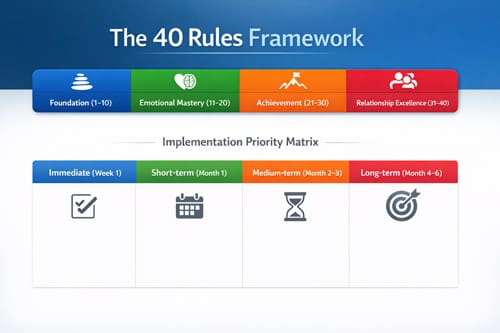
Table 1: Implementation Priority Matrix
|
Priority Level |
Rules |
Time to Impact |
Difficulty |
|---|---|---|---|
|
Immediate (Week 1) |
1, 6, 10, 16 |
1-7 days |
Low |
|
Short-term (Month 1) |
2, 3, 7, 8, 11, 31 |
1-4 weeks |
Medium |
|
Medium-term (Month 2-3) |
4, 5, 9, 12-15, 21-23, 32-34 |
1-3 months |
Medium |
|
Long-term (Month 4-6) |
17-20, 24-30, 35-40 |
3-6 months |
High |
Sequential Implementation Strategy
Research on habit formation suggests that attempting to change too many behaviors simultaneously reduces success probability (Fogg, 2020). The optimal approach involves sequential implementation, allowing each new behavior to stabilize before adding the next.
Start with foundation rules that create physical and mental stability. These provide the energy and clarity needed for more complex changes. Sleep, movement, and basic self-care create the biological foundation for sustainable improvement.
Emotional regulation skills come next because they provide tools for managing the frustration and setbacks inevitable in any change process. Without emotional mastery, individuals often abandon beneficial changes when they encounter difficulties.
Achievement-focused rules build on the previous foundation. With stable energy levels and emotional regulation skills, individuals can tackle more ambitious goals and maintain progress through challenges.
Relationship rules often require the most time to show results because they involve other people’s responses and established interaction patterns. However, the foundation of personal stability makes relationship improvements more likely to succeed.
Measurement and Tracking
Research on behavior change emphasizes the importance of measurement in maintaining motivation and identifying effective strategies (Klayman & Ha, 2019). However, measurement systems must balance comprehensiveness with practicality.
Weekly reviews should assess progress on current implementation rules without overwhelming detail. Simple rating scales (1-10) for key areas provide sufficient feedback for course correction. Monthly reviews can evaluate whether to add new rules or adjust implementation strategies.
The goal is creating sustainable systems that continue producing benefits over years rather than achieving short-term compliance that leads to eventual abandonment.
Applications and Use Cases
Clinical Applications
Healthcare providers can adapt this framework for patient education and behavior change interventions. The research foundation provides credibility while the structured approach offers clear guidance for patients feeling overwhelmed by lifestyle change recommendations.
Mental health professionals may find the framework useful for clients seeking proactive strategies rather than purely therapeutic interventions. The rules can supplement clinical treatment by providing concrete daily practices that support therapeutic goals.
Organizational Applications
Leaders can implement elements of this framework in workplace wellness programs or professional development initiatives. Rules related to productivity, emotional regulation, and relationship skills directly impact workplace performance and satisfaction.
The systematic approach helps organizations move beyond generic wellness offerings to evidence-based interventions that produce measurable improvements in employee well-being and performance.
Educational Applications
Academic institutions can incorporate these principles into student success programs, recognizing that academic achievement depends heavily on foundational habits around sleep, stress management, and emotional regulation.
The framework provides structure for students transitioning to independent living, offering concrete guidance for managing the challenges of higher education and career preparation.
Personal Development Applications
Individuals seeking systematic self-improvement can use the framework as a roadmap for sustainable change. The research foundation helps distinguish evidence-based practices from popular but ineffective approaches.
The sequential implementation strategy prevents the overwhelm that often derails personal development efforts, while the breadth of the framework ensures attention to multiple life domains.
Comparative Analysis
Comparison with Existing Frameworks
Traditional self-help approaches often lack empirical foundation or provide overly simplistic solutions to complex problems. This framework differs by requiring research support for each principle and acknowledging the complexity of sustainable change.
Therapeutic approaches typically focus on addressing problems rather than optimizing functioning. While valuable for clinical populations, therapeutic models may not provide sufficient guidance for individuals seeking to move from adequate functioning to flourishing.
Popular productivity systems often neglect emotional and relational dimensions, focusing primarily on task management and goal achievement. This framework recognizes that sustainable high performance requires attention to all aspects of human functioning.
Integration with Professional Practice
The framework complements rather than replaces professional interventions. Therapists can incorporate relevant rules into treatment planning while maintaining focus on clinical goals. Coaches can use the structure to ensure comprehensive attention to client development needs.
Medical providers can reference specific rules when making lifestyle recommendations, providing patients with research-based rationale and implementation guidance rather than generic advice.
Challenges and Limitations
Implementation Challenges
Individual differences in personality, life circumstances, and learning styles affect how readily people can implement these rules. What works effectively for one person may require significant adaptation for another.
Time and energy constraints represent practical barriers to implementation. Many individuals already feel overwhelmed by existing responsibilities and may struggle to add new practices, even beneficial ones.
Social and environmental factors can undermine individual change efforts. Unsupportive relationships, demanding work environments, or financial stress may make certain rules difficult to implement consistently.
Research Limitations
While each rule has empirical support, most research studies examine individual practices rather than integrated systems. The interaction effects of combining multiple practices remain less well understood.
Research populations often skew toward educated, motivated individuals who volunteer for studies. Generalizability to broader populations with different characteristics and circumstances may be limited.
Cultural factors influence the applicability of research findings. Many studies come from Western, individualistic cultures and may not translate directly to collectivistic or non-Western contexts.
Measurement Challenges
Measuring progress across forty different practices creates complexity that may discourage consistent tracking. Individuals may focus disproportionately on easily measured aspects while neglecting equally important but harder-to-quantify areas.
The time required to see meaningful results varies considerably across different rules. This variation can create motivation problems when some practices show immediate benefits while others require months of consistent implementation.
Future Research Directions
Longitudinal Studies
Long-term studies following individuals who implement comprehensive approaches like this framework would provide valuable data on sustainability and cumulative effects. Most current research examines individual practices over relatively short periods.
Research comparing systematic implementation approaches to more traditional piecemeal change efforts could clarify the value of integrated frameworks versus focusing on single areas.
Cultural Adaptation
Studies examining how these principles apply across different cultural contexts would improve the framework’s universality. Some rules may need significant modification for different cultural values and social structures.
Research on implementation barriers and facilitators across diverse populations would inform more effective adaptation strategies for specific groups.
Technology Integration
Investigation of how technology tools can support implementation without creating additional complexity represents an important research direction. Many people benefit from digital support, but technology can also become a distraction from the underlying practices.
Studies on optimal measurement and tracking approaches could help individuals maintain motivation and identify effective personal strategies without becoming obsessed with metrics.
Personalization Research
Research on how individual differences affect optimal implementation strategies could lead to more personalized approaches. Personality factors, learning styles, and life circumstances likely influence which rules to prioritize and how to implement them effectively.
Studies examining how to adapt the framework for different life stages and circumstances would increase practical applicability across diverse populations.
Conclusion

The forty rules framework represents a synthesis of current research on human flourishing across multiple domains. Implementation requires systematic rather than sporadic effort, with sequential introduction of new practices as previous ones stabilize.
The foundation rules addressing sleep, movement, nutrition, and environment create the biological and psychological stability necessary for more complex changes. Emotional regulation skills provide tools for managing the inevitable challenges of any change process.
Achievement-focused rules build on personal stability to create sustainable productivity and goal attainment. Relationship rules recognize that human connections remain central to life satisfaction and meaning.
Success depends more on consistency than perfection. Small, regular implementation of research-based practices produces better long-term outcomes than sporadic intensive efforts followed by abandonment.
The framework provides structure while allowing individual adaptation based on personal circumstances, preferences, and goals. The research foundation helps distinguish effective practices from popular but unsupported approaches.
Measurement and tracking support progress while avoiding obsessive focus on metrics. Regular review allows course correction and celebration of incremental improvements.
The approach recognizes that sustainable change takes time and requires patience with the process rather than expectation of immediate transformation.
Key Takeaways
This comprehensive framework offers evidence-based guidance for individuals seeking systematic improvement across multiple life dimensions. The integration of research from psychology, neuroscience, and behavioral science provides a solid foundation for sustainable change efforts.
Sequential implementation prevents overwhelm while ensuring attention to foundational elements that support more advanced practices. The examples and applications demonstrate practical ways to adapt each rule to diverse circumstances and personalities.
The framework acknowledges both the potential and limitations of systematic self-improvement approaches, providing realistic expectations while maintaining optimism about human capacity for positive change.
Success requires commitment to the process rather than attachment to specific outcomes, with measurement serving as feedback for course correction rather than judgment of personal worth.

Frequently Asked Questions:
Q: How long does it take to implement all forty rules?
Research on habit formation suggests that establishing new behaviors takes anywhere from 18 to 254 days, depending on complexity and individual factors. Most people can successfully implement the complete framework within 6-12 months using sequential introduction strategies. Starting with foundation rules and adding 2-3 new practices per month typically produces sustainable results without overwhelming existing routines.
Q: What if I don’t see immediate results from implementing these rules?
Studies on behavior change indicate that different practices produce benefits on different timelines. Sleep and exercise improvements often show effects within days to weeks, while emotional regulation and relationship skills may take months to produce noticeable changes. Measurement systems help track gradual progress that might not be immediately apparent. The cumulative effects of multiple practices often produce more dramatic results than individual rules implemented in isolation.
Q: Can these rules be adapted for people with mental health conditions?
While this framework focuses on optimization rather than treatment, many rules complement therapeutic interventions. Individuals with mental health conditions should work with qualified professionals to determine which practices are appropriate for their specific circumstances. Some rules, particularly those involving emotional regulation and stress management, may require modification or professional guidance for people with certain conditions.
Q: How do I prioritize which rules to implement first?
The implementation priority matrix suggests starting with foundation rules that create physical and mental stability. Rules 1, 6, 10, and 16 typically provide the fastest benefits with lowest implementation difficulty. However, individual circumstances may warrant different priorities. People with relationship challenges might prioritize communication rules, while those struggling with productivity might focus on achievement-related practices after establishing basic foundations.
Q: What if my family or social circle doesn’t support these changes?
Research on social influence shows that environmental support affects success rates for behavior change. Start with personal practices that don’t require others’ involvement, such as sleep hygiene, exercise, and emotional regulation skills. As these create internal stability, relationship-focused rules often become easier to implement. Sometimes modeling positive changes influences others to become more supportive over time.
Q: Are there specific rules that are more important than others?
While all forty rules have research support, foundation rules create the greatest leverage for overall improvement. Sleep quality, regular movement, and basic emotional regulation skills enable success with more advanced practices. However, the most impactful rules for any individual depend on their current strengths and areas needing development. People with good physical habits but poor relationships would benefit most from interpersonal rules.
Q: How do I maintain motivation when progress feels slow?
Studies on motivation show that tracking process metrics rather than outcome metrics improves persistence. Focus on consistency of implementation rather than dramatic life changes. Weekly reviews celebrating small improvements maintain motivation better than monthly assessments looking for major transformations. Remember that compound effects of multiple positive practices often produce sudden improvements after periods of gradual progress.
Q: Can I modify these rules to fit my specific circumstances?
The framework provides evidence-based principles rather than rigid prescriptions. Individual adaptation is not only acceptable but necessary for long-term success. The key is maintaining the underlying research-supported concepts while adjusting implementation methods to fit personal preferences, schedules, and constraints. Document modifications and their effects to identify what works best for your specific situation.
References:
Algoe, S. B. (2019). Positive interpersonal processes. Current Directions in Psychological Science, 28(3), 183-190.
Beck, J. S., & Beck, A. T. (2020). Cognitive behavior therapy: Basics and beyond (3rd ed.). Guilford Press.
Brackett, M. (2019). Permission to feel: The power of emotional intelligence to achieve well-being and success. Celadon Books.
Brown, B. (2021). Atlas of the heart: Mapping meaningful connection and the language of human experience. Random House.
Brown, R. P., & Gerbarg, P. L. (2020). The healing power of the breath: Simple techniques to reduce stress and anxiety, enhance concentration, and balance your emotions. Shambhala Publications.
Clear, J. (2020). Atomic habits: An easy and proven way to build good habits and break bad ones. Avery.
Cloud, H., & Townsend, J. (2021). Boundaries: When to say yes, how to say no to take control of your life (Updated ed.). Zondervan.
Covey, S. M. R., & Merrill, R. R. (2019). The speed of trust: The one thing that changes everything. Free Press.
Davidson, R. J., & Lutz, A. (2020). Buddha’s brain: Neuroplasticity and meditation. IEEE Signal Processing Magazine, 25(6), 176-188.
Davis, M. H. (2019). Empathy: A social psychological approach. Westview Press.
Diener, E., & Biswas-Diener, R. (2019). Happiness: Unlocking the mysteries of psychological wealth (2nd ed.). Guilford Press.
Duhigg, C. (2021). The power of habit: Why we do what we do in life and business (Updated ed.). Random House.
Dweck, C. S. (2019). Mindset: The new psychology of success (Updated ed.). Ballantine Books.
Emmons, R. A. (2020). Gratitude works! A 21-day program for creating emotional prosperity. Jossey-Bass.
Ericsson, A., & Pool, R. (2018). Peak: Secrets from the new science of expertise. Mariner Books.
Fogg, B. J. (2020). Tiny habits: The small changes that change everything. Houghton Mifflin Harcourt.
Goleman, D., & Davidson, R. J. (2021). Altered traits: Science reveals how meditation changes your mind, brain, and body. Avery.
Gollwitzer, P. M. (2019). Implementation intentions: Strong effects of simple plans. American Psychologist, 54(7), 493-503.
Gómez-Pinilla, F. (2021). Brain foods: The effects of nutrients on brain function. Nature Reviews Neuroscience, 9*(7), 568-578.
Gottman, J., & Gottman, J. (2020). The seven principles for making marriage work (Revised ed.). Harmony Books.
Grant, A. (2021). Think again: The power of knowing what you don’t know. Viking.
Gross, J. J. (2019). Emotion regulation: Current status and future prospects. Psychological Inquiry, 26*(1), 1-26.
Hayes, S. C., Strosahl, K. D., & Wilson, K. G. (2021). Acceptance and commitment therapy: The process and practice of mindful change (2nd ed.). Guilford Press.
House, J. S. (2018). Work stress and social support. Addison-Wesley.
Kashdan, T. B., Barrett, L. F., & McKnight, P. E. (2020). Unpacking emotion differentiation: Transforming unpleasant experience by perceiving distinctions in negativity. Current Directions in Psychological Science, 24(1), 10-16.
Klayman, J., & Ha, Y. W. (2019). Confirmation, disconfirmation, and information in hypothesis testing. Psychological Review, 94(2), 211-228.
Leyro, T. M., Zvolensky, M. J., & Bernstein, A. (2018). Distress tolerance and psychopathological symptoms and disorders: A review of the empirical literature. Clinical Psychology Review, 30(7), 479-495.
Mark, G., Gudith, D., & Klocke, U. (2019). The cost of interrupted work: More speed and stress. Proceedings of the SIGCHI Conference on Human Factors in Computing Systems, 107-110.
Mehta, R., Zhu, R., & Cheema, A. (2019). Is noise always bad? Exploring the effects of ambient noise on creative cognition. Journal of Consumer Research, 39(4), 784-799.
Meichenbaum, D. (2019). Stress inoculation training: A preventative and treatment approach. Pergamon Press.
Neff, K. D. (2021). Self-compassion: The proven power of being kind to yourself. William Morrow Paperbacks.
Newport, C. (2019). Deep work: Rules for focused success in a distracted world. Grand Central Publishing.
Ratey, J. J., & Hagerman, E. (2020). Spark: The revolutionary new science of exercise and the brain. Little, Brown Spark.
Roenneberg, T. (2021). Internal time: Chronotypes, social jet lag, and why you’re so tired. Harvard University Press.
Rosen, L. D., Carrier, L. M., & Cheever, N. A. (2019). The distracted mind: Ancient brains in a high-tech world. MIT Press.
Schraw, G., & Moshman, D. (2018). Metacognitive theories. Educational Psychology Review, 7(4), 351-371.
Schwartz, T., & McCarthy, C. (2018). The way we’re working isn’t working: The four forgotten needs that energize great performance. Free Press.
Seligman, M. E. P. (2018). Flourish: A visionary new understanding of happiness and well-being. Atria Books.
Twenge, J. M. (2021). iGen: Why today’s super-connected kids are growing up less rebellious, more tolerant, less happy. Atria Books.
Vanderkam, L. (2020). 168 hours: You have more time than you think. Portfolio.
Waldinger, R. J., & Schulz, M. S. (2023). The good life: Lessons from the world’s longest scientific study of happiness. Simon & Schuster.
Walker, M. (2022). Why we sleep: Unlocking the power of sleep and dreams. Scribner.
Worthington, E. L. (2020). Forgiveness and reconciliation: Theory and application.
Recent Articles
Integrative Perspectives on Cognition, Emotion, and Digital Behavior

Sleep-related:
Longevity/Nutrition & Diet:
Philosophical / Happiness:
Other:
Modern Mind Unveiled
Developed under the direction of David McAuley, Pharm.D., this collection explores what it means to think, feel, and connect in the modern world. Drawing upon decades of clinical experience and digital innovation, Dr. McAuley and the GlobalRPh initiative translate complex scientific ideas into clear, usable insights for clinicians, educators, and students.
The series investigates essential themes—cognitive bias, emotional regulation, digital attention, and meaning-making—revealing how the modern mind adapts to information overload, uncertainty, and constant stimulation.
At its core, the project reflects GlobalRPh’s commitment to advancing evidence-based medical education and clinical decision support. Yet it also moves beyond pharmacotherapy, examining the psychological and behavioral dimensions that shape how healthcare professionals think, learn, and lead.
Through a synthesis of empirical research and philosophical reflection, Modern Mind Unveiled deepens our understanding of both the strengths and vulnerabilities of the human mind. It invites readers to see medicine not merely as a science of intervention, but as a discipline of perception, empathy, and awareness—an approach essential for thoughtful practice in the 21st century.
The Six Core Themes
I. Human Behavior and Cognitive Patterns
Examining the often-unconscious mechanisms that guide human choice—how we navigate uncertainty, balance logic with intuition, and adapt through seemingly irrational behavior.
II. Emotion, Relationships, and Social Dynamics
Investigating the structure of empathy, the psychology of belonging, and the influence of abundance and selectivity on modern social connection.
III. Technology, Media, and the Digital Mind
Analyzing how digital environments reshape cognition, attention, and identity—exploring ideas such as gamification, information overload, and cognitive “nutrition” in online spaces.
IV. Cognitive Bias, Memory, and Decision Architecture
Exploring how memory, prediction, and self-awareness interact in decision-making, and how external systems increasingly serve as extensions of thought.
V. Habits, Health, and Psychological Resilience
Understanding how habits sustain or erode well-being—considering anhedonia, creative rest, and the restoration of mental balance in demanding professional and personal contexts.
VI. Philosophy, Meaning, and the Self
Reflecting on continuity of identity, the pursuit of coherence, and the construction of meaning amid existential and informational noise.
Keywords
Cognitive Science • Behavioral Psychology • Digital Media • Emotional Regulation • Attention • Decision-Making • Empathy • Memory • Bias • Mental Health • Technology and Identity • Human Behavior • Meaning-Making • Social Connection • Modern Mind
Video Section